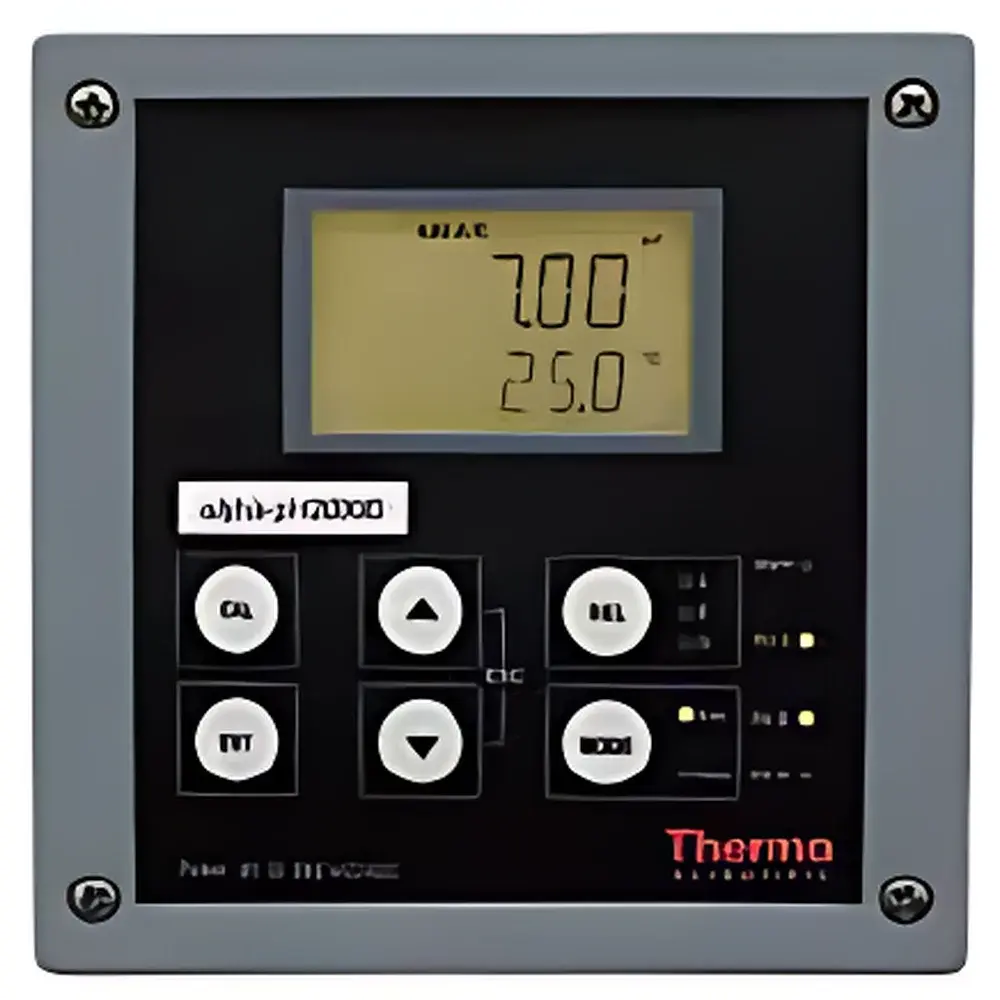
Thermo Fisher Scientific alpha-pH2000D Differential pH/ORP Controller (Wall-Mountable)
| Brand | Thermo Fisher Scientific |
|---|---|
| Origin | Singapore |
| Manufacturer Type | Original Equipment Manufacturer (OEM) |
| Origin Category | Imported |
| Model | alpha-pH2000D |
| Pricing | Upon Request |
| pH Range | −2.00 to 16.00 pH |
| pH Resolution/Accuracy | 0.01 pH / ±0.01 pH |
| Supported Buffer Standards | pH 1.01, 4.01, 6.86, 7.00, 9.00, 9.18, 10.01 |
| ORP Range | 0–100% or −2000 to +2000 mV |
| ORP Resolution/Accuracy | 0.1% of full scale or 1 mV / ±2 mV |
| Temperature Range | 0–100 °C |
| Temperature Resolution/Accuracy | 0.1 °C / ±0.5 °C |
| ATC Sensor | 300 Ω NTC thermistor |
| Control Modes | On/Off, Proportional (P), Proportional-Integral-Derivative (PID) |
| Power Supply | 80–250 VAC, 48–62 Hz or DC |
| Enclosure Size | 1/2 DIN (144 mm × 144 mm) |
| Ingress Protection | NEMA 4X |
| Mounting | Panel-mount (with optional wall-mount bracket kit) |
| Analog Outputs | Two isolated 0/4–20 mA outputs (configurable for pH/ORP and temperature) |
| Relay Functions | Dual control relays with adjustable hysteresis (0–2000 s delay), HOLD mode, cleaning cycle relay, password-protected configuration |
Overview
The Thermo Fisher Scientific alpha-pH2000D is a high-integrity differential pH/ORP controller engineered for continuous, real-time monitoring and closed-loop process control in demanding industrial environments. Designed around a dual-sensor differential measurement architecture, it compensates for common-mode interference—such as ground loops, stray potentials, and electrode drift—by comparing the voltage potential between two independently referenced electrodes. This architecture delivers superior stability in electrochemically noisy applications, including wastewater treatment, chemical dosing systems, electroplating baths, and pharmaceutical water purification loops. The controller complies with IEC 61000-6-2 (immunity) and IEC 61000-6-4 (emissions) standards, ensuring robust operation in electrically congested plant settings. Its microprocessor-based architecture supports stable analog signal conditioning, digital filtering, and temperature-compensated calculations per NIST-traceable pH conventions.
Key Features
- Dual-mode differential sensing architecture minimizes offset errors caused by solution grounding, cable capacitance, or reference junction instability.
- Auto-buffer recognition during calibration reduces operator error and ensures traceable, repeatable calibration across seven NIST-certified buffer points (pH 1.01, 4.01, 6.86, 7.00, 9.00, 9.18, 10.01).
- Configurable control strategies: discrete on/off switching, linear proportional (P) output, and full PID with tunable integral time and derivative action—each assignable to pH, ORP, or temperature inputs.
- NEMA 4X-rated polycarbonate enclosure provides protection against dust, water ingress (IP66 equivalent), and corrosive splashes—validated per UL 50E and CSA C22.2 No. 94.1.
- Two galvanically isolated 4–20 mA outputs support independent scaling for primary measurement (e.g., pH) and secondary parameter (e.g., temperature), enabling integration into DCS/SCADA systems without external signal splitters.
- Relay logic includes programmable hysteresis (0–2000 s), HOLD function for interlocked safety shutdowns, and dedicated cleaning-cycle relay with user-defined interval and duration.
- Non-volatile EEPROM retains all calibration coefficients, setpoints, PID parameters, and alarm thresholds through power loss or unexpected reset—supporting GLP-compliant audit trails.
Sample Compatibility & Compliance
The alpha-pH2000D interfaces with standard glass-body pH electrodes (BNC or DIN connectors), redox (ORP) sensors with platinum or gold elements, and 300 Ω NTC temperature probes compliant with DIN 43760. It supports both aqueous and low-conductivity media (≥50 µS/cm), with automatic temperature compensation applied per the Nernst equation. The device meets requirements for use in GMP-regulated environments: its configuration lockout (dual-level password), timestamped calibration logs, and immutable parameter storage align with FDA 21 CFR Part 11 data integrity expectations when paired with validated software workflows. It is certified for CE marking under the EMC Directive 2014/30/EU and Low Voltage Directive 2014/35/EU.
Software & Data Management
Local configuration is performed via intuitive front-panel navigation with backlit dual-line LCD (128 × 64 pixels), displaying real-time pH/ORP value, temperature, status icons (e.g., CAL, ALARM, HOLD), and active setpoint. All parameters—including sensor slope/mV offset, alarm thresholds, relay deadband, and PID tuning constants—are stored in protected memory. While the alpha-pH2000D operates autonomously without PC connectivity, optional RS-485 Modbus RTU interface (add-on module) enables remote readout, firmware updates, and centralized logging via industry-standard SCADA platforms. Audit-ready event logs record calibration dates, relay activations, and configuration changes—exportable via serial protocol for QA documentation.
Applications
- Neutralization control in chemical effluent treatment plants, where differential pH measurement prevents false triggers from variable ground potentials.
- Chlorine residual monitoring in potable water distribution networks using ORP feedback to modulate sodium hypochlorite dosing.
- pH stabilization in bioreactors and clean-in-place (CIP) systems, where rapid thermal transients require fast-response ATC compensation.
- Electrochemical plating bath management, leveraging mV-range ORP control to maintain optimal oxidation state of metal ions.
- Pharmaceutical purified water (PW) and water-for-injection (WFI) loops, meeting USP conductivity and pH monitoring guidance under Annex 1 environmental controls.
FAQ
Does the alpha-pH2000D support automatic temperature compensation (ATC)?
Yes—it accepts input from a 300 Ω NTC thermistor and applies Nernst-based temperature correction in real time, configurable per ASTM D1293 or ISO 10523 conventions.
Can the two 4–20 mA outputs be assigned independently?
Yes—Output 1 may be scaled to pH (−2.00 to 16.00) while Output 2 is scaled to temperature (0–100 °C), or both may transmit ORP values with different ranges.
Is the device suitable for hazardous area installations?
No—the alpha-pH2000D is rated for general-purpose industrial use (NEMA 4X) but lacks intrinsic safety certification (e.g., ATEX, IECEx); explosion-proof enclosures must be used externally if deployed near classified zones.
How is calibration data secured against unauthorized modification?
Configuration access requires two-tier password authentication: Level 1 permits basic operation; Level 2 (admin) is required for calibration, PID tuning, or relay logic changes—both passwords are stored in encrypted EEPROM.
What is the maximum allowable cable length between the controller and pH electrode?
For optimal noise immunity, shielded twisted-pair cable is recommended; maximum run length is 30 meters with standard BNC termination, or up to 60 meters when using low-capacitance coaxial cable and proper grounding practices.
Related Products