
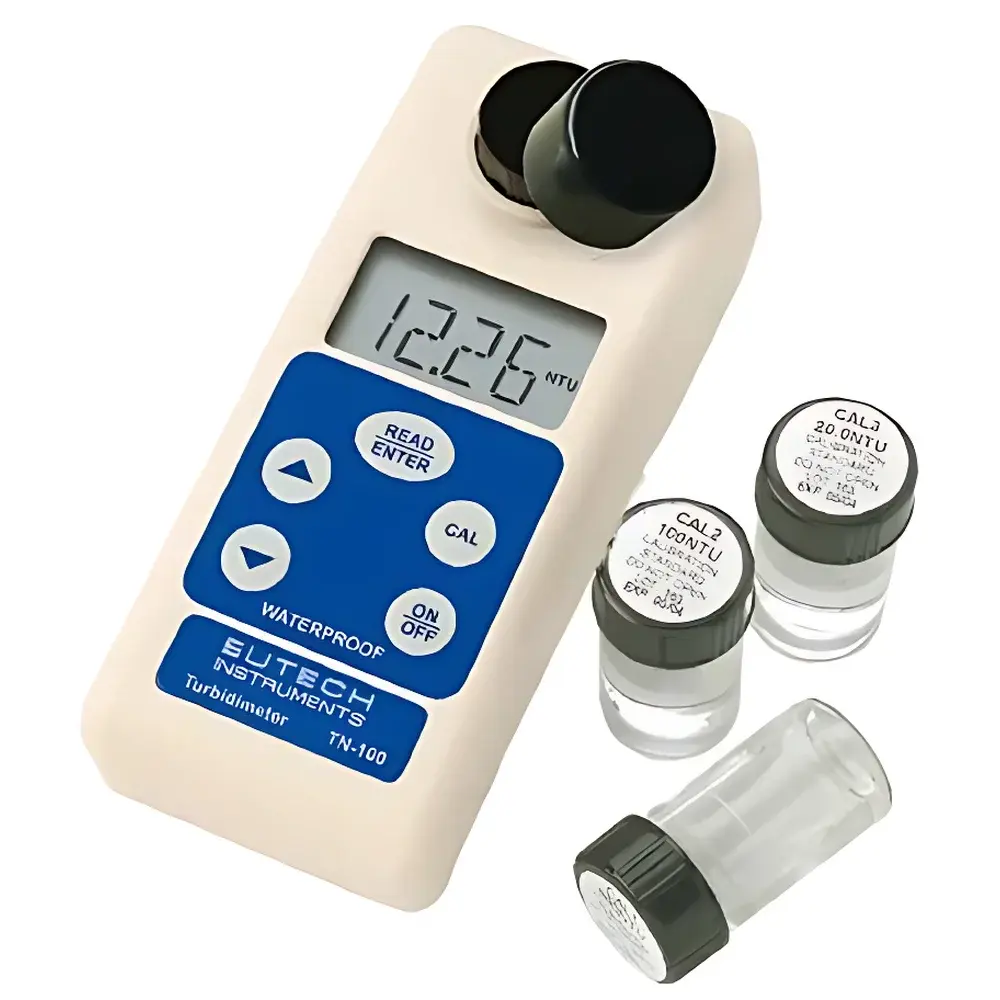
Thermo Fisher Scientific Eutech CyberScan TN 100 Turbidimeter
| Brand | Thermo Fisher Scientific |
|---|---|
| Origin | Singapore |
| Manufacturer | Thermo Fisher Scientific |
| Product Type | Imported Instrument |
| Model | TN 100 |
| Pricing | Upon Request |
| Principle | ISO 7027-compliant Nephelometric Measurement (850 nm Infrared LED) |
| Range | 0–1000 NTU with Auto-ranging (0.01–19.99 NTU, 20.0–99.9 NTU, 100–1000 NTU) |
| Resolution | 0.01 NTU (0–19.99), 0.1 NTU (20–99.9), 1 NTU (100–1000) |
| Accuracy | ±2% ±1 digit (0–500 NTU) |
| Repeatability | ≤±1% of reading |
| Calibration Points | 4-point (0.02, 20.0, 100, 800 NTU) |
| Calibration Accuracy | ±0.02 NTU at low point |
| Response Time | <6 seconds |
| Sample Volume | 10 mL |
| Light Source | 850 nm infrared LED |
| Operating & Sample Temperature | 0–50 °C |
| Enclosure Material | ABS plastic |
| Ingress Protection | IP67 |
| Power Supply | 4 × 1.5 V AAA alkaline batteries (>1200 measurements per set) |
| Dimensions (Instrument) | 15.5 × 6.8 × 4.6 cm |
| Weight (Instrument) | 200 g |
| Packaging Dimensions | 35.5 × 16.5 × 10.5 cm |
| Weight (Packaged) | 1160 g |
Overview
The Thermo Fisher Scientific Eutech CyberScan TN 100 Turbidimeter is a portable, ISO 7027-compliant nephelometric instrument engineered for high-precision turbidity measurement in field, laboratory, and quality control environments. It operates on the principle of 90° light scattering detection using a stable 850 nm infrared LED source—eliminating color interference and ensuring compliance with international regulatory requirements for non-formazin-based calibration. Unlike traditional white-light turbidimeters, the TN 100’s infrared optics deliver enhanced stability across colored or UV-absorbing samples, making it suitable for wastewater effluent, drinking water distribution systems, pharmaceutical process water, and environmental monitoring applications where spectral independence is critical. Its compact form factor, IP67-rated enclosure, and battery-powered operation enable reliable deployment in humid, dusty, or intermittently submerged conditions without compromising metrological integrity.
Key Features
- ISO 7027 and DIN 27027 certified optical design with 850 nm infrared LED illumination for spectrally robust, formazin-free turbidity quantification
- Four-point calibration protocol with traceable standards (0.02, 20.0, 100, and 800 NTU), supporting rigorous QA/QC documentation and audit readiness
- Auto-ranging measurement engine covering 0–1000 NTU in three dynamic ranges, optimized for resolution fidelity across low-, mid-, and high-turbidity regimes
- Sub-6-second response time per reading, enabling rapid sequential analysis of multiple samples during routine monitoring or emergency response protocols
- IP67-rated ABS housing ensures dust-tightness and temporary submersion resistance (up to 1 m for 30 min), validated per IEC 60529
- Large backlit LCD display with intuitive icon-driven interface, supporting real-time unit switching (NTU, FNU, FAU) and status indicators for battery level, calibration validity, and error codes
- Integrated sample chamber accommodates standard 10 mL round vials; included high-optical-grade glass cuvettes minimize stray light and surface scatter artifacts
Sample Compatibility & Compliance
The TN 100 is validated for use with aqueous matrices including potable water, surface water, treated wastewater, and purified water (PW) per USP and EP 2.2.2. Its infrared detection system inherently rejects absorbance contributions from dissolved organics, iron, or manganese—common interferents in conventional visible-light turbidimetry. The instrument meets U.S. EPA Method 180.1 requirements for non-formazin calibration traceability and supports GLP-compliant data generation when paired with documented calibration logs and instrument usage records. While not intrinsically compliant with FDA 21 CFR Part 11 due to lack of electronic signature capability, its measurement output and calibration history are fully exportable for integration into validated LIMS or ELN platforms under site-specific procedural controls.
Software & Data Management
The TN 100 operates as a standalone, firmware-controlled device with no embedded Bluetooth or USB connectivity. All measurement data—including date/time stamp, NTU value, range used, and calibration status—are retained in non-volatile memory for up to 500 readings. Data export requires manual transcription or optional PC-based logging via third-party serial-to-USB adapters (RS-232 TTL interface, not included). Firmware supports user-configurable auto-power-off (1–60 min), backlight timeout (5–30 sec), and unit preference persistence. For regulated environments, laboratories must implement procedural controls to ensure calibration frequency, standard traceability, and raw data archiving in accordance with ISO/IEC 17025 Clause 7.7 and ASTM D6508-22 Annex A1.
Applications
- Drinking water treatment: Verification of filtration efficiency and disinfection barrier integrity at intake, intermediate, and finished water points
- Wastewater discharge monitoring: Compliance verification against NPDES permit limits for effluent turbidity
- Pharmaceutical water systems: Routine surveillance of Purified Water (PW) and Water for Injection (WFI) loops per USP
- Environmental field surveys: Rapid assessment of sediment plumes, stormwater runoff, and lake stratification dynamics
- Educational laboratories: Teaching core principles of light scattering theory, calibration hierarchy, and uncertainty propagation in optical metrology
FAQ
Does the TN 100 require formazin standards for calibration?
No. It is designed for non-formazin calibration using stable, traceable primary standards at 0.02, 20.0, 100, and 800 NTU—fully aligned with U.S. EPA Method 180.1 and eliminating associated health and stability concerns.
Can the TN 100 measure samples above 1000 NTU?
Not directly. Samples exceeding 1000 NTU must be diluted with turbidity-free water (e.g., filtered 0.2 µm DI water) and measured within the instrument’s valid range; dilution factors must be applied post-acquisition.
Is the TN 100 suitable for GMP-regulated environments?
Yes—as a Class II measuring instrument—provided calibration is performed per documented SOPs, standards are certified to ISO/IEC 17025, and usage records are maintained for audit trail completeness.
What is the expected battery life under typical usage?
Approximately 1200 measurements on a single set of four AAA alkaline cells, assuming ambient temperature operation and default 5-minute auto-shutdown.
How is optical path length controlled given the fixed 10 mL vial volume?
The instrument uses a precision-machined cuvette holder that positions the vial’s optical axis concentrically within the detector’s acceptance angle, ensuring consistent 10 mm effective path length regardless of minor meniscus variation.




