
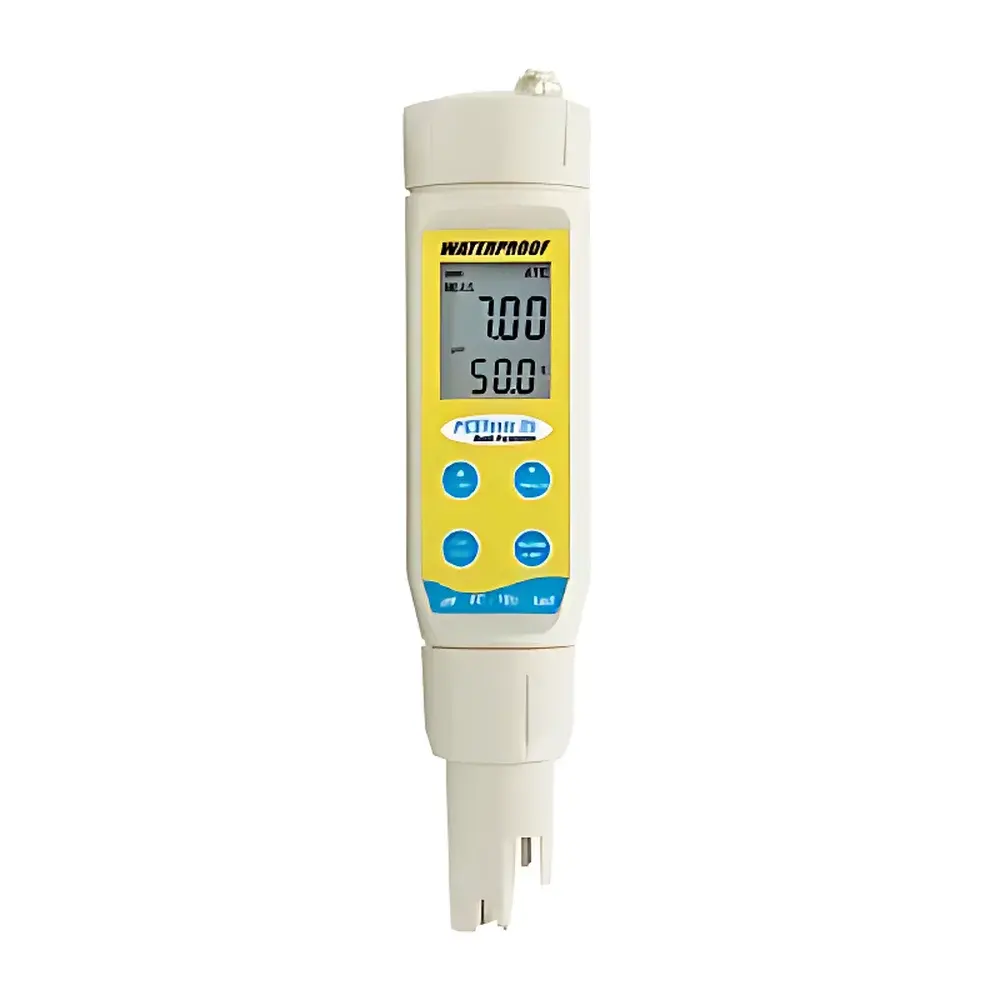
Thermo Fisher Scientific Eutech PCSTestr 35 Portable Multiparameter Water Quality Analyzer
| Brand | Thermo Fisher Scientific |
|---|---|
| Origin | USA |
| Manufacturer | Thermo Fisher Scientific |
| Product Type | Imported |
| Model | PCSTestr 35 |
| Instrument Category | Portable / Handheld Water Quality Analyzer |
| Key | pH Range 0.00–14.00, Resolution 0.01 pH, Accuracy ±0.01 pH |
| Calibration | Up to 5-point auto pH, 3-point auto/manual conductivity, 3-point manual TDS, 1-point auto salinity >1.00 ppt |
| Auto-Range Selection | Yes |
| Electrode Module | Integrated replaceable 5-in-1 sensor |
| Power | 4 × 1.5 V button cells (>150 h life) |
| Dimensions | 16.5 × 3.8 cm (unit), Weight: 90 g |
| Display | Dual-line LCD (2.1 × 2.7 cm) |
| Auto-Off | 8.5 min (configurable) |
Overview
The Thermo Fisher Scientific Eutech PCSTestr 35 is a compact, field-deployable multiparameter water quality analyzer engineered for rapid, reliable in-situ assessment of critical physicochemical parameters in industrial process water, wastewater effluents, environmental surface waters, and potable water distribution systems. Unlike conventional benchtop analyzers requiring multiple probes or complex setup, the PCSTestr 35 employs a single integrated electrochemical sensor module that simultaneously measures pH, conductivity, total dissolved solids (TDS), salinity, and temperature—eliminating inter-probe calibration drift and measurement inconsistency. Its operating principle leverages potentiometric pH sensing with a gel-filled Ag/AgCl reference system, combined with four-electrode conductivity measurement using a graphite-based cell optimized for low- and high-conductivity regimes. The instrument implements automatic range switching across three distinct conductivity/TDS decades (μS/cm → mS/cm), enabling accurate quantification from ultrapure water (<1 μS/cm) to brackish samples (~20 mS/cm) without manual intervention. Designed to meet the operational demands of field technicians and plant operators, it conforms to IP67 ingress protection—ensuring full functionality after immersion in 1 m of water for up to 30 minutes—and features a ruggedized polycarbonate housing rated for continuous use in humid, dusty, or splash-prone environments.
Key Features
- Single integrated 5-in-1 sensor module eliminates cross-parameter calibration errors and reduces consumable costs
- True auto-ranging conductivity and TDS measurement across three calibrated spans: 0.0–199.9 μS/cm, 200–1999 μS/cm, and 2.00–20.00 mS/cm
- High-resolution pH measurement (0.01 pH) with up to five-point automatic calibration and built-in NIST-traceable buffer recognition (pH 4.01, 7.00, 10.01)
- Configurable TDS conversion factor (0.40–1.00) and linear temperature compensation coefficient (0.0–10.0 %/°C) for application-specific accuracy
- Dual-line LCD display with dedicated parameter icons and real-time unit indicators for unambiguous interpretation under variable lighting conditions
- Non-volatile memory retains calibration constants and measurement history during battery replacement or power loss
- Programmable auto-off (8.5 minutes default, disable option available) extends battery life beyond 150 hours on standard SR44 cells
- Modular electrode design supports field replacement without recalibration of the base unit—reducing downtime and service overhead
Sample Compatibility & Compliance
The PCSTestr 35 is validated for direct immersion in aqueous matrices ranging from deionized water (conductivity <1 μS/cm) to saline wastewater (up to 10.00 ppt or 1.00% w/w NaCl equivalent). It complies with ISO 7888 (electrical conductivity of water), ASTM D1125 (standard test methods for electrical conductivity and resistivity of water), and USP (water conductivity testing for pharmaceutical use). While not intended for regulatory submission-grade data per FDA 21 CFR Part 11, its calibration traceability, audit-ready calibration logs (accessible via manual entry), and stable sensor architecture support GLP-aligned field documentation protocols. The device meets IEC 60529 IP67 requirements for dust-tightness and temporary submersion, and its operating temperature range (0–50.0 °C) aligns with EPA Method 120.1 (pH) and Method 120.2 (conductivity) field sampling guidelines.
Software & Data Management
The PCSTestr 35 operates as a standalone field instrument with no proprietary software dependency or USB connectivity. All calibration, configuration, and measurement functions are executed via tactile membrane keys and interpreted through its dual-line LCD interface. Calibration data—including date/time stamps, buffer values used, slope/mV offset diagnostics, and conductivity cell constant—are stored in non-volatile memory and recalled automatically upon power-up. Users may manually log measurements using standardized field notebooks or integrate readings into LIMS via transcription; the device’s consistent output formatting (e.g., “pH 7.24”, “Cond 1,240 μS/cm”, “Sal 0.87%”) minimizes transcription error. For QA/QC workflows, the instrument supports periodic verification using certified reference standards traceable to NIST SRM 1699 (conductivity) and NIST SRM 186c (pH buffers).
Applications
- Routine monitoring of cooling tower and boiler feedwater chemistry to prevent scaling and corrosion
- Pre- and post-treatment validation in municipal and industrial wastewater treatment plants
- Field screening of stormwater runoff and receiving stream compliance with NPDES permit limits
- Verification of reverse osmosis and deionization system performance in semiconductor and pharmaceutical facilities
- Educational laboratory demonstrations of ionic strength, buffering capacity, and solution conductivity principles
- Emergency response assessments following chemical spills or infrastructure failures affecting drinking water integrity
FAQ
Does the PCSTestr 35 require separate electrodes for pH and conductivity measurements?
No—the instrument uses a single, replaceable 5-in-1 electrochemical module integrating a pH glass electrode, dual-graphite conductivity cell, and integrated thermistor. This design ensures spatially coincident sampling and eliminates inter-sensor alignment variability.
Can the device measure seawater salinity accurately?
It provides reliable salinity estimates up to 10.00 ppt (1.00%) using NaCl-equivalent algorithms. For marine applications exceeding this range (e.g., open-ocean seawater ~35 ppt), a dedicated marine salinometer with PSS-78 algorithm support is recommended.
Is calibration data exportable to a computer?
No—calibration records are retained internally and viewable only on-device. Manual transcription into electronic lab notebooks or LIMS is required for archival purposes.
What maintenance is required between calibrations?
Rinse the sensor module with deionized water after each use; store immersed in storage solution (pH 4 buffer or KCl) to maintain hydration. Inspect the graphite conductivity cell surface monthly for biofilm or mineral deposits; clean gently with dilute HCl (0.1 M) if necessary.
Does the instrument comply with FDA 21 CFR Part 11 for electronic records?
No—it lacks electronic signature capability, audit trail generation, and user access controls required under Part 11. It is suitable for field screening and non-GMP environments where handwritten or transcribed records are acceptable.







