
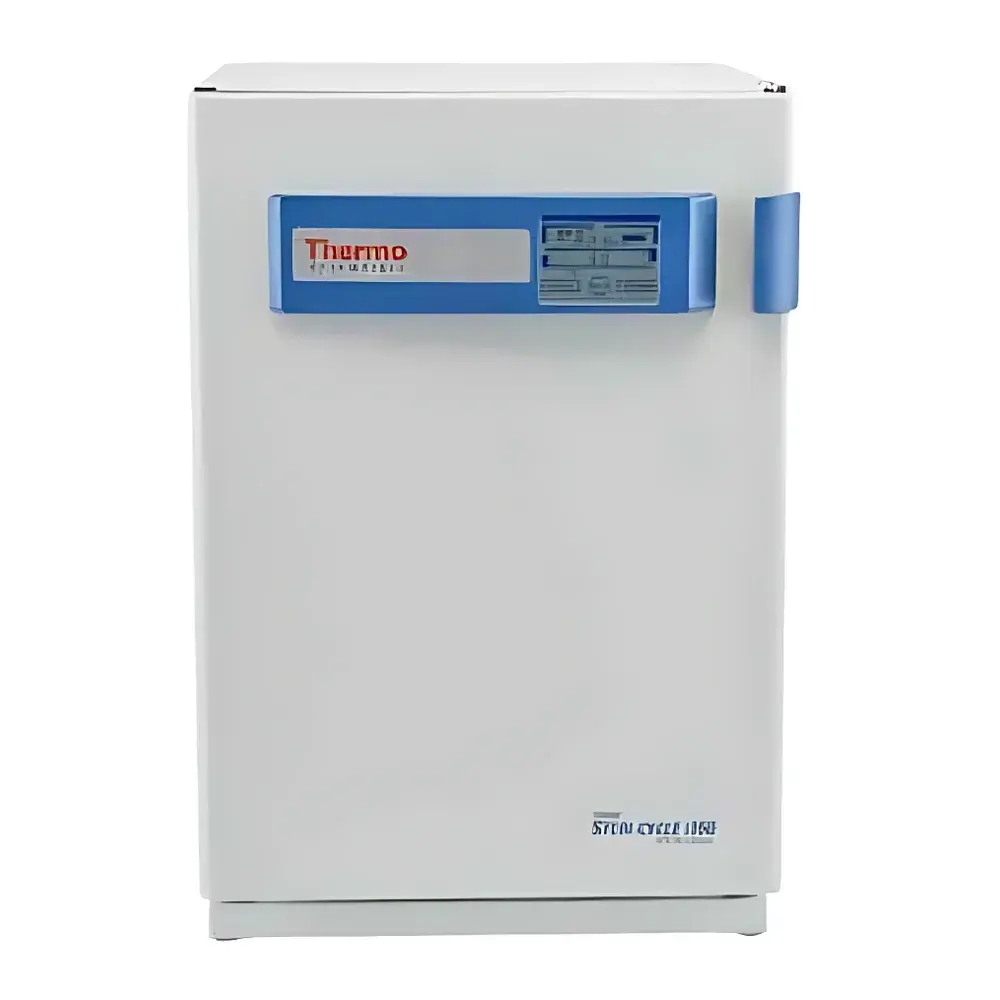
Thermo Fisher Scientific Forma Steri-Cycle i160 CO₂ Incubator
| Brand | Thermo Fisher Scientific |
|---|---|
| Origin | USA |
| Manufacturer | Yes |
| Import Status | Imported |
| Model | Forma Steri-Cycle i160 |
| Temperature Range & Accuracy | 3–55 °C |
| Temperature Uniformity | ±0.3 °C |
| Humidity Range & Accuracy | 20–95% RH |
| Chamber Capacity | 165 L |
| CO₂ Sensor | IR-based (Si-MEMS), 0–20% range |
| Optional O₂ Control | 1–21% |
| Sterilization | Dry-heat cycle at 180 °C, 12-log SAL |
| Air Filtration | ISO Class 5 HEPA |
| Humidification System | Integrated covered reservoir (condensate-free) |
| Airflow Technology | THRIVE™ laminar airflow |
| Interior Material Options | Electropolished stainless steel or 100% copper |
Overview
The Thermo Fisher Scientific Forma Steri-Cycle i160 CO₂ Incubator is an engineered platform for high-fidelity mammalian cell culture under tightly controlled physiological conditions. Designed around the fundamental requirements of stem cell expansion, primary cell maintenance, and sensitive co-culture systems, it integrates advanced environmental control with modular physical compartmentalization to minimize operational perturbation. Its core measurement and regulation architecture relies on dual feedback loops: a silicon-based MEMS infrared (IR180Si) CO₂ sensor delivering long-term drift stability and calibration resilience, coupled with a high-resolution platinum resistance thermometer (Pt100) array for spatial temperature mapping. The incubator maintains a physiologically relevant CO₂ concentration (typically 5%), balanced O₂ tension (optional), stable humidity (20–95% RH), and uniform thermal distribution (±0.3 °C) across its 165 L chamber—conditions validated per ISO 13485 and aligned with ASTM E178 guidelines for environmental chamber performance testing.
Key Features
- Cell Locker™ modular compartment system: Six independently sealed, removable chambers within the main incubator volume, each with individual door seals and dedicated airflow paths—designed to isolate cultures, reduce cross-contamination risk, and preserve microenvironmental integrity during frequent access.
- THRIVE™ laminar airflow technology: Optimized air distribution pattern that minimizes turbulence and thermal stratification, enabling rapid (<15 min) recovery of setpoint temperature and CO₂ after door opening (tested per ISO 15197 Annex B protocols).
- Condensate-free humidification: Integrated, covered water reservoir with evaporation surface area engineering ensures consistent RH delivery without internal condensation—a critical factor in preventing microbial proliferation and maintaining optical clarity for time-lapse microscopy.
- Dry-heat sterilization cycle (Steri-Run): Fully automated 180 °C cycle achieving ≥12-log reduction of Bacillus stearothermophilus spores (SAL ≤10⁻¹²), compliant with ISO 14644-1 Class 5 cleanroom air standards post-cycle.
- iCAN™ intelligent control interface: Touchscreen HMI with real-time graphical display of all critical parameters (CO₂, O₂, T, RH, door status, alarm history), audit-trail logging, and configurable user permissions—designed to support 21 CFR Part 11 compliance when paired with networked data archiving.
- Interior material options: Electropolished 316L stainless steel for corrosion resistance and ease of decontamination, or solid copper alloy (99.9% Cu) for intrinsic antimicrobial activity validated per EPA Test Method 9210B.
Sample Compatibility & Compliance
The i160 accommodates standard tissue culture formats—including T-flasks (up to T225), multi-well plates (6–384-well), Petri dishes, roller bottles, and bioreactor vessels—across all three adjustable stainless-steel shelves. Its Cell Locker™ compartments accept custom-fit inserts for specialized vessels (e.g., organ-on-chip platforms). Regulatory alignment includes design verification per IEC 61010-1 (safety), IEC 61326-1 (EMC), and ISO 13485:2016 (QMS). Environmental validation documentation supports GLP/GMP workflows, including IQ/OQ/PQ templates and traceable calibration certificates for CO₂ and temperature sensors.
Software & Data Management
The iCAN™ interface records timestamped parameter logs at user-defined intervals (1 sec–60 min), stores >1 year of local data (non-volatile memory), and exports CSV/Excel-compatible files via USB or Ethernet. Optional Thermo Fisher Connect™ cloud integration enables remote monitoring, role-based alerts (SMS/email), and centralized fleet management. Audit trails include operator ID, parameter changes, door events, and sterilization cycle metadata—all structured to meet ALCOA+ principles (Attributable, Legible, Contemporaneous, Original, Accurate, Complete, Consistent, Enduring, Available).
Applications
- Long-term expansion of human pluripotent stem cells (hPSCs) requiring strict CO₂ and pH stability.
- Primary neuron and cardiomyocyte cultures demanding low-volatility humidity and minimal thermal fluctuation.
- Co-culture experiments involving immune cells and tumor spheroids where compartmental isolation prevents cytokine-mediated interference.
- GMP-compliant production of viral vectors (AAV, lentivirus) under ISO Class 5 air quality conditions.
- Regulatory submission studies requiring full environmental traceability (e.g., USP , ICH Q5D).
FAQ
What is the recommended calibration frequency for the IR CO₂ sensor?
Annual calibration against NIST-traceable gas standards is advised; field verification using certified test gas (5.0 ± 0.1% CO₂ in N₂) is supported via the iCAN™ service menu.
Can the i160 operate in hypoxic conditions without optional O₂ control?
No—ambient O₂ levels (~21%) are maintained unless the factory-installed O₂ module (electrochemical or paramagnetic sensor + N₂ mixing valve) is specified at time of order.
Is copper interior compatible with hydrogen peroxide vapor (HPV) decontamination?
Yes—solid copper surfaces withstand repeated HPV cycles (e.g., Bioquell®), though electropolished stainless steel is preferred for routine liquid disinfectant compatibility.
Does the Steri-Run cycle require removal of shelves or accessories?
No—full-chamber sterilization is performed with all standard components installed; only non-metallic items (e.g., plastic inserts, rubber gaskets) must be removed per manufacturer instructions.
How is humidity accuracy verified during qualification?
Using chilled-mirror hygrometry (Vaisala HMT337) placed at nine defined spatial locations per ISO 14644-3 Annex B, with deviation from setpoint reported as mean ± max deviation across all points.
Related Products




