
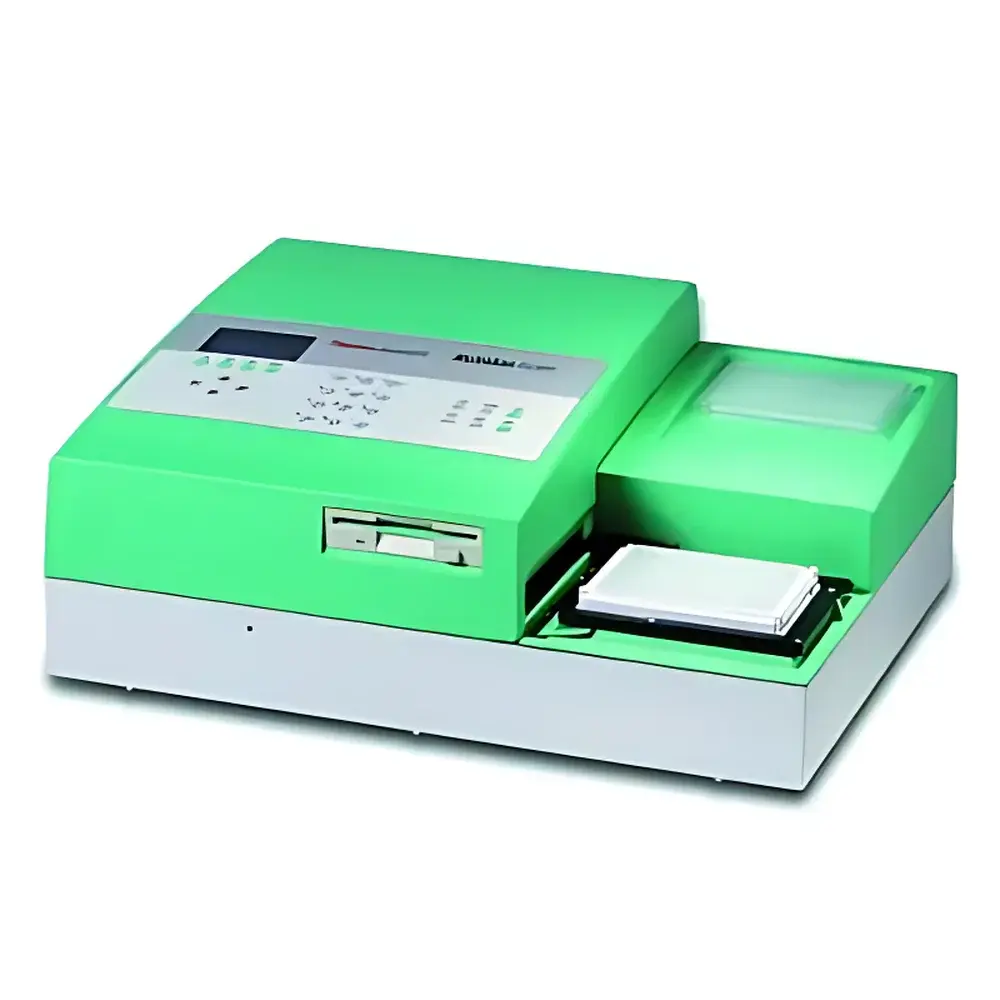
Thermo Fisher Scientific MULTISKAN ASCENT Microplate Reader
| Origin | Assembled in Shanghai, China |
|---|---|
| Manufacturer Type | Authorized Distributor |
| Regional Origin | Domestic (China) |
| Model | MULTISKAN ASCENT |
| Pricing | Upon Request |
Overview
The Thermo Fisher Scientific MULTISKAN ASCENT is a high-performance absorbance microplate reader engineered for precision, reproducibility, and workflow flexibility in clinical diagnostics, pharmaceutical research, and academic life science laboratories. Based on dual-beam photometry with temperature-stabilized optics, it delivers robust endpoint, kinetic, and dual-wavelength measurements across the 340–750 nm spectral range. Designed to meet the demands of high-throughput environments, the instrument supports both 96-well and 384-well microplates—enabling rapid acquisition (as fast as 14 seconds per 96-well plate) without compromising photometric linearity or dynamic range. Its optical architecture achieves an absorbance measurement range up to 4.0 OD (with extended capability to 6.0 OD in specific configurations), minimizing sample dilution requirements and improving assay efficiency. The system adheres to fundamental photometric principles defined in ISO 15197 and CLSI EP17-A2 for analytical performance verification, ensuring traceable accuracy and inter-laboratory comparability.
Key Features
- Dual-beam optical design with integrated reference channel for real-time drift correction and enhanced photometric stability
- Photometric range: 0–6.0 OD (standard mode: 0–4.0 OD with ≤±0.01 OD linearity deviation up to 3.0 OD)
- Wavelength selection via precision interference filters (standard set: 340, 405, 450, 492, 540, 570, 620, 690 nm; optional filter wheel supports up to 10 positions)
- Fast read times: ≤14 s for full 96-well plates; ≤35 s for 384-well plates using single-read mode
- Onboard memory stores up to 100 user-defined protocols and 50 result sets
- Optional integrated incubation module (temperature range: ambient +4°C to 50°C, ±0.5°C uniformity)
- Floppy disk drive option (3.5″) for ASCII-formatted data export and protocol backup
- Robust mechanical platform compatible with third-party robotic handlers and stackers (e.g., Thermo Scientific RapidStack, STARlet integrations)
Sample Compatibility & Compliance
The MULTISKAN ASCENT is validated for use with standard flat-bottom, U-bottom, and V-bottom polystyrene microplates—including Thermo Scientific CLINIPLATE™ (96-well), CLINIPLATE™ 384, and COMBIPLATE™ formats. Plate surface flatness and optical clarity comply with ANSI/SBS standards (ANSI SLAS 1–4:2022), ensuring minimal well-to-well variability and low background scatter. For regulatory environments, the system supports audit-trail-enabled operation when paired with ASCENT PC software under controlled IT infrastructure. While the instrument itself does not embed FDA 21 CFR Part 11 compliance features natively, its data export architecture (ASCII, CSV, Excel-compatible) facilitates integration into validated LIMS/HIS platforms operating under GLP or GMP frameworks. Performance Verification Kits (PVKs), calibrated against NIST-traceable standards, enable routine verification per ISO/IEC 17025 requirements for absorbance accuracy (±0.02 OD at 0.3–4.0 OD) and wavelength accuracy (±1 nm).
Software & Data Management
Two complementary software environments are provided: the embedded instrument firmware and the Windows-based ASCENT PC Software v2.6. The onboard interface employs a question-driven, menu-guided workflow—ideal for routine QC testing and standardized ELISA protocols. It supports endpoint, two-point, and kinetic assays, with built-in calculations including linear regression, quadratic/cubic/quartic polynomial fitting, point-to-point, and four-parameter logistic (4PL) curve modeling. ASCENT PC Software extends functionality with a full spreadsheet environment, customizable report templates, multi-plate batch processing, and direct interfacing with laboratory automation systems via RS-232 or USB. All curve models support bidirectional conversion (e.g., 4PL to linearized % inhibition), automatic blank subtraction, concentration interpolation, and statistical outlier detection. Data export options include raw OD values, fitted parameters, and annotated plate maps—fully compatible with downstream analysis in GraphPad Prism, R, or Python-based bioinformatics pipelines.
Applications
The MULTISKAN ASCENT serves as a foundational tool across diverse life science applications requiring quantitative colorimetric detection. These include enzyme-linked immunosorbent assays (ELISA), cell viability assays (MTT, XTT, WST-1), protein quantification (Bradford, BCA), microbial growth monitoring, and kinetic enzyme activity profiling (e.g., β-galactosidase, LDH, ALP). Its broad dynamic range and low inter-plate CV (<1.5% at 1.0 OD) make it suitable for both high-sensitivity immunoassays and high-concentration biochemical endpoints. In translational research settings, the instrument supports biomarker validation workflows where reproducible, multi-parametric plate-level data are essential for statistical power and cross-cohort harmonization.
FAQ
What wavelength range does the MULTISKAN ASCENT support?
It operates from 340 nm to 750 nm using fixed-position interference filters; optional filter wheels expand configurability.
Can the instrument perform kinetic measurements?
Yes—it supports time-resolved absorbance acquisition with programmable interval timing (1 second to 60 minutes) and up to 300 readings per well.
Is temperature control available during measurement?
An optional internal incubation module maintains temperatures from ambient +4°C to 50°C with ±0.5°C uniformity across the plate.
How is data integrity ensured for regulated environments?
While the standalone reader lacks native electronic signatures, its ASCII/CSV export enables secure transfer into validated LIMS or ELN systems compliant with 21 CFR Part 11.
Does the system support 384-well plates without loss of accuracy?
Yes—optical path correction algorithms compensate for reduced well volume, maintaining <2.0% CV at 1.0 OD in 384-well format.
What verification tools are provided for routine performance checks?
Thermo Fisher’s Performance Verification Kit includes NIST-traceable liquid standards covering 0.3–4.0 OD at key wavelengths (340–750 nm), aligned with CLSI EP17-A2 guidelines.




