
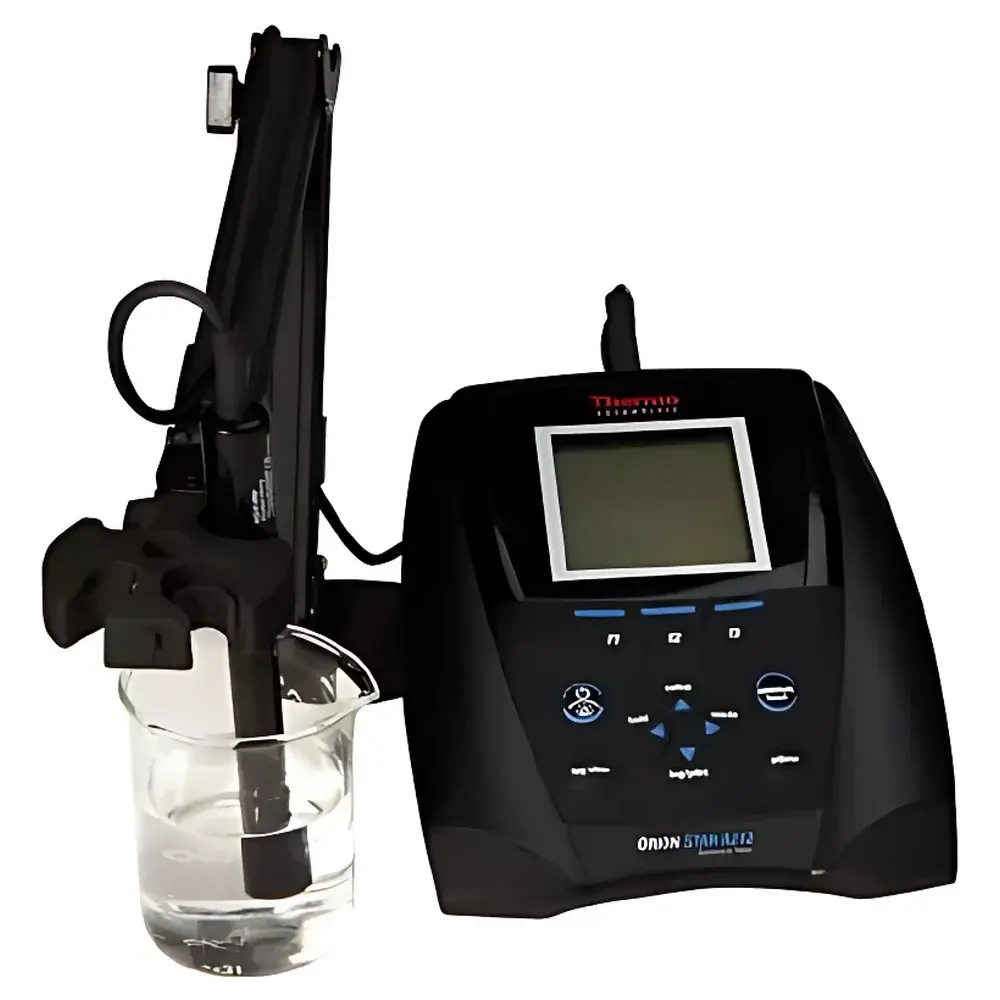
Thermo Fisher Scientific Orion Star A215/A325 Benchtop & Portable pH/Conductivity Meter
| Brand | Thermo Fisher Scientific |
|---|---|
| Origin | Singapore |
| Manufacturer | Thermo Fisher Scientific |
| Product Type | Imported |
| Model | A215 (Benchtop), A325 (Portable) |
| Instrument Category | Benchtop |
| Parameter Types | Dual (pH & Conductivity) |
| Measurement Accuracy | ±0.001 pH / ±0.5% of reading (conductivity) |
| Conductivity Range | 0.001 μS/cm to 3000 mS/cm |
| Resolution | 0.001 μS/cm minimum or 4 significant digits |
| Calibration Solutions | Auto-recognized (USA/NIST/DIN buffers) |
| Data Storage | 2000 entries (A215), 5000 entries (A325), GLP-compliant |
| Environmental Rating | IP54 (benchtop), IP67 (portable) |
| Power | AC adapter or 4 × AA batteries |
Overview
The Thermo Fisher Scientific Orion Star A215 and A325 are dual-parameter benchtop and portable meters engineered for high-precision electrochemical measurement of pH, conductivity, resistivity, total dissolved solids (TDS), and salinity across diverse laboratory, field, and industrial environments. Based on potentiometric and conductometric principles—pH via Nernstian potential response of glass membrane electrodes and conductivity via four-electrode or two-electrode AC conductivity cells—these instruments deliver traceable, reproducible results under varying temperature, ionic strength, and sample matrix conditions. Designed for compliance-critical workflows, the Star A series supports Good Laboratory Practice (GLP) and Good Manufacturing Practice (GMP) requirements through full audit-trail data logging, user-defined ID tagging, calibration history retention, and timestamped measurements. The dual-channel architecture enables simultaneous or independent monitoring of pH/mV/RmV and conductivity/TDS/salinity/resistivity—each with real-time temperature compensation using either linear, non-linear, or USP-defined ultra-pure water algorithms.
Key Features
- Intuitive multi-language interface (English, Chinese, Spanish, French, German, Portuguese) with large backlit LCD supporting dual-parameter side-by-side or single-channel focused display
- AUTO-READ™ functionality locks stable readings automatically and displays visual stability indicators—eliminating subjective judgment in endpoint determination
- Advanced calibration management: auto-recognition of USA, NIST, and DIN pH buffer sets; editable slope/offset values to refine calibration curves without re-calibration
- Temperature compensation flexibility: selectable reference temperatures (5–25 °C), adjustable linear compensation coefficient (0–10.0%/°C), and dedicated non-linear models for ultrapure water per USP
- Comprehensive electrode support: compatibility with BNC pH electrodes, 8-pin mini-DIN ATC probes, and conductivity sensors with configurable cell constants (0.001–199.9 cm⁻¹)
- Ruggedized design: IP54-rated benchtop (A215) for lab bench use; IP67-rated portable (A325) with shock-absorbing holster, 3-meter cable options, and battery-powered operation (up to 2000 hours)
Sample Compatibility & Compliance
The Star A platform accommodates a broad spectrum of aqueous samples—from aggressive wastewater and natural seawater to ultrapure boiler feedwater and pharmaceutical-grade Water for Injection (WFI). Its conductivity module supports both standard K = 0.475 cm⁻¹ cells for general-purpose analysis and low-conductivity K = 0.1 cm⁻¹ flow-cell configurations optimized for sub-1 μS/cm measurements in power generation and biopharmaceutical applications. The built-in seawater salinity curve conforms to PSS-78 standards, while TDS conversion adheres to ISO/EN 27888 for environmental reporting. All data records comply with GLP documentation requirements—including operator ID, sample ID, calibration verification timestamps, electrode status flags, and full calibration parameter logs—ensuring full traceability during FDA 21 CFR Part 11–aligned audits.
Software & Data Management
- Onboard memory stores up to 2000 (A215) or 5000 (A325) GLP-compliant datasets with manual, timed, or auto-triggered capture modes
- Full edit capability: selective deletion, annotation, and export of individual or batch records
- Bi-directional communication via USB or RS232 interfaces; compatible with Thermo Fisher’s Orion COMM software for report generation, trend visualization, and firmware updates
- Export formats include CSV and TXT for integration into LIMS, ELN, or statistical process control (SPC) platforms
- No proprietary cloud dependency: all data remains under user control with local storage and transfer protocols aligned with ISO/IEC 27001 information security principles
Applications
The Orion Star A215 is routinely deployed in environmental testing labs for EPA Method 120.1 (pH) and 120.2 (conductivity) compliance; municipal water treatment facilities performing daily raw/finished water QA/QC; and university teaching laboratories requiring robust, student-safe instrumentation. The A325 variant serves field-based applications including coastal oceanography (salinity profiling), industrial effluent monitoring at remote discharge points, and cleanroom environmental surveillance in semiconductor fabs. In regulated industries, both models support USP purified water testing, ASTM D1125 conductivity validation, and ISO 9001-certified process control documentation where measurement uncertainty budgets must be demonstrably maintained.
FAQ
Does the Star A series support USP purified water conductivity testing?
Yes—the A215 and A325 implement the non-linear temperature compensation algorithm and conductivity acceptance criteria defined in USP , including Stage 1–3 testing logic when paired with appropriate low-K conductivity cells and certified standards.
Can calibration data be exported and archived externally?
Yes—calibration events, including date/time, buffer IDs, slope, offset, and electrode ID, are embedded in each dataset and exportable via USB/RS232 in human-readable formats compliant with internal QA archival policies.
Is the instrument suitable for measuring high-salinity brines above 80 ppt?
The A325 and A215 report salinity up to 80.0 ppt NaCl-equivalent; for higher concentrations, conductivity mode should be used directly with appropriate K-value selection and temperature correction.
What is the maximum allowable temperature for continuous immersion of the A325’s probe cables?
The 3-meter ruggedized cables (e.g., for 8107UWMMD and 013010MD) are rated for continuous operation from –10 °C to +50 °C ambient; extended exposure above 50 °C may affect long-term insulation integrity.
How does the instrument handle electrode drift during extended field deployments?
The AUTO-READ™ stability detection, combined with periodic user-initiated verification checks against known standards and automatic electrode status flagging, provides early drift indication—enabling proactive recalibration before measurement bias exceeds ±0.002 pH or ±1% conductivity tolerance limits.




