
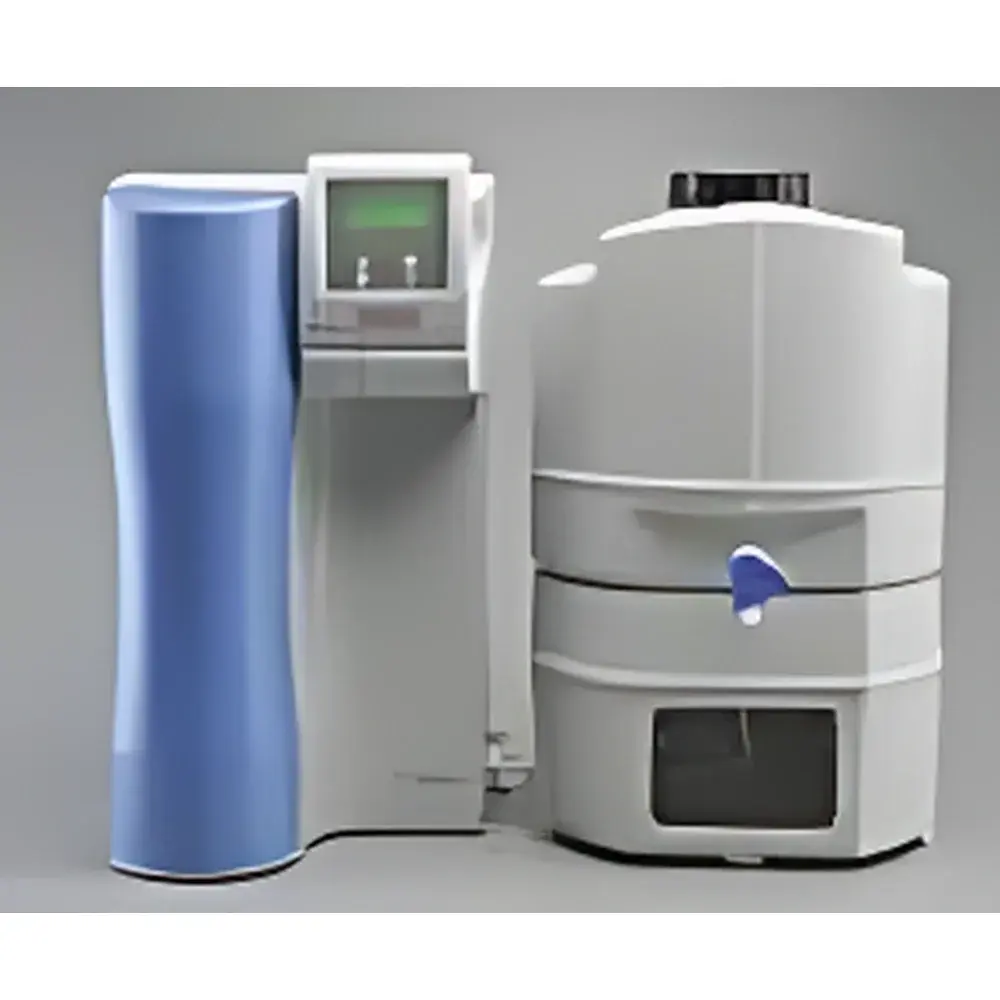
Thermo Fisher Scientific Pacific RO Ultra Pure Water System
| Brand | Thermo Fisher Scientific |
|---|---|
| Origin | Imported |
| Manufacturer Type | Manufacturer |
| Model | Pacific RO |
| Purified Water Grade | ASTM Type III |
| Ion Removal Efficiency | 98% |
| TOC Reduction | 99% |
| Particulate Removal (>0.1 µm) | 99% |
| Pre-filter Configuration | Dual 10-inch (25.4 cm) Cartridges — 5 µm Sediment Filter + Activated Carbon + Anti-scaling Column |
| Resistivity Probe Accuracy | ±0.16 cm⁻¹ |
| Display | Backlit Tilt-adjustable LCD with Real-time Resistivity/Conductivity, Tank Level (%), and Operational Mode Indication |
| Control System | Microprocessor-based with GLP-compliant Event Logging, Password-protected Settings, and RS-232 Data Export (Configurable Interval) |
| Storage Tank | Polyethylene (Pigment-free), Conical-bottom Design for Complete Drainage |
| Footprint | Benchtop or Wall-mountable |
| Flow Rates | 3 / 7 / 12 / 20 / 40 L/hr |
| Data Retention | Up to 4 Weeks of Timestamped System Events and Parameters |
| Compliance | Meets ASTM D1193-20 (Type III Water), Supports GLP/GMP Documentation Requirements |
Overview
The Thermo Fisher Scientific Pacific RO Ultra Pure Water System is a modular, microprocessor-controlled reverse osmosis (RO)-based purification platform engineered for consistent production of ASTM Type III laboratory-grade water. It employs a dual-stage pre-treatment architecture—comprising a 5 µm sediment filter, high-capacity activated carbon cartridge, and an integrated anti-scaling column—to protect the RO membrane from particulate fouling, chlorine degradation, and mineral scaling. The core RO module delivers stable rejection of ionic contaminants (≥98% removal efficiency), while post-RO polishing is optimized for downstream compatibility with further purification stages (e.g., deionization or UV oxidation). Designed for reliability in routine analytical, preparative, and general lab applications—including buffer preparation, glassware rinsing, and feed water for higher-purity systems—the Pacific RO emphasizes operational transparency, long-term serviceability, and audit-ready data integrity.
Key Features
- Benchtop or wall-mountable compact footprint, minimizing spatial demand in constrained laboratory environments.
- Five selectable flow rates (3, 7, 12, 20, and 40 L/hr) to match evolving lab throughput requirements without system replacement.
- Real-time microprocessor control with backlit, tilt-adjustable LCD display showing resistivity (MΩ·cm), conductivity (µS/cm), tank level (%), and active mode (“Produce”, “Standby”, “Rinse”).
- Conical-bottom, pigment-free polyethylene storage tank enabling full drainage—critical for effective cleaning, sanitization, and microbial control per GLP practices.
- GLP-compliant internal logging: timestamps all system events, alarms, and parameter deviations; stores up to 4 weeks of data in plain-text format for traceability.
- Password-protected configuration interface prevents unauthorized modification of critical settings (e.g., alarm thresholds, rinse cycles, data export intervals).
- RS-232 serial interface supports scheduled transmission of operational metrics and fault logs to external PCs or printers—configurable time intervals support integration into centralized lab informatics infrastructure.
- High-accuracy resistivity sensor with electrode cell constant of 0.16 cm⁻¹ ensures repeatable, NIST-traceable conductivity measurement across the full operating range.
Sample Compatibility & Compliance
The Pacific RO system is validated for continuous generation of ASTM Type III reagent water (D1193-20), meeting specifications for maximum conductivity (≤1000 µS/cm at 25°C), total organic carbon (TOC ≤ 200 ppb, achieved via ≥99% TOC reduction), and particulate load (0.1 µm, supported by ≥99% particulate removal). Its pre-treatment design accommodates municipal tap water feed with typical hardness (<200 ppm CaCO₃), free chlorine (<2 ppm), and turbidity (<1 NTU). While not intended for end-use as USP/EP/JP purified water or ISO 3696 Grade 1 water, it serves as a robust, compliant first-stage purification unit compatible with subsequent polishing modules. All electronic logging functions align with GLP documentation standards, including user-access controls, immutable event timestamps, and exportable audit trails—facilitating regulatory readiness during inspections under FDA 21 CFR Part 11 (when paired with validated software interfaces) or ISO/IEC 17025-accredited quality systems.
Software & Data Management
No proprietary software installation is required. System diagnostics, status monitoring, and historical data review are performed directly via the embedded LCD interface. All logged parameters—including resistivity readings, tank fill levels, pump runtime, alarm triggers, and maintenance reminders—are stored internally in non-volatile memory. Data export occurs exclusively via RS-232 serial communication in ASCII text format, allowing seamless ingestion into laboratory information management systems (LIMS), electronic lab notebooks (ELN), or custom database platforms. Export intervals are programmable (e.g., every 5 minutes, hourly, or on-demand), and each record includes date/time stamps, sensor values, and operational context—ensuring full traceability without reliance on cloud services or vendor-specific applications.
Applications
- Feed water supply for Type I ultrapure water systems (e.g., Thermo Fisher Barnstead E-Pure or GenPure units).
- Routine laboratory tasks requiring low-conductivity water: media preparation, HPLC mobile phase dilution, spectrophotometer blanking, and general equipment rinsing.
- Supporting QC/QA workflows where documented water quality consistency is mandated under ISO 17025 or CAP accreditation.
- Pharmaceutical R&D labs performing non-sterile formulation development and analytical method validation.
- Academic teaching laboratories needing reliable, low-maintenance water sources with verifiable performance history.
FAQ
What water quality standard does the Pacific RO meet?
It produces ASTM Type III reagent water per D1193-20, with typical resistivity >0.5 MΩ·cm (conductivity <2 µS/cm) after RO treatment and ≥99% TOC reduction.
Can the system be upgraded to produce Type I water?
Yes—the Pacific RO is designed as a modular first stage; integration with optional ion exchange, UV oxidation, or ultrafiltration modules enables progression to ASTM Type I specifications.
Is the storage tank material compliant with USP Class VI requirements?
The pigment-free polyethylene tank meets USP cytotoxicity testing criteria and is suitable for pharmaceutical-grade water storage when maintained per validated cleaning protocols.
How is data integrity ensured during power loss?
All logged events and parameters are written to non-volatile memory prior to power-down; no data is lost during unexpected outages.
What maintenance intervals are recommended for pre-filters?
The 5 µm sediment and activated carbon cartridges require replacement every 6–12 months depending on feed water quality; the anti-scaling column should be replaced annually or after 10,000 L of processed water.



