
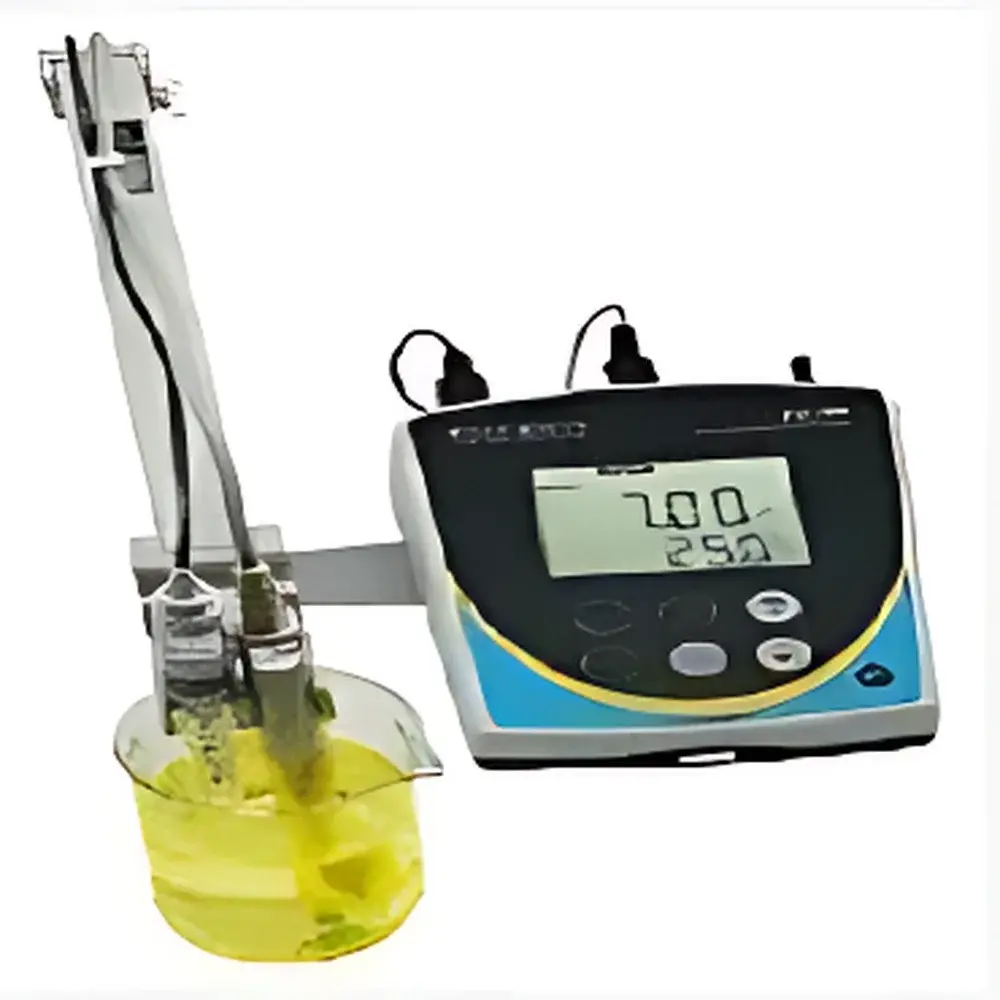
Thermo Fisher Scientific PC700 Multi-Parameter Benchtop Meter
| Brand | Thermo Fisher Scientific |
|---|---|
| Origin | USA |
| Model | PC700 |
| pH Range | –2.00 to 16.00 pH |
| pH Resolution | 0.01 pH |
| pH Accuracy | ±0.01 pH + 1 LSD |
| pH Calibration | Up to 5-point (pH 1.68, 4.01, 7.00, 10.01, 12.45) |
| Temperature Range | –10.0 to 110.0 °C |
| Temperature Resolution | 0.1 °C |
| Temperature Accuracy | ±0.5 °C |
| Conductivity Range | 0–200.0 mS/cm |
| Conductivity Resolution | 0.1 / 0.01 mS/cm |
| Conductivity Accuracy | ±1% of full scale |
| Conductivity Calibration | Up to 5-point per range |
| TDS Range | 0–100 ppt (TDS factor 0.5) |
| TDS Resolution | 0.1 / 0.01 ppt |
| TDS Accuracy | ±1% of full scale + 1 digit |
| TDS Calibration | Up to 5-point per range |
| mV Range | ±2000 mV |
| mV Resolution | 0.1 mV (±199.9 mV), 1 mV (>±200 mV) |
| mV Accuracy | ±0.2 mV (±199.9 mV), ±2 mV (>±200 mV) |
Overview
The Thermo Fisher Scientific PC700 Multi-Parameter Benchtop Meter is an engineered solution for routine and advanced electrochemical analysis in quality control laboratories, environmental monitoring facilities, academic research settings, and industrial process support environments. Designed around a stable potentiometric measurement architecture, the instrument simultaneously acquires and displays pH, mV, conductivity, TDS, and temperature data—each parameter measured via dedicated sensor interfaces compliant with IUPAC-recommended electrode configurations and ASTM D1125 and ISO 7888 standards. Its dual-channel analog input supports interchangeable pH/mV and conductivity/TDS probes, enabling rapid method switching without hardware reconfiguration. The meter employs auto-ranging conductivity circuitry with five selectable resolution modes (down to 0.01 µS/cm), ensuring high fidelity across ultra-low ionic strength samples (e.g., ultrapure water) and highly conductive brines. Temperature compensation is applied using either fixed β-coefficient or user-defined NIST-traceable RTD curves, supporting both linear and non-linear correction models per ASTM D5391.
Key Features
- Simultaneous real-time display of pH, mV, conductivity, TDS, and temperature on a backlit 4.3-inch graphical LCD with intuitive icon-driven navigation
- Five-point pH calibration with built-in standard buffer recognition (pH 1.68, 4.01, 7.00, 10.01, 12.45) and slope/offset diagnostics for electrode health assessment
- Multi-range conductivity measurement with automatic range selection and five resolution tiers (0.01 µS/cm to 0.1 mS/cm), supporting cell constants from 0.01 to 10 cm⁻¹
- Configurable TDS conversion factors (0.4–1.0), enabling compliance with USP , APHA Standard Methods 2510, and EPA Method 120.1
- Integrated temperature measurement via Pt1000 RTD probe with manual or automatic temperature compensation (ATC)
- GLP-compliant data logging: stores up to 2,000 timestamped readings with operator ID, calibration history, and sensor serial numbers
- USB-B interface for direct connection to Windows-based PCs; supports CSV export and firmware updates via Thermo Fisher’s Instrument Manager software
Sample Compatibility & Compliance
The PC700 is validated for use with aqueous and mildly aggressive electrolyte solutions, including buffered standards, drinking water, wastewater effluents, pharmaceutical buffers, and food extracts. It accommodates standard BNC pH electrodes, DIN-conductivity cells (e.g., 2-cell or 4-cell designs), and combination pH/conductivity probes. All measurement protocols align with regulatory expectations for analytical instrumentation under FDA 21 CFR Part 11 (when paired with audit-trail-enabled software), ISO/IEC 17025 clause 5.5.2 (equipment verification), and GLP principles for data integrity. The instrument’s IP54-rated enclosure ensures operational reliability in laboratory environments with controlled humidity and ambient particulate levels.
Software & Data Management
Data acquisition and reporting are supported through Thermo Fisher’s Instrument Manager v3.x, a validated desktop application that provides secure user authentication, electronic signatures, and full audit trail functionality—including modification timestamps, parameter changes, and calibration event logs. Exported datasets include metadata headers (date/time, probe ID, calibration status, temperature), facilitating traceability in regulated workflows. Raw data files conform to ASTM E1382-compliant CSV structure and can be imported into LIMS platforms (e.g., LabWare, STARLIMS) via ODBC or API integration. Firmware updates preserve all stored calibration coefficients and user preferences.
Applications
- Pharmaceutical water system monitoring (PW, WFI) per USP and
- Environmental water quality assessment (surface water, groundwater, wastewater) per EPA methods and ISO 5667 series
- Food and beverage QC—acid titration endpoint verification, brine concentration validation, and rinse water conductivity screening
- Academic teaching labs for fundamental electrochemistry experiments involving buffer capacity, ion migration, and activity coefficient estimation
- Industrial boiler feedwater and cooling tower chemistry control programs requiring simultaneous pH and conductivity trending
FAQ
Does the PC700 support automatic temperature compensation for conductivity measurements?
Yes—ATC is enabled by default using the integrated Pt1000 sensor; users may also select manual temperature entry or disable compensation for specialized applications.
Can the instrument store calibration data for multiple electrodes?
Each calibration session is tagged with probe serial number (if encoded) and date; up to 10 independent calibration histories are retained in non-volatile memory.
Is the PC700 compliant with 21 CFR Part 11 when used with Instrument Manager?
Yes—when deployed with configured electronic signatures, audit trails, and role-based access controls, the system meets predicate rule requirements for electronic records and signatures.
What conductivity cell constants are supported?
The meter auto-detects cell constant values entered during calibration (0.01, 0.1, 1.0, or 10 cm⁻¹) and applies appropriate scaling algorithms per ISO 7888 Annex B.
How is measurement uncertainty reported for pH readings?
Uncertainty is calculated per ISO/IEC 17025:2017 Annex A.3 as the root-sum-square of repeatability (±0.005 pH), calibration error (±0.005 pH), and temperature-induced drift (±0.002 pH), yielding a typical expanded uncertainty (k=2) of ±0.014 pH.





