
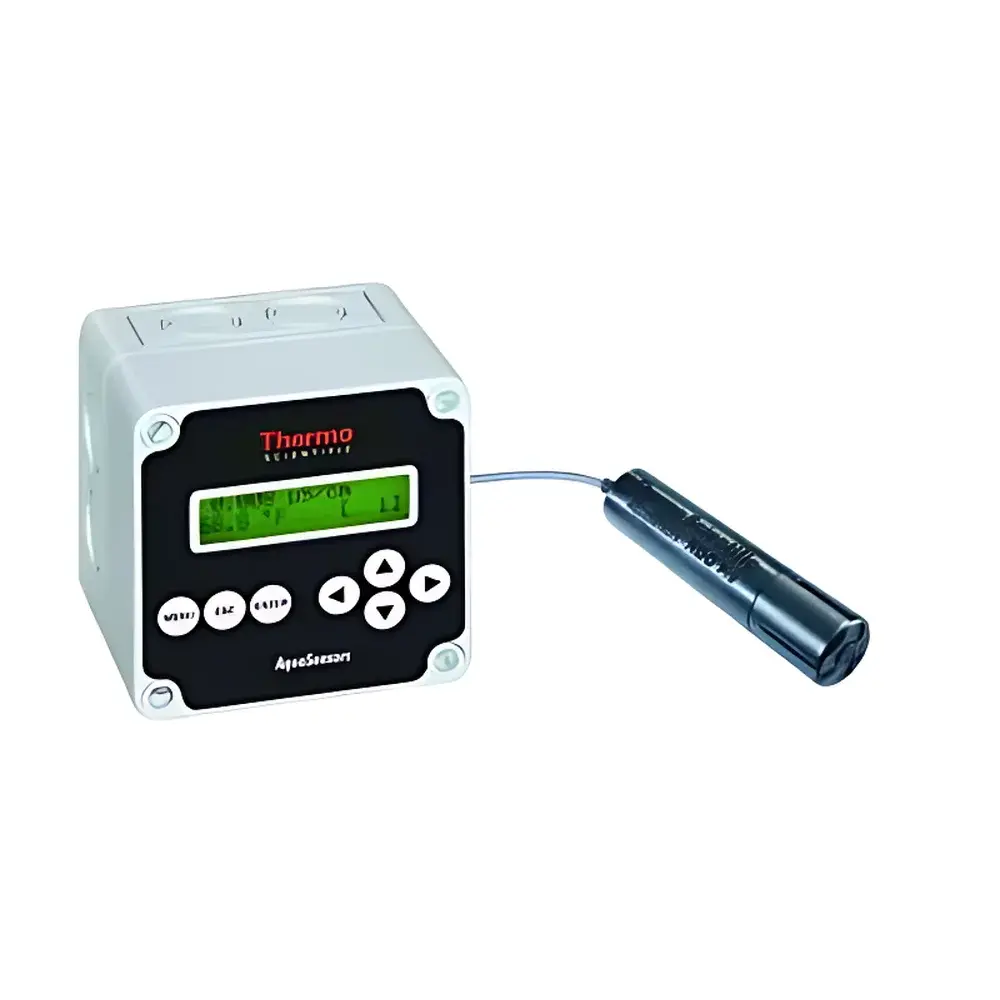
Thermo Fisher Scientific RDO Pro Fluorescence-Based Dissolved Oxygen Meter
| Brand | Thermo Fisher Scientific |
|---|---|
| Origin | USA |
| Manufacturer | Thermo Fisher Scientific |
| Product Type | Imported Instrument |
| Model | RDO Pro |
| Price | Upon Request |
| Measurement Principle | Fluorescence Lifetime Quenching |
| Range | 0–20 ppm / 0–200% saturation |
| Resolution | 0.01 ppm (<10 ppm), 0.1 ppm (≥10 ppm) |
| Accuracy | ±0.1 ppm (<8 ppm), ±0.2 ppm (8–20 ppm) |
| Response Time | t₉₀ = 30 s, t₉₅ = 37 s |
| Units | ppm, % saturation, °C, °F |
| Calibration | Single-point air-saturation calibration |
| Compensation | Automatic temperature, barometric pressure, and salinity compensation |
| Operating Temperature | 0–50 °C |
| Max Pressure Rating | 300 PSIG (20.7 bar) at 50 °C |
| Flow Independence | Yes |
| Housing Materials | Delrin®, Polystyrene |
| Probe Dimensions | 203 mm length × 47 mm diameter |
| Threaded Mount | 1.25" NPT |
| Warranty | 2 years |
Overview
The Thermo Fisher Scientific RDO Pro is a high-performance, fluorescence-based dissolved oxygen (DO) meter engineered for continuous, maintenance-free operation in demanding environmental monitoring, wastewater treatment, aquaculture, and laboratory water quality applications. Unlike traditional electrochemical Clark-type sensors—which rely on oxygen diffusion through a permeable membrane and generate current proportional to O₂ partial pressure—the RDO Pro employs optical fluorescence lifetime quenching. At the probe tip, a proprietary oxygen-sensitive fluorophore is excited by pulsed blue LED light. In the presence of molecular oxygen, the excited-state lifetime of the fluorophore is shortened in a quantifiable, reversible, and highly linear manner. A reference red LED synchronously illuminates the sensor surface to precisely time the excitation pulse, enabling robust phase-shift or lifetime decay measurement independent of photobleaching, light intensity drift, or fouling-induced signal attenuation. This principle eliminates membrane degradation, electrolyte depletion, cathode polarization, and zero-current stabilization delays—resulting in true zero-maintenance operation with no consumables required.
Key Features
- Fluorescence lifetime detection ensures long-term stability without membrane replacement or electrolyte refills
- Complete immunity to common interferents: H₂S, sulfides, CO₂, NH₃/NH₄⁺, heavy metals, Cl⁻, SO₄²⁻, and pH fluctuations (range 4–10)
- Flow-independent measurement—valid across static, low-flow, and turbulent conditions up to 3 m/s
- Factory-calibrated for 0–20 ppm (0–200% saturation); single-point air-saturation calibration suffices for field verification
- Integrated automatic compensation for temperature (0–50 °C), barometric pressure (50–110 kPa), and salinity (0–70 ppt)
- Ruggedized probe housing constructed from Delrin® acetal resin and impact-resistant polystyrene
- Pressure-rated to 300 PSIG (20.7 bar) at 50 °C—suitable for pressurized distribution systems and deep-well monitoring
- No warm-up time; full measurement stability achieved within 37 seconds (t₉₅)
Sample Compatibility & Compliance
The RDO Pro is validated for use in freshwater, seawater, brackish water, activated sludge, digester effluent, and process streams containing suspended solids or biofilm-prone surfaces. Its optical design inherently resists chemical poisoning—particularly critical in anaerobic digesters or sulfidic sediments where H₂S “poisoning” renders amperometric sensors inoperative. The instrument meets ASTM D888-22 (Standard Test Methods for Dissolved Oxygen in Water) for fluorescence-based DO determination and supports compliance with EPA Method 360.1 and ISO 5814:2012 (Water quality — Determination of dissolved oxygen — Electrochemical probe method), with documented equivalence for optical methods under regulatory review frameworks. Data integrity features—including timestamped calibration logs, sensor diagnostics, and non-volatile memory retention—align with GLP and GMP documentation requirements. While not FDA 21 CFR Part 11–certified out-of-the-box, audit trails and user-access controls can be implemented via compatible Thermo Fisher data acquisition platforms.
Software & Data Management
The RDO Pro outputs analog (4–20 mA) and digital (RS-485 Modbus RTU) signals compatible with SCADA, DCS, and PLC systems. When paired with Thermo Fisher’s Orion Star™ Connect software or third-party OPC UA–enabled platforms, users gain access to real-time trend visualization, automated calibration logging, sensor health diagnostics (e.g., fluorophore decay rate, LED drive voltage), and configurable alarm thresholds. All calibration events—including date, operator ID, ambient pressure, and salinity input—are stored with ISO 8601 timestamps and cannot be edited retroactively. Data export supports CSV and Excel formats for integration into LIMS or statistical process control (SPC) workflows. Firmware updates are performed via USB interface with cryptographic signature validation to ensure traceability and cybersecurity compliance.
Applications
- Real-time DO monitoring in municipal and industrial wastewater treatment plants (aeration basins, secondary clarifiers, nitrification/denitrification zones)
- Process control in aquaculture recirculating systems and hatchery tanks
- Environmental compliance reporting for NPDES permits and watershed restoration programs
- Research-grade dissolved oxygen profiling in limnological and marine field studies
- Validation of oxygen mass transfer efficiency in bioreactors and fermentation vessels
- Long-term unattended deployment in remote monitoring stations powered by solar/battery systems
FAQ
Does the RDO Pro require periodic recalibration?
Calibration is recommended annually under routine use or after exposure to extreme fouling events. However, due to inherent stability of the fluorophore and absence of consumables, the sensor maintains factory calibration for >12 months in clean-to-moderately-fouled environments.
Can the probe be cleaned in place without removal?
Yes—gentle wiping with isopropyl alcohol or low-concentration enzymatic cleaners is permitted. Abrasive scrubbing or ultrasonic cleaning is prohibited to preserve fluorophore integrity.
Is temperature compensation automatic?
Yes—integrated Pt1000 RTD provides continuous, high-accuracy temperature measurement, and compensation algorithms are embedded in firmware per ISO 5814 Annex B.
What is the expected service life of the fluorophore layer?
Under normal operating conditions (0–40 °C, pH 5–9), the fluorophore exhibits >5 years of functional lifetime with <2% signal drift per year, as verified by accelerated aging tests per IEC 60751.
How does the RDO Pro handle high-sulfide environments?
Unlike electrochemical sensors, it experiences zero performance degradation in H₂S concentrations up to 100 ppm—confirmed in side-by-side testing per ASTM D129-19 in anaerobic digester supernatant.







