
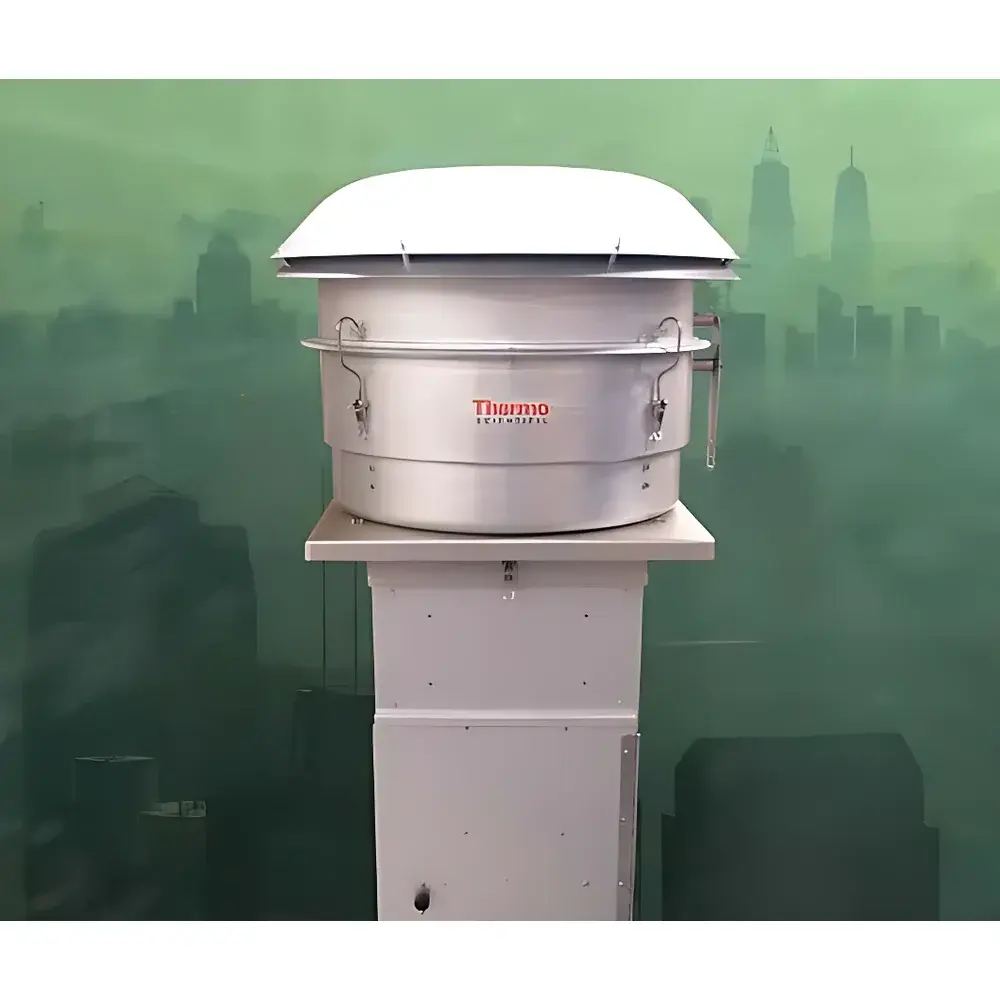
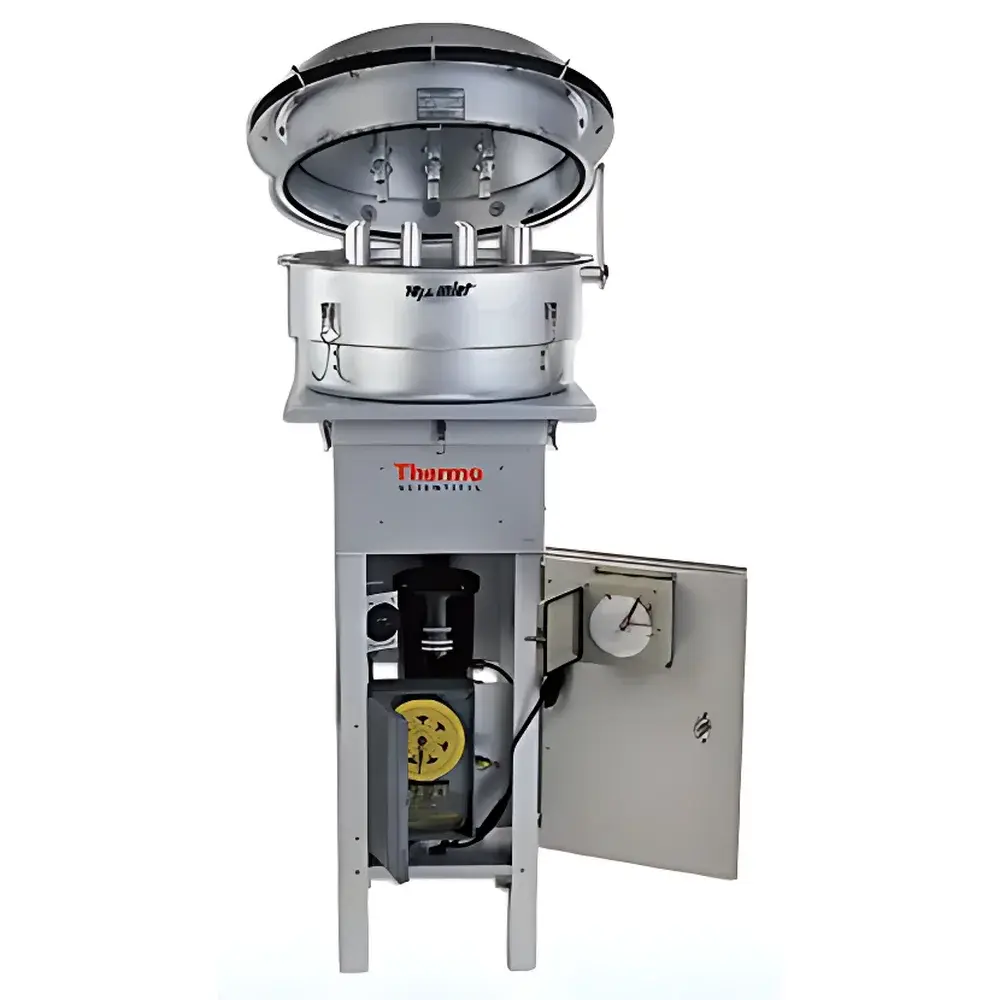
Thermo Fisher Scientific VFC-PM10 High-Volume Particulate Matter Sampler
| Brand | Thermo Fisher Scientific |
|---|---|
| Origin | USA |
| Manufacturer | Thermo Fisher Scientific |
| Type | Imported Instrument |
| Model | VFC-PM10 |
| Typical Configuration | PM₁₀ Inhalable Particulate Sampler |
| Flow Rate | 40 ACFM (1.13 m³/min) |
| Flow Accuracy | < ±1% deviation over 24 h |
| Motor | 1.0 HP, 7 A, 840 W |
| Power Supply | 110 V AC, single-phase, 60 Hz (optional configurations available) |
| Weight | 62 kg (total system) |
| Dimensions | Cabinet: 129 cm H × 56 cm W × 56 cm D (22 kg) |
| PM₁₀ Cyclone | 81 cm H × 81 cm W × 63.5 cm D (25 kg) |
| VFC Fan & Filter Holder Assembly | 71 cm H × 53 cm W × 48 cm D (12 kg) |
| Flow Control Principle | Critical-flow Venturi with aerodynamic energy recovery |
| Compliance | U.S. EPA Reference Method RFPS-1287-063 for PM₁₀ |
Overview
The Thermo Fisher Scientific VFC-PM10 High-Volume Particulate Matter Sampler is a precision-engineered, passive-flow-controlled instrument designed for regulatory-grade ambient air monitoring of inhalable particulate matter with aerodynamic diameter ≤10 µm (PM₁₀). It operates on the physical principle of critical-flow Venturi restriction—leveraging choked flow conditions where gas velocity reaches local sonic speed at the throat of a smoothly contoured, polished Venturi tube. Under this regime, volumetric flow becomes inherently insensitive to downstream pressure fluctuations, filter loading, ambient temperature, and barometric pressure variations. This eliminates reliance on active electronic flow feedback or moving mechanical regulators, resulting in exceptional long-term stability and metrological robustness. The system integrates a high-efficiency centrifugal blower, an EPA-compliant PM₁₀ size-selective cyclone inlet, a stainless-steel filter holder with horizontal membrane positioning, and a rigid anodized aluminum enclosure engineered for field durability and thermal stability.
Key Features
- Critical-flow Venturi volume controller with >95% pressure recovery efficiency—minimizing total system energy loss and enabling stable operation under variable backpressure conditions.
- No electronic flow sensors, microprocessors, or motor-speed control circuits—reducing failure modes and enhancing reliability in unattended, remote deployments.
- Full compliance with U.S. Environmental Protection Agency (EPA) Reference Method RFPS-1287-063 for PM₁₀ monitoring, supporting data acceptance in federal and state air quality networks.
- Horizontal filter support platform ensures uniform particle deposition and eliminates gravitational bias during gravimetric analysis per EPA Method IO-3.2 and ISO 7708.
- Anodized aluminum chassis provides corrosion resistance, electromagnetic shielding, and structural rigidity across wide ambient temperature ranges (−20 °C to +50 °C).
- Modular architecture: Separable cyclone, fan/VFC assembly, and cabinet facilitate transport, maintenance, and calibration traceability.
Sample Compatibility & Compliance
The VFC-PM10 accepts standard 8×10 inch (20.3×25.4 cm) quartz fiber or Teflon® membrane filters (e.g., Pallflex Tissuquartz QAT-UP, Whatman QMA), compatible with subsequent gravimetric, elemental carbon (EC/OC), and ion chromatography analyses. Its cyclone cutpoint (D₅₀ = 10 µm ±0.2 µm at 40 ACFM) meets ISO 7708 and EN 12341 specifications for inhalable fraction definition. All components are manufactured to ASME BPE and ASTM D1357 standards for cleanroom-compatible materials. The system supports audit-ready documentation per EPA 40 CFR Part 58 and ISO/IEC 17025 requirements, including as-found/as-left calibration records, leak test logs, and flow verification reports traceable to NIST-certified primary standards.
Software & Data Management
While the VFC-PM10 operates without embedded firmware or real-time digital output, it is fully compatible with Thermo Fisher’s optional VFC-DataLink module—a NIST-traceable, Class I, Division 2 rated external flow monitor that records time-stamped volumetric flow, temperature, pressure, and runtime data compliant with 21 CFR Part 11 (electronic records & signatures). Raw flow verification data may be exported in CSV format for integration into LIMS platforms or EPA’s AQS database via AQMIS-compliant templates. Calibration certificates include uncertainty budgets calculated per GUM (JCGM 100:2008) and documented adherence to ISO/IEC 17025 Clause 6.4.
Applications
- Regulatory ambient air quality monitoring networks (e.g., EPA SLAMS, State IMPROVE sites)
- Long-term trend analysis of PM₁₀ mass concentration in urban, rural, and industrial zones
- Source apportionment studies requiring high-volume, gravimetrically validated filter samples
- Method validation and interlaboratory comparison exercises under ISO 5725-2
- Baseline characterization for environmental impact assessments (EIA) and NEPA compliance
- Research applications in aerosol physics, atmospheric chemistry, and exposure science
FAQ
Does the VFC-PM10 require periodic recalibration?
Yes—per EPA guidance, flow verification must be performed before and after each sampling event using a NIST-traceable primary calibrator (e.g., bubble meter or critical-orifice-based transfer standard), with documented deviation ≤±1% of nominal 40 ACFM.
Can the system operate at non-standard voltage or frequency?
Standard configuration is 110 V / 60 Hz; custom motor windings and capacitor kits are available for 220–240 V / 50 Hz operation upon order specification.
Is the PM₁₀ cyclone included in the base configuration?
Yes—the EPA-compliant 10 µm cutpoint cyclone is integral to the VFC-PM10 system and shipped pre-aligned with the Venturi and filter holder.
What maintenance intervals are recommended for unattended operation?
Blower bearing inspection and grease replacement every 2,000 operational hours; Venturi bore inspection and cleaning every 6 months or after 10,000 m³ of sampled air.
How is filter weighing accuracy preserved during handling?
The horizontal filter stage minimizes edge effects and particle redistribution; combined with controlled humidity conditioning (40% RH, 20 °C) per EPA Method IO-3.2, it ensures ≤0.01 mg repeatability in gravimetric analysis.







