
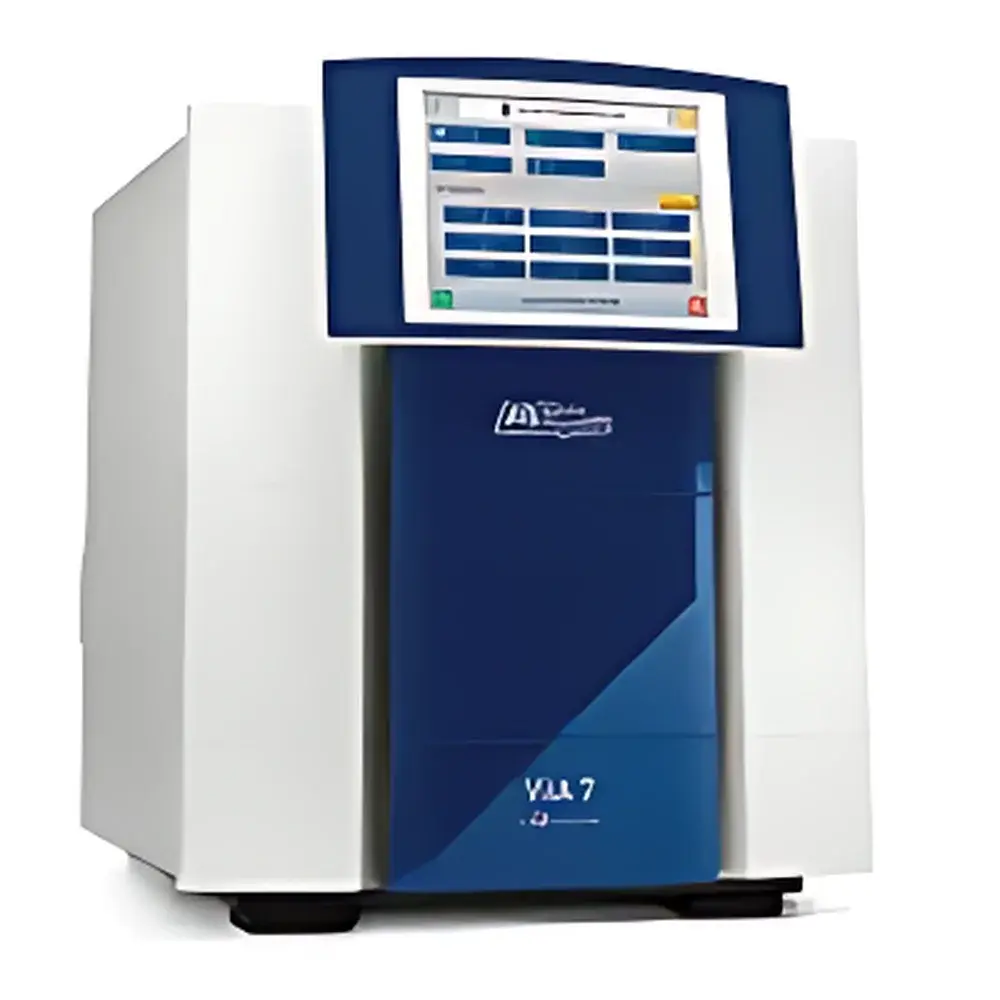
Thermo Fisher Scientific ViiA™ 7 Real-Time PCR System
| Brand | Thermo Fisher Scientific |
|---|---|
| Origin | USA |
| Model | ViiA™ 7 Real-Time PCR System |
| Instrument Type | Real-Time Quantitative PCR (qPCR) System |
| Throughput | 384-well format (with TaqMan® Array microfluidic cards) |
| Thermal Ramp Rate | Up to 5.5 °C/sec (typical, per manufacturer specifications) |
| Temperature Uniformity | ±0.25 °C across block (per ISO/IEC 17025-validated performance data) |
| Temperature Accuracy | ±0.25 °C at 95 °C (traceable to NIST standards) |
| Optical Channels | 6 independently configurable excitation/emission filter sets |
| Detection Sensitivity | Reliable detection of ≤1.5-fold copy number differences in single-plex assays |
| Software Compliance | Optional 21 CFR Part 11-compliant SAE module available |
Overview
The Thermo Fisher Scientific ViiA™ 7 Real-Time PCR System is a high-performance, modular thermal cycler engineered for quantitative nucleic acid detection using fluorescence-based real-time polymerase chain reaction (qPCR). Leveraging the proven OptiFlex® optical architecture and precision thermal control, the system delivers reproducible amplification kinetics, accurate endpoint quantification, and high-resolution melting (HRM) analysis—all within a single platform. Designed for mid-to-high-throughput laboratories engaged in gene expression profiling, pathogen detection, genotyping, miRNA quantification, and biomarker validation, the ViiA™ 7 integrates seamlessly into GLP- and GMP-aligned workflows. Its core measurement principle relies on sequence-specific probe hydrolysis (e.g., TaqMan® chemistry) or intercalating dye binding, with real-time fluorescence monitoring synchronized to thermal cycling stages. The system meets essential metrological requirements defined in ISO/IEC 17025 for calibration traceability and supports NIST-traceable temperature verification protocols.
Key Features
- OptiFlex® Optical System: Six independently configurable excitation/emission filter channels enable simultaneous detection of up to six fluorescent dyes—supporting complex multiplex assays including TaqMan® MicroRNA, Pri-miRNA, protein-coding gene, and non-coding RNA targets.
- 384-Well Microfluidic Integration: Native compatibility with TaqMan® Array microfluidic cards eliminates manual pipetting variability; sample loading requires only addition of template and master mix—no robotics or liquid handlers needed.
- Thermal Performance: Achieves rapid ramp rates (up to 5.5 °C/sec) and maintains ±0.25 °C uniformity across the entire 384-well block, validated per ISO/IEC 17025-accredited methods.
- Tool-Free Block Exchange: Front-access door design allows hot-swap replacement of thermal blocks without repositioning adjacent automation hardware (e.g., robotic arms or host PCs), minimizing workflow interruption.
- Touchscreen-Driven Workflow: Integrated 12.1-inch capacitive touchscreen provides one-touch protocol initiation, real-time run monitoring, and intuitive navigation—reducing operator training time and transcription errors.
- HRM-Optimized MeltDoctor™ Software: Preconfigured melt curve acquisition and analysis routines—including automatic baseline correction, derivative peak calling, and genotype clustering—reduce method development time by >40% compared to manual optimization.
Sample Compatibility & Compliance
The ViiA™ 7 supports all major qPCR chemistries—including hydrolysis probes (TaqMan®), hybridization probes (Molecular Beacons), and double-stranded DNA intercalating dyes (SYBR® Green I)—across diverse sample types: purified genomic DNA, cDNA, total RNA (post-reverse transcription), FFPE-derived nucleic acids, and clinical swab extracts. It complies with ASTM E2597-22 (Standard Practice for Validation of qPCR Assays) and supports assay validation per CLSI EP17-A2 guidelines. For regulated environments, the optional Secure Audit Extension (SAE) software module enables full 21 CFR Part 11 compliance—including electronic signatures, role-based access control, immutable audit trails, and secure data archiving—facilitating FDA, EMA, and PMDA submissions.
Software & Data Management
ViiA™ 7 software employs a modular, scalable architecture built on Microsoft .NET Framework and SQL Server database backend. Core capabilities include automated baseline adjustment, threshold cycle (Ct) calculation with user-defined confidence intervals, relative quantification (ΔΔCt), absolute standard curve fitting, and multiplate normalization. Advanced modules support SNP genotyping clustering, HRM variant calling, and digital PCR-like statistical modeling for low-abundance targets. Raw fluorescence data (.eds files) and processed results (.csv, .xlsx) are exportable in FAIR-compliant formats. The software integrates natively with Thermo Fisher’s Cloud-based Connect Platform for remote instrument monitoring, centralized data aggregation, and cross-laboratory comparative analytics—fully compatible with LIMS and ELN systems via RESTful API.
Applications
- Quantitative gene expression analysis across tissue panels and time-course studies
- High-sensitivity viral load monitoring (e.g., HIV, SARS-CoV-2, HBV) in clinical diagnostics
- SNP genotyping and copy number variation (CNV) detection in pharmacogenomics
- MicroRNA and long non-coding RNA profiling in oncology and developmental biology
- Pathogen identification and antimicrobial resistance gene screening in food safety and environmental testing
- Quality control of biologics manufacturing processes (e.g., residual host cell DNA quantification)
FAQ
Does the ViiA™ 7 support both 96-well and 384-well formats?
Yes—the system accepts standard 96-well plates, 384-well plates, and TaqMan® Array microfluidic cards (384- or 1,536-assay formats) via interchangeable thermal blocks.
Is the instrument compatible with third-party master mixes and primers?
Yes—while optimized for Applied Biosystems® TaqMan® assays and PowerUp™ SYBR® Green Master Mixes, the ViiA™ 7 accepts any commercially available qPCR reagents meeting standard thermal and optical specifications.
Can raw fluorescence data be exported for offline analysis?
Yes—fluorescence intensity values per well, per cycle, and per channel are exportable as tab-delimited text or Excel files for integration with R/Bioconductor, Python (NumPy/Pandas), or MATLAB-based pipelines.
What regulatory documentation is provided for installation qualification (IQ) and operational qualification (OQ)?
Thermo Fisher supplies IQ/OQ protocols compliant with ISO/IEC 17025 and ASTM E2500-13, including temperature mapping reports, optical calibration certificates, and software validation summaries.
How is firmware updated, and does it require service engineer intervention?
Firmware updates are performed remotely via USB drive or network connection using the ViiA™ 7 software interface—no field service visit is required for routine maintenance releases.




