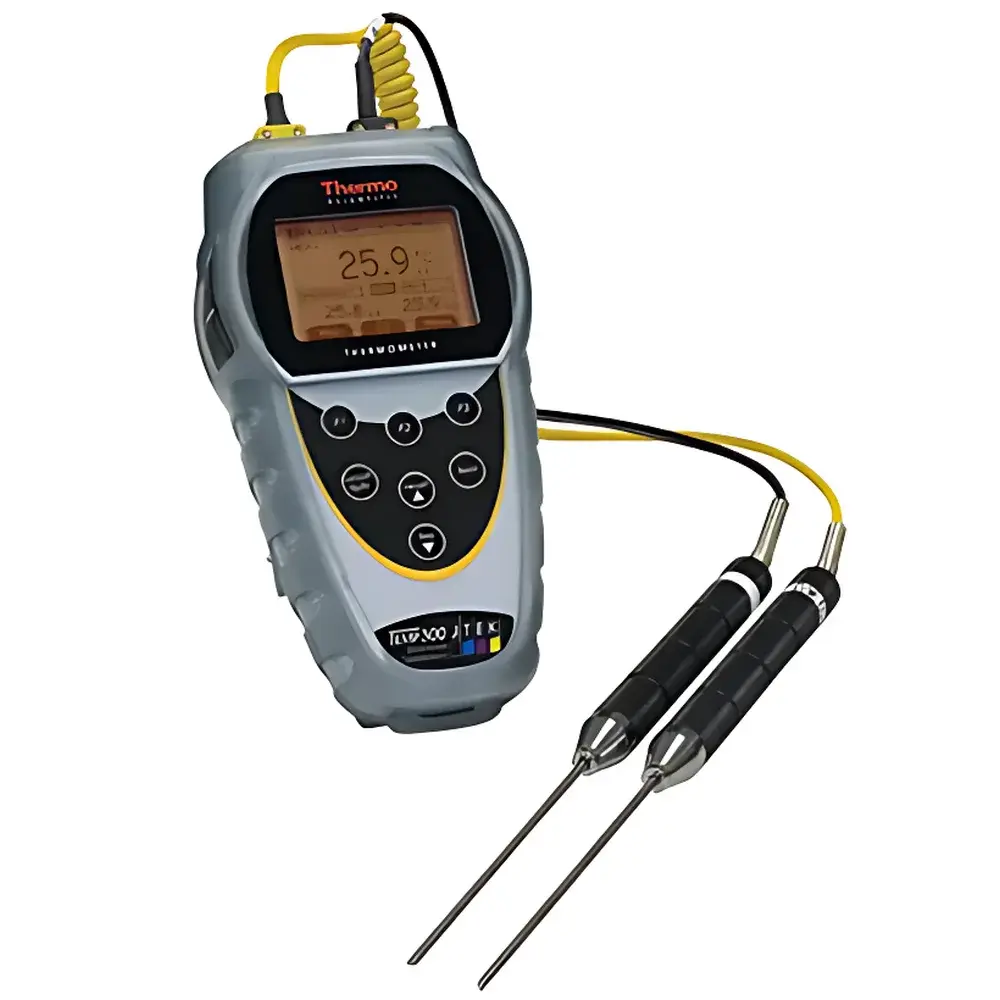
Thermo Fisher Temp 300 Dual-Channel Thermocouple Temperature Meter
| Brand | Thermo Fisher |
|---|---|
| Origin | Singapore |
| Manufacturer | Thermo Fisher Scientific |
| Product Type | Imported |
| Model | Temp 300 |
| Pricing | Upon Request |
| Thermocouple Types Supported | J, K, T, E, R, S, N, B |
| Temperature Range (Type K) | −250 °C to +1372 °C |
| Resolution | 0.1 °C/°F (−199.9 to 999.9 °C/°F) |
| Accuracy (J/K/T/E/N) | ±0.25 % of reading + 1 °C (above −150 °C) |
| Accuracy (R/S/B) | ±0.1 % of reading + 1 °C |
| Data Storage Capacity | 2,000 readings |
| Logging Interval | 1 s – 60 min |
| Display | 58 × 40 mm backlit LCD |
| Power | 3 × AA 1.5 V alkaline batteries (>750 h battery life, backlight off) |
| Dimensions (without case) | 175 × 97 × 42 mm |
| Weight (without case) | 267 g |
| Enclosure Rating (with probe connected) | IP54 |
| Compliance | CE (EN 61326-1/A1:1998), EMC Directive 2014/30/EU |
Overview
The Thermo Fisher Temp 300 Dual-Channel Thermocouple Temperature Meter is a precision-engineered, field-deployable instrument designed for high-reliability temperature monitoring across industrial, laboratory, and quality control environments. Built upon standardized thermoelectric measurement principles—where voltage generated at the junction of two dissimilar metals (e.g., chromel–alumel in Type K) is converted to temperature using NIST-traceable polynomial calibration—the Temp 300 delivers traceable, repeatable measurements across eight internationally recognized thermocouple types (J, K, T, E, R, S, N, B). Its dual-channel architecture enables simultaneous, independent acquisition from two probes—critical for differential temperature analysis, thermal gradient mapping, or process validation where relative delta-T stability must be quantified with sub-degree resolution. The instrument’s core architecture prioritizes metrological integrity: auto-ranging analog-to-digital conversion with cold-junction compensation (CJC) performed via integrated platinum RTD sensors ensures accuracy compliance with ASTM E230 and IEC 60584 standards across its full operational range.
Key Features
- Dual-channel input with independent scaling, zero offset, and unit selection (°C/°F) per channel
- Auto-ranging resolution switching: 0.1 °C/°F within −199.9 °C to 999.9 °C; 1 °C/°F outside this span
- On-device calibration verification via ice-point reference (0 °C) using dedicated CAL key—supports user-initiated zero-point adjustment per channel
- Backlit 58 × 40 mm LCD with multi-line display showing real-time channel values, ΔT difference, Min/Max tracking, and status icons (e.g., stability indicator, low-battery, memory full)
- Ruggedized housing: ABS polymer body with overmolded rubber boot (IP54 rated when probe connectors are mated), integrated kickstand, and three mounting options—benchtop, magnetic surface attachment, or lanyard suspension
- Configurable auto-power-off (17.5 min default) and manual data hold function with visual lock indicator
Sample Compatibility & Compliance
The Temp 300 interfaces exclusively with industry-standard miniature, standard, and transition-junction thermocouples meeting IEC 60584-1 dimensional and EMF specifications. It supports both grounded and ungrounded probe configurations without signal degradation, provided probe insulation resistance exceeds 100 MΩ at 500 VDC (per IEC 60359). All measurement uncertainties are stated per ISO/IEC 17025:2017 Annex A3 guidelines and align with the manufacturer’s declared metrological performance under controlled ambient conditions (23 °C ± 5 °C, RH < 75 %, non-condensing). The device carries CE marking per EN 61326-1:2013 (EMC) and EN 61010-1:2010 (safety), confirming suitability for use in Class I, Division 2 hazardous locations when operated with intrinsically safe probes. It meets the essential requirements of the EU Measuring Instruments Directive (MID) Annex MI-001 for non-automatic weighing instruments where temperature serves as a supporting parameter in regulated processes.
Software & Data Management
Data export is enabled via USB 2.0 interface (USB-B port) compliant with CDC ACM class protocol, requiring no proprietary drivers on Windows, macOS, or Linux systems. Raw time-stamped readings—including channel ID, timestamp (YYYY-MM-DD HH:MM:SS), temperature value, unit, and status flags—are streamed in CSV format at user-defined intervals (1 s to 60 min). Firmware v2.1+ supports GLP-compliant audit trail generation: each logging session records operator ID (user-configurable), start/stop timestamps, calibration event log (date, reference temp, deviation), and memory overwrite history. Data files are digitally signed using SHA-256 hash for integrity verification—meeting FDA 21 CFR Part 11 requirements for electronic records when deployed with validated host software (e.g., Thermo Fisher TraceFinder™ or third-party LIMS integrations).
Applications
- Process validation in pharmaceutical manufacturing (e.g., autoclave cycle monitoring per USP , lyophilizer shelf temperature profiling)
- Thermal mapping of ovens, furnaces, and environmental chambers per ISO 17025 clause 5.8.2
- Food safety compliance: HACCP critical control point verification (e.g., cooking, chilling, holding temperatures per FDA Food Code 2022)
- Automotive component testing: exhaust manifold, catalytic converter, and battery thermal management system characterization
- Chemical reactor exotherm monitoring and batch release temperature documentation
- Calibration lab support: secondary standard transfer between dry-block calibrators and reference thermometers
FAQ
Does the Temp 300 support thermocouple wire extension with compensating cable?
Yes—provided the extension cable matches the thermocouple type (e.g., Type K extension wire for Type K probes) and complies with ASTM E230 Table 2 tolerances. Cold-junction compensation remains valid only if the instrument’s terminal block temperature is stable and measured accurately.
Can the device store Min/Max values per channel independently?
Yes—each channel maintains separate Min/Max registers updated continuously during active measurement. Values persist across power cycles until manually reset.
Is firmware upgrade capability available in the field?
Yes—via USB connection using Thermo Fisher’s authenticated firmware update utility (v3.0+), which enforces digital signature verification prior to installation.
What is the maximum allowable lead resistance for accurate measurement?
For optimal accuracy, total loop resistance (probe + extension wire) should not exceed 100 Ω per channel. Higher resistances may induce gain error exceeding ±0.5 °C at extremes of the K-type range.
Does the Temp 300 meet GMP documentation requirements for audit trails?
When used with validated host software and configured per Thermo Fisher’s GxP Implementation Guide (Doc #TF-TEMP300-GXP-2024), it satisfies ALCOA+ principles for attributable, legible, contemporaneous, original, and accurate electronic records.