
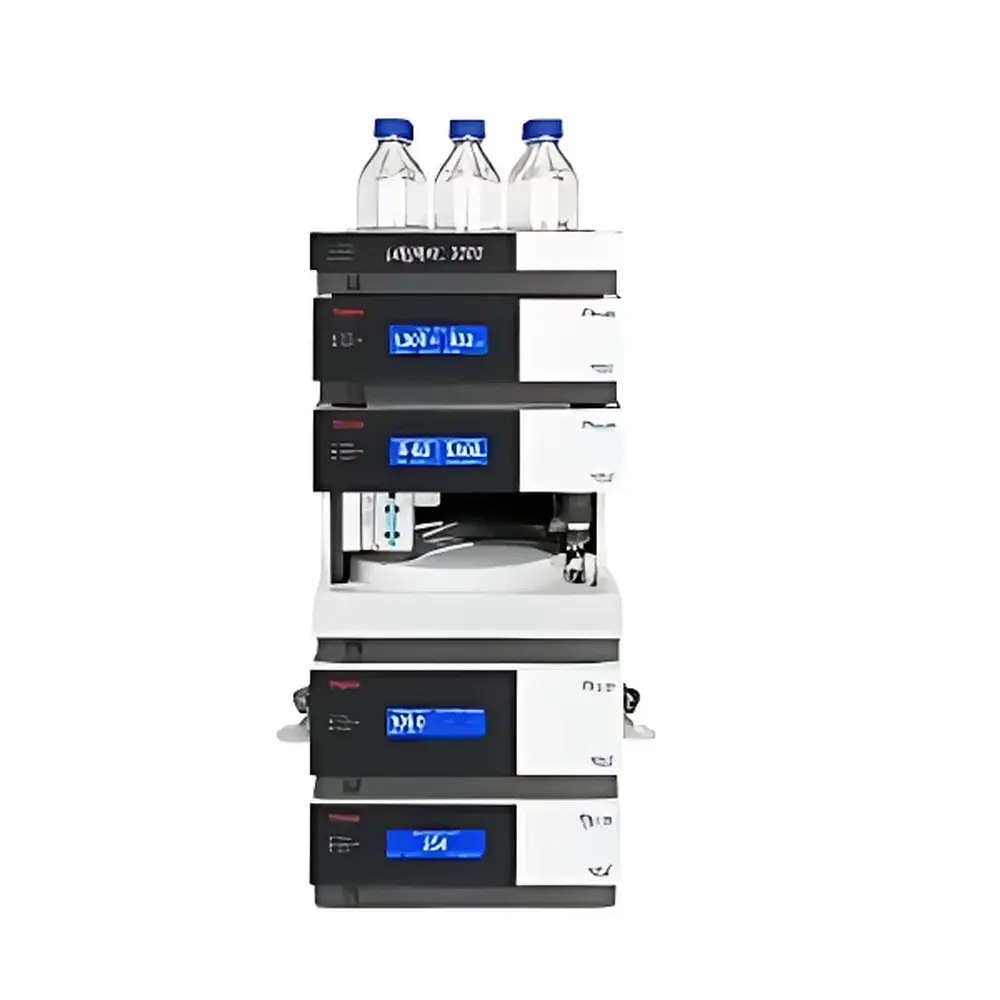
Thermo Fisher UltiMate 3000 Ti BioRS High-Performance Liquid Chromatograph
| Brand | Thermo Fisher |
|---|---|
| Origin | USA |
| Model | UltiMate 3000 Ti (BioRS) |
| Instrument Type | Ultra-High Performance Liquid Chromatograph (UHPLC) |
| Maximum Pressure | 100 MPa (15000 psi) |
| Flow Rate Range | Up to 8 mL/min |
| Column Oven Temperature Range | 5–110 °C |
| Gradient Delay Volume | Adjustable via SpinFlow™ Technology |
| Detection Compatibility | UV-Vis (DAD, MWD, VWD), Fluorescence, CAD, RID, MS |
| Sample Introduction | Low-Residue Autosampler with Ceramic Needle and Fixed Loop |
| Fluidic Path | Non-stainless-steel (PEEK, Titanium, Sapphire) |
| Software Platform | Chromeleon CDS v6.x / v7.x |
| Compliance | FDA 21 CFR Part 11, GLP/GMP-ready audit trail, IQ/OQ/PQ support |
Overview
The Thermo Fisher UltiMate 3000 Ti BioRS is an ultra-high-performance liquid chromatograph engineered for demanding biomolecular separations and high-throughput analytical workflows. Built upon a titanium- and PEEK-based fluidic architecture, it eliminates metal-mediated adsorption and degradation of sensitive analytes—particularly critical for monoclonal antibodies (mAbs), antibody-drug conjugates (ADCs), glycoproteins, oligonucleotides, and large-format biopolymers. Its core operational principle relies on high-pressure gradient elution coupled with precision flow control (via Dionex SmartFlow™) and thermally stabilized separation environments. Unlike conventional HPLC systems, the BioRS variant delivers UHPLC-grade resolution and speed while maintaining compatibility with wide-bore and high-load columns used in process development and QC release testing. It supports method transfer across scales—from analytical to preparative—and integrates natively with mass spectrometry platforms for orthogonal detection and structural confirmation.
Key Features
- Titanium- and bio-inert PEEK fluidic path minimizes metal leaching and surface interactions, ensuring integrity of acidic, basic, and chelating mobile phases (e.g., TFA, EDTA, ammonium acetate buffers)
- Dionex SmartFlow™ technology enables sub-microliter flow accuracy (<0.1% RSD) and long-term retention time stability—even under variable backpressure conditions up to 100 MPa
- SpinFlow™ gradient mixing system allows real-time adjustment of delay volume (0.1–2.0 mL), optimizing peak shape and reproducibility for shallow gradients common in intact protein analysis
- Viper fingertip-tight fittings provide near-zero dead volume connections; validated for >10,000 injections without leakage or peak distortion
- Thermostatted autosampler (WPS-3000TBRS) maintains sample integrity at 4–40 °C with <0.01% carryover between injections, even for viscous or sticky biologics
- Column compartment (TCC-3000RS) accommodates up to two column-switching valves and supports dual-column thermal equilibration from 5–110 °C (±0.1 °C stability)
- Integrated pH and conductivity monitoring (PCM-3000) enables precise control of ion-exchange and mixed-mode gradients—essential for charge variant profiling per ICH Q5E guidelines
Sample Compatibility & Compliance
The UltiMate 3000 Ti BioRS is routinely deployed in regulated environments supporting biopharmaceutical development, manufacturing, and quality control. Its hardware and software stack comply with international regulatory expectations: all instrument modules—including pumps, detectors, autosamplers, and column ovens—are qualified per ASTM E2500 and ISO/IEC 17025. Chromeleon CDS v7.2 provides full 21 CFR Part 11 compliance, including electronic signatures, role-based access control, immutable audit trails, and automated IQ/OQ/PQ documentation templates. The system supports GxP-aligned workflows for USP , EP 2.2.46, and ICH Q2(R2) method validation requirements. Mobile phase compatibility extends to corrosive solvents (e.g., HFIP for oligonucleotide analysis), high-pH mobile phases (up to pH 12), and volatile buffers required for LC-MS coupling.
Software & Data Management
Chromeleon Chromatography Data System (CDS) v6.x and v7.x serves as the unified control, acquisition, and reporting platform. Version 7.2 introduces eWorkflow automation—enabling sequence-driven method switching, conditional valve actuation, and dynamic detector parameter adjustment based on retention time windows. Raw data files are stored in vendor-neutral .cdf format, compatible with third-party processing tools (e.g., UNIFI, MassHunter, BioConfirm). Batch-level metadata tagging supports ALCOA+ principles: attributable, legible, contemporaneous, original, and accurate. Remote monitoring and control are enabled via secure HTTPS/TLS connections, with optional integration into enterprise LIMS and MES systems through RESTful APIs. All calibration logs, maintenance records, and user actions are timestamped and cryptographically signed within the audit trail database.
Applications
- Intact mass analysis and subunit mapping of mAbs using reversed-phase and SEC-UHPLC
- Charge variant profiling via cation-exchange chromatography (CEX) with pH gradient control
- Glycan release and labeling followed by HILIC-UHPLC separation (GlycanPac™ AXH-1 columns)
- Oligonucleotide purity assessment using DNAPac™-PA200RS columns under high-pH anion-exchange conditions
- Host cell protein (HCP) clearance monitoring via 2D-LC with heart-cutting interfaces
- Stability-indicating assays for biosimilars per ICH Q5C recommendations
- Process intermediate testing during purification campaigns (e.g., Protein A eluate analysis)
FAQ
Is the UltiMate 3000 Ti BioRS compatible with mass spectrometry interfaces?
Yes—it features standard ESI and APCI source synchronization signals, low-diffusion capillary routing, and seamless method export to Thermo Scientific™ Orbitrap™ and TSQ™ series instruments via Chromeleon MS Link.
Can this system perform both analytical and preparative-scale separations?
While primarily optimized for analytical and micro-preparative workloads (up to 4.6 mm ID columns), optional high-flow modules (e.g., HPG-3400RS pump) and fraction collection (AFC-3000) enable direct scale-up to 10 mm ID columns with minimal re-optimization.
Does the system support method transfer from legacy HPLC platforms?
Yes—Chromeleon includes automated method translation utilities that adjust gradient times, flow rates, and injection volumes based on column dimensions and particle size, preserving selectivity and resolution across platforms.
What validation documentation is provided out-of-the-box?
Factory-installed IQ/OQ protocols compliant with ASTM E2500-13 and EU Annex 11 are included, along with instrument-specific performance verification reports (e.g., pressure accuracy, gradient composition error, temperature uniformity).
How is system suitability monitored during routine operation?
Chromeleon’s System Suitability Test (SST) module executes pre-run checks—including retention time window validation, peak symmetry assessment, and signal-to-noise ratio calculation—against user-defined acceptance criteria, generating PDF-certified reports automatically.
Related Products





