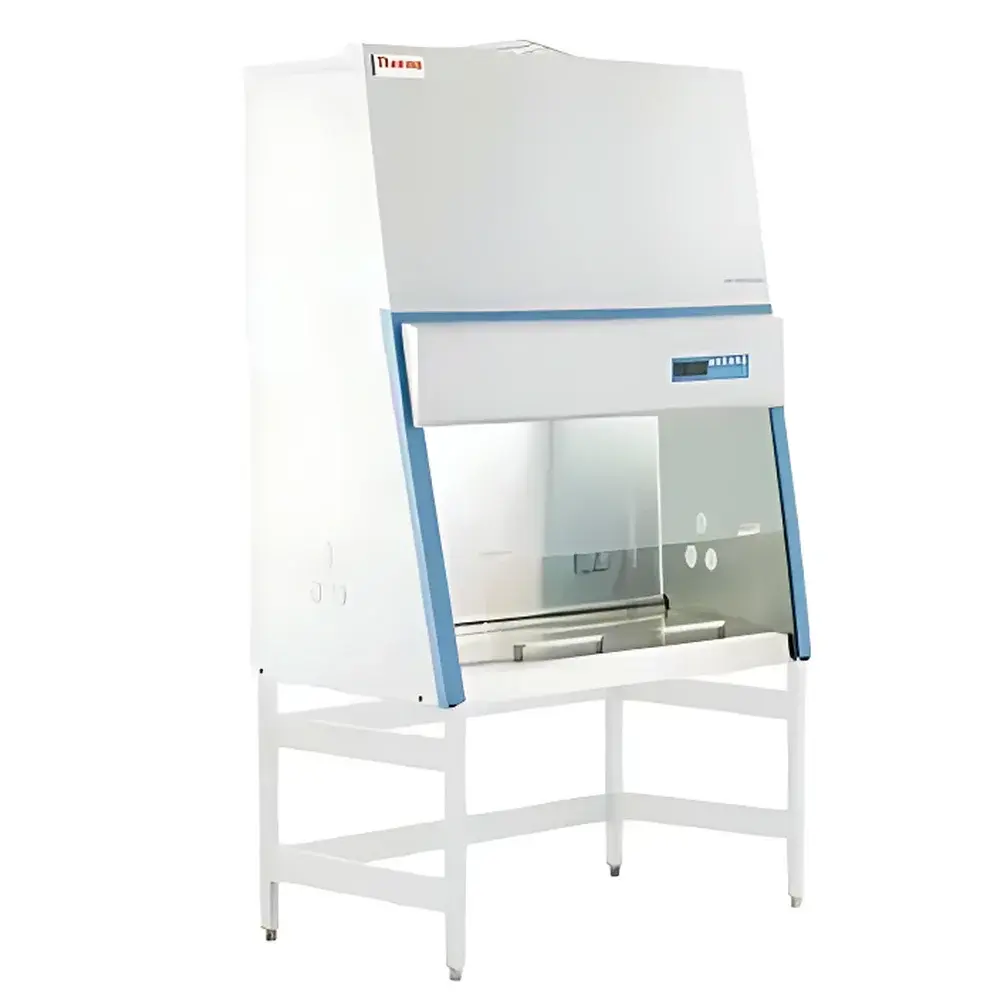
Thermo Scientific 1300 Series Class II Type A2 Biological Safety Cabinet
| Brand | Thermo Fisher Scientific |
|---|---|
| Origin | USA (assembled in China under strict quality control) |
| Cabinet Class | Class II, Type A2 |
| Compliance | YY 0569-2005 (China NMPA-regulated Class III medical device), NSF/ANSI 49-2022 compliant |
| Airflow System | Dual independent DC motor-driven blowers with SmartFlow™ real-time air velocity balancing |
| Inflow Velocity | ≥0.5 m/s (adjustable and auto-compensated) |
| Downflow Velocity | ≥0.25 m/s (HEPA-filtered) |
| Filtration | Dual HEPA filters (≥99.99% @ 0.3 µm) — supply and exhaust |
| Noise Level | ≤65 dB(A) |
| Power Requirement | 230 V AC, 50/60 Hz |
| Energy Mode | Night-Save mode reduces power consumption by >75% while maintaining ISO Class 5 (Class 100) work area integrity |
| UV Lamp Option | Timer-controlled (30 min – 24 h), germicidal UVC (254 nm) |
| Construction | Monolithic 304 stainless steel interior or modular anti-glare coated interior |
| Sash Opening Options | 3", 4", 5", or 6" vertical sash height |
| Certification | NMPA registered as Class III medical device |
Overview
The Thermo Scientific™ 1300 Series Class II Type A2 Biological Safety Cabinet is an engineered solution for laboratories requiring simultaneous protection of personnel, product, and environment during microbiological, molecular, or cell culture workflows. Designed in accordance with international biosafety standards—including NSF/ANSI 49-2022 and China’s stringent YY 0569-2005—the cabinet operates on the principle of laminar, HEPA-filtered downflow combined with balanced inward inflow and partially recirculated airflow. Its dual-fan architecture ensures dynamic compensation for filter loading, maintaining consistent inflow (≥0.5 m/s) and downflow (≥0.25 m/s) velocities throughout the service life of the primary and exhaust HEPA filters. As a Class III medical device regulated by China’s National Medical Products Administration (NMPA), each unit undergoes full functional validation, airflow mapping, and containment integrity testing prior to release—aligning with GLP-compliant documentation requirements and supporting audit readiness for GMP, CLIA, and ISO 15189 environments.
Key Features
- SmartFlow™ Real-Time Air Velocity Balancing: Patented dual DC-motor blower system continuously monitors and adjusts inflow and downflow velocities to maintain nominal setpoints within ±5% tolerance—even as filter resistance increases over time.
- Digital Airflow Verification (DAVe): Integrated sensor array provides continuous, real-time display of both inflow and downflow velocities on the front control panel; audible and visual alarms trigger if deviation exceeds ±20% of nominal values.
- SmartClean™ Sash Design: Optimized sash geometry minimizes turbulence at the work surface entry plane, reducing cross-contamination risk and enhancing operator safety during glove transitions.
- Energy-Efficient Night-Save Mode: Reduces blower speed and power draw by >75% while preserving ISO Class 5 (Class 100) air cleanliness in the work area—ideal for overnight incubation or low-activity periods.
- Modular Interior Configurations: Choice of monolithic 304 stainless steel chamber (welded seams, no crevices) or segmented anti-glare coated panels—both designed for easy decontamination and long-term corrosion resistance.
- UV Sterilization Integration: Optional UVC lamp (254 nm) with programmable timer (30 min–24 h); interlocked with sash position and blower status to prevent accidental exposure.
Sample Compatibility & Compliance
The 1300 Series A2 cabinet supports a broad range of biological materials—including BSL-1, BSL-2, and select BSL-2+ agents—as defined by the WHO Laboratory Biosafety Manual and CDC/NIH Biosafety in Microbiological and Biomedical Laboratories (BMBL). It is validated for use with volatile chemicals at concentrations ≤5% v/v of total airflow volume (e.g., ethanol, isopropanol), provided secondary containment and proper exhaust ducting are implemented. All units assembled in China comply with YY 0569-2005 Annex E (containment verification), Annex F (airflow velocity uniformity), and Annex G (HEPA filter integrity testing). Documentation includes full test reports traceable to Thermo Fisher’s global calibration standards and meets FDA 21 CFR Part 11 requirements for electronic records when paired with optional data-logging software.
Software & Data Management
The cabinet features an embedded microprocessor-based controller with non-volatile memory storing up to 12 months of operational logs—including daily airflow readings, alarm events, UV cycle history, and sash position timestamps. Optional Thermo Connect™ integration enables remote monitoring via Ethernet or Wi-Fi, exporting CSV-formatted logs compatible with LIMS and QMS platforms. Audit trails support GLP/GMP compliance, including user authentication (password-protected access levels), change tracking, and electronic signature capability per 21 CFR Part 11 Subpart B. Firmware updates are delivered through secure, digitally signed packages verified against Thermo Fisher’s public key infrastructure.
Applications
This cabinet is routinely deployed in academic research labs, clinical diagnostics centers, pharmaceutical QC/QA suites, and biomanufacturing cleanrooms for tasks such as: aseptic cell passage and transfection; preparation of sterile reagents and media; handling of genetically modified organisms (GMOs); mycological and virological culture work; and compounding of non-hazardous parenterals. Its A2 classification makes it suitable for applications involving small volumes of low-to-moderate toxicity volatile compounds when connected to dedicated exhaust systems meeting local building codes (e.g., ASHRAE 110 tracer gas containment verification).
FAQ
What regulatory certifications does the 1300 Series A2 cabinet hold in China?
It is registered with China’s NMPA as a Class III medical device under YY 0569-2005 and bears full certification documentation—including third-party test reports for containment, airflow uniformity, and filter integrity.
Can this cabinet be used with hazardous chemicals?
It is approved for limited use with low-volatility, low-toxicity substances (≤5% v/v), but requires connection to an external exhaust system and adherence to local chemical safety regulations; it is not rated for toxic or highly volatile solvents without supplemental engineering controls.
How often must the HEPA filters be replaced?
Filter replacement intervals depend on usage intensity and ambient particulate load; typical service life ranges from 18 to 36 months, with DAVe system alerts indicating performance degradation prior to critical failure.
Is the Night-Save mode compliant with ISO 14644-1 Class 5 requirements?
Yes—validation data confirms sustained particle counts <3,520/m³ (0.5 µm) in the work area during Night-Save operation, meeting ISO 14644-1:2015 Class 5 (formerly Class 100) specifications.
Does the cabinet support integration into a centralized lab monitoring network?
Yes—via Thermo Connect™ (optional), enabling SNMP-based status polling, alarm forwarding to IT infrastructure, and synchronization with enterprise asset management systems.