
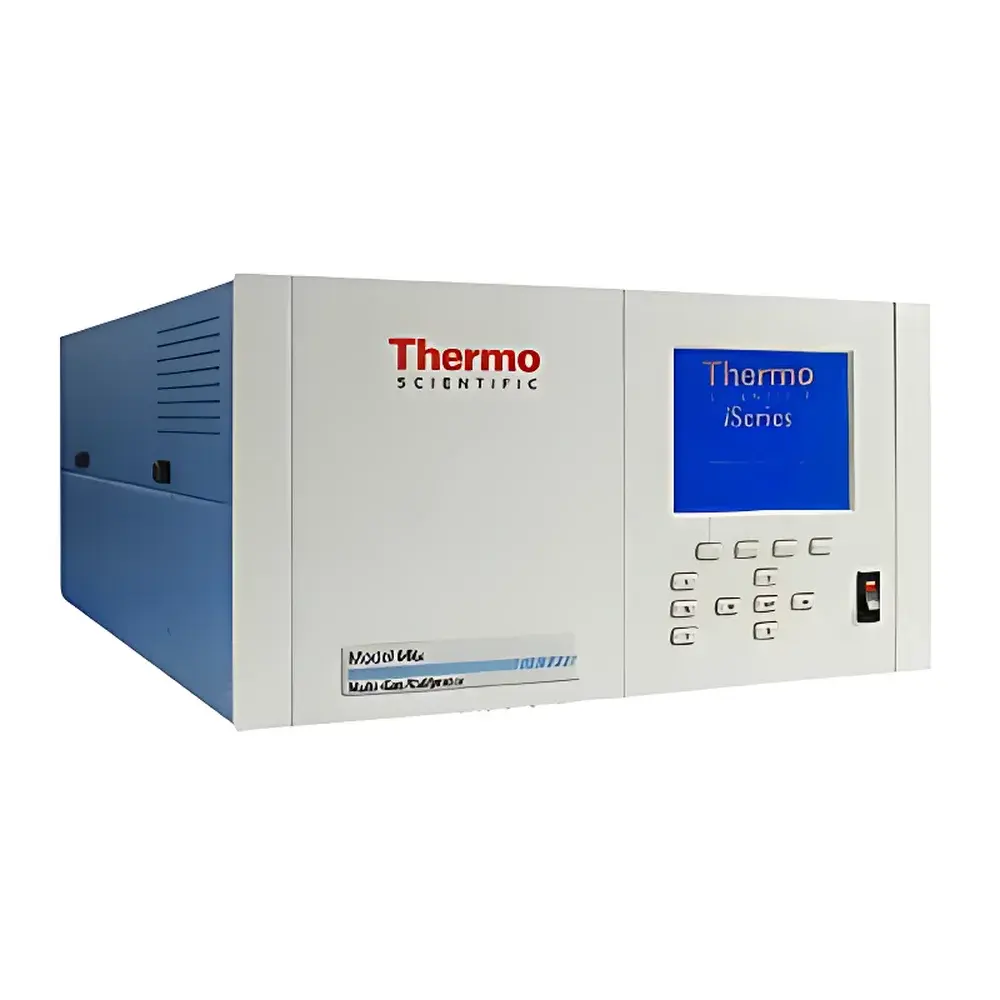
Thermo Scientific 146i Multi-Gas Calibration Analyzer
| Brand | Thermo Fisher |
|---|---|
| Origin | USA |
| Manufacturer Type | Original Equipment Manufacturer (OEM) |
| Import Status | Imported |
| Model | Thermo Scientific 146i |
| Instrument Type | Online Calibration System |
| Calibrant Gases | SO₂, NO₂, H₂S, NH₃, O₃, NO |
| Response Time | <60 s |
| Flow Accuracy | ±2% of reading or ±1% of full scale (whichever is lower, at 20–100% FS) |
| Flow Linearity | ±0.5% of full scale |
| Flow Repeatability | ±2% of reading or ±1% of full scale (whichever is lower, at 20–100% FS) |
| Zero Air Flow Options | 5, 10 (standard), or 20 SLPM |
| Span Gas Flow Options | 50, 100 (standard), or 200 SCCM |
| Permeation Oven Temperature Control | 30, 35, or 45 °C ±0.1 °C |
| Ozone Generator Output | 1 ppm @ 6 SLPM (meets or exceeds U.S. EPA stability and reproducibility requirements) |
Overview
The Thermo Scientific 146i Multi-Gas Calibration Analyzer is an online, microprocessor-controlled calibration standard generator engineered for high-accuracy, traceable gas concentration delivery in ambient air quality monitoring networks. It operates on the principle of dynamic dilution—precisely metering certified span gases or thermally controlled permeation sources into a purified zero-air stream via mass flow controllers (MFCs), enabling continuous, programmable generation of reference gas mixtures across multiple analyte species. Designed to meet stringent regulatory requirements for calibration traceability—including U.S. EPA Reference Method 205 and EU EN 14625—the 146i serves as a primary calibration source for continuous emission monitoring systems (CEMS), ambient air analyzers (e.g., chemiluminescence NOx, UV fluorescence SO2, pulsed fluorescence O3), and portable gas detection instruments. Its architecture supports both fixed-site network integration and mobile calibration deployment, with all critical functions accessible via Ethernet-connected remote operation.
Key Features
- Integrated dual-path mass flow control system with independent MFCs for zero air (5–20 SLPM) and span gas (50–200 SCCM), each calibrated per ISO/IEC 17025-accredited procedures
- Thermally stabilized permeation ovens (30/35/45 °C ±0.1 °C) for SO2, NO2, H2S, and NH3 generation, ensuring long-term stability and low drift (<0.5% per 30 days)
- Dedicated ozone photolysis source producing 1 ppm O3 at 6 SLPM with <±1.5% output variability over 24 hours—validated against NIST-traceable UV absorption standards
- Gaseous titration module for NO2 synthesis via NO + O3 reaction, enabling precise, interference-free NO2 calibration without cylinder dependency
- Flash-memory-based data logger storing >12 months of audit-ready calibration logs, including timestamps, setpoints, actual flows, oven temperatures, and system diagnostics
- Modular internal layout with tool-less access to MFCs, permeation tubes, ozone lamp, and scrubber cartridges—reducing mean time to repair (MTTR) to under 20 minutes
Sample Compatibility & Compliance
The 146i is compatible with all major ambient air monitoring analyzers compliant with U.S. EPA 40 CFR Part 58, EU Directive 2008/50/EC, and ISO 12039. It supports calibration of instruments measuring SO2 (0–100 ppb to 0–10 ppm), NO/NO2/NOx (0–100 ppb to 0–20 ppm), O3 (0–100 ppb to 0–1 ppm), H2S (0–10 ppb to 0–1 ppm), and NH3 (0–10 ppb to 0–5 ppm). All flow measurements are traceable to NIST SRM 2197a; permeation rates are certified per ASTM D6167. The unit meets IEC 61326-1 (EMC) and UL 61010-1 safety requirements. Firmware supports GLP/GMP-compliant audit trails and 21 CFR Part 11–enabled electronic signatures when integrated with Thermo’s TraceFinder or third-party LIMS platforms.
Software & Data Management
The 146i runs embedded Linux-based firmware with a web-accessible interface (HTTPS/TLS 1.2), supporting remote configuration, real-time status monitoring, and automated calibration sequence scheduling. Data export formats include CSV, XML, and PDF reports compliant with ISO/IEC 17025 clause 7.8.2. Calibration event logs include operator ID, instrument serial number, gas lot numbers, environmental conditions (T/P), and uncertainty budgets calculated per GUM (JCGM 100:2008). Optional integration with Thermo’s Centralized Calibration Management System (CCMS) enables centralized validation documentation, version-controlled method storage, and automatic certificate generation aligned with ISO/IEC 17025 Clause 7.7.
Applications
- Primary calibration of regulatory-grade ambient air analyzers at national reference laboratories and regional monitoring stations
- Field verification and bump testing of CEMS in power plants, refineries, and waste incinerators per EN 15267 and EPA PS-18
- Multi-gas intercomparison studies coordinated by WMO-GAW or EMEP
- Validation of low-cost sensor networks requiring traceable reference exposure concentrations
- Method development and uncertainty analysis for new gas-phase measurement techniques (e.g., cavity ring-down spectroscopy, photoacoustic detection)
FAQ
What calibration gases can the 146i generate without external cylinders?
The 146i generates SO2, NO2, H2S, NH3, and O3 using certified permeation tubes and a photolytic ozone source—eliminating reliance on compressed gas standards.
Does the 146i support automated multi-point calibration sequences?
Yes—up to 99 programmable calibration points per gas, with variable dwell times, ramp rates, and auto-zero/span cycles, fully scriptable via HTTP POST or Modbus TCP.
How is traceability maintained for permeation-based calibrants?
Each permeation tube carries a NIST-traceable certificate with gravimetrically determined emission rate, temperature coefficient, and expiration date; the 146i applies real-time temperature compensation per ASTM D6167 Annex A1.
Can the 146i be integrated into an existing SCADA or EMS platform?
Yes—it provides native Modbus TCP, BACnet/IP, and OPC UA server functionality, with configurable polling intervals and alarm thresholds for flow deviation, temperature excursion, or lamp failure.
What maintenance intervals are recommended for routine operation?
Zero-air scrubbers: every 6 months; ozone lamp: 12,000 hours; permeation tubes: per manufacturer shelf-life (typically 12–24 months); MFC recalibration: annually per ISO/IEC 17025.







