
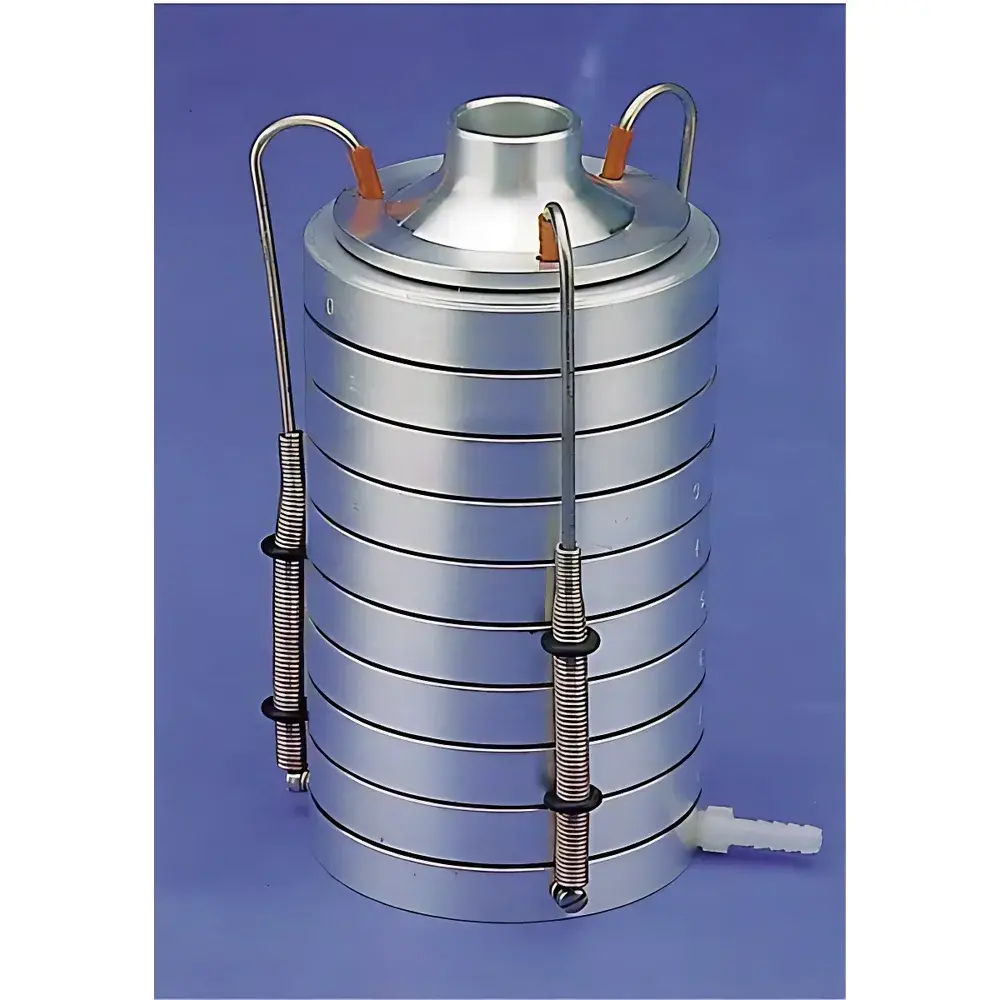
Thermo Scientific 20-810 Eight-Stage Andersen Impactor
| Brand | Thermo Fisher |
|---|---|
| Origin | USA |
| Manufacturer | Thermo Fisher Scientific |
| Product Type | Imported |
| Model | 20-810 |
| Typical Configuration | Integrated Sampling System |
| Flow Rate | 28.3 L/min (1 CFM, calibrated) |
| Staged Aerodynamic Cut-Points (at 28.3 L/min) | 9.0, 5.8, 4.7, 3.3, 2.1, 1.1, 0.7, 0.4 µm |
| Sampler Height | 21.6 cm |
| Sampler Diameter | 9.5 cm |
| Sampler Weight | 1.6 kg |
| Pump Dimensions | 24.1 × 14.0 × 11.4 cm |
| Pump Weight | 3.9 kg |
| Sampling Media Compatibility | Glass slides, stainless steel plates, membrane filters (e.g., PVC, PTFE, polycarbonate) |
| Compliance | Designed for ASTM D1424, ISO 14644-1, USP <788>, and EPA Compendium Method TO-13A applications |
Overview
The Thermo Scientific 20-810 Eight-Stage Andersen Impactor is a precision-engineered inertial impactor designed for size-resolved collection of airborne particulate matter based on aerodynamic diameter. Operating on the principle of inertial impaction, the device subjects an aerosol-laden air stream to successive acceleration through precisely sized orifices in eight stacked stainless-steel stages. At each stage, particles exceeding the stage-specific aerodynamic cut-point—determined by flow rate, orifice geometry, and particle density—possess sufficient inertia to deviate from the streamlined airflow and impact onto a solid or porous collection surface. Particles below the cut-point remain entrained and proceed to the next stage. This cascade enables quantitative physical separation across eight discrete aerodynamic size fractions (9.0 to 0.4 µm), facilitating gravimetric analysis, elemental composition profiling (e.g., via SEM-EDS or ICP-MS), and microbiological enumeration (e.g., viable fungal spores or bacteria). The instrument is calibrated at a standard volumetric flow rate of 28.3 L/min (1 CFM), ensuring reproducibility in compliance with internationally recognized aerosol measurement protocols.
Key Features
- Eight-stage stainless-steel impactor assembly with CNC-machined orifices, optimized for high collection efficiency and minimal particle bounce or wall loss
- Modular design allows rapid disassembly, cleaning, and sterilization—critical for bioaerosol studies under GLP or ISO 17025 environments
- Compatible with multiple substrate types: glass microscope slides, stainless-steel collection plates, and standard 37-mm or 47-mm membrane filters (PVC, PTFE, mixed cellulose ester)
- Integrated calibration port and certified flowmeter interface support traceable flow verification per ISO 5167 and ASTM D1424 Annex A
- Robust aluminum housing and vibration-damped base minimize mechanical perturbation during extended sampling campaigns
- Designed for seamless integration with Thermo Scientific portable vacuum pumps (e.g., Model 20-810P) delivering stable 28.3 L/min under variable backpressure conditions
Sample Compatibility & Compliance
The 20-810 supports both dry and humidified aerosol sampling without condensation-induced artifact formation. Its inert stainless-steel construction resists corrosion from acidic or saline aerosols, making it suitable for industrial hygiene, cleanroom monitoring (ISO 14644-1 Class 3–8), and pharmaceutical environmental control (EU GMP Annex 1, USP ). Each stage’s cut-point uncertainty remains within ±5% of nominal values when operated at 28.3 ± 0.2 L/min, satisfying data integrity requirements for regulatory submissions. The system is routinely validated for use in EPA Compendium Method TO-13A (for PM10/PM2.5 source apportionment) and ASTM D1424 (for textile fiber aerosol characterization). Full audit trails—including flow calibration logs, operator IDs, and substrate lot numbers—can be maintained in accordance with FDA 21 CFR Part 11 when paired with compliant LIMS or ELN platforms.
Software & Data Management
While the 20-810 operates as a standalone hardware platform, its output integrates into structured analytical workflows via digital documentation protocols. Users record stage-specific mass loading (via microbalance), particle counts (via optical microscopy or automated image analysis), or elemental signatures (via XRF or ICP-OES) into standardized templates aligned with ISO/IEC 17025 reporting frameworks. Thermo Fisher’s TraceFinder™ and Chromeleon™ CDS software support metadata tagging (e.g., location, duration, RH/T, pump serial number) and automated generation of size distribution histograms (dM/dlogDae) and mass median aerodynamic diameter (MMAD) calculations. All raw data files retain native timestamping and are exportable in .csv, .xlsx, or .cdf formats for third-party statistical analysis (e.g., R, Python pandas).
Applications
- Occupational health assessment of respirable crystalline silica (RCS) and metal fumes in foundries and mining operations
- Pharmaceutical manufacturing: monitoring viable and non-viable particle shedding during aseptic processing (Grade A–D environments)
- Atmospheric science: source apportionment of urban PM using multi-elemental fingerprinting across size fractions
- Biodefense research: recovery efficiency validation of Bacillus anthracis simulants across aerodynamic ranges
- Filter testing: challenge aerosol generation and fractional collection efficiency mapping for HEPA and ULPA media
- Material science: characterization of nanoparticle agglomerate dispersion stability under controlled shear conditions
FAQ
What is the recommended calibration frequency for the 20-810 impactor?
Calibration of the volumetric flow rate must be performed prior to each sampling campaign using a NIST-traceable primary standard (e.g., bubble meter or electronic calibrator), in accordance with ISO 5167-1 and ASTM D1424 Section 7.3.
Can the 20-810 be used for viable bioaerosol collection?
Yes—when paired with nutrient agar-coated glass slides or sterile membrane filters, the impactor achieves >90% recovery of culturable Aspergillus niger spores at 28.3 L/min, as verified per ISO 14698-1 Annex B.
Is the cut-point data valid for particles with densities other than unit density?
Cut-points are specified for unit-density spheres; correction factors per ISO 29463-3 must be applied for particles of known effective density (e.g., soot agglomerates, salt crystals) to derive true aerodynamic diameter.
How is particle bounce mitigated in this design?
Each stage incorporates a viscous silicone oil coating option (optional) and low-velocity impaction surfaces engineered to reduce rebound—validated via monodisperse PSL aerosol testing at 50% RH.
Does Thermo Fisher provide certified reference materials for performance verification?
Yes—NIST SRM 1648a (Urban Particulate Matter) and SRM 2783 (Air Particulate Matter on Filter Media) are recommended for gravimetric and elemental QA/QC across all eight stages.
Related Products







