
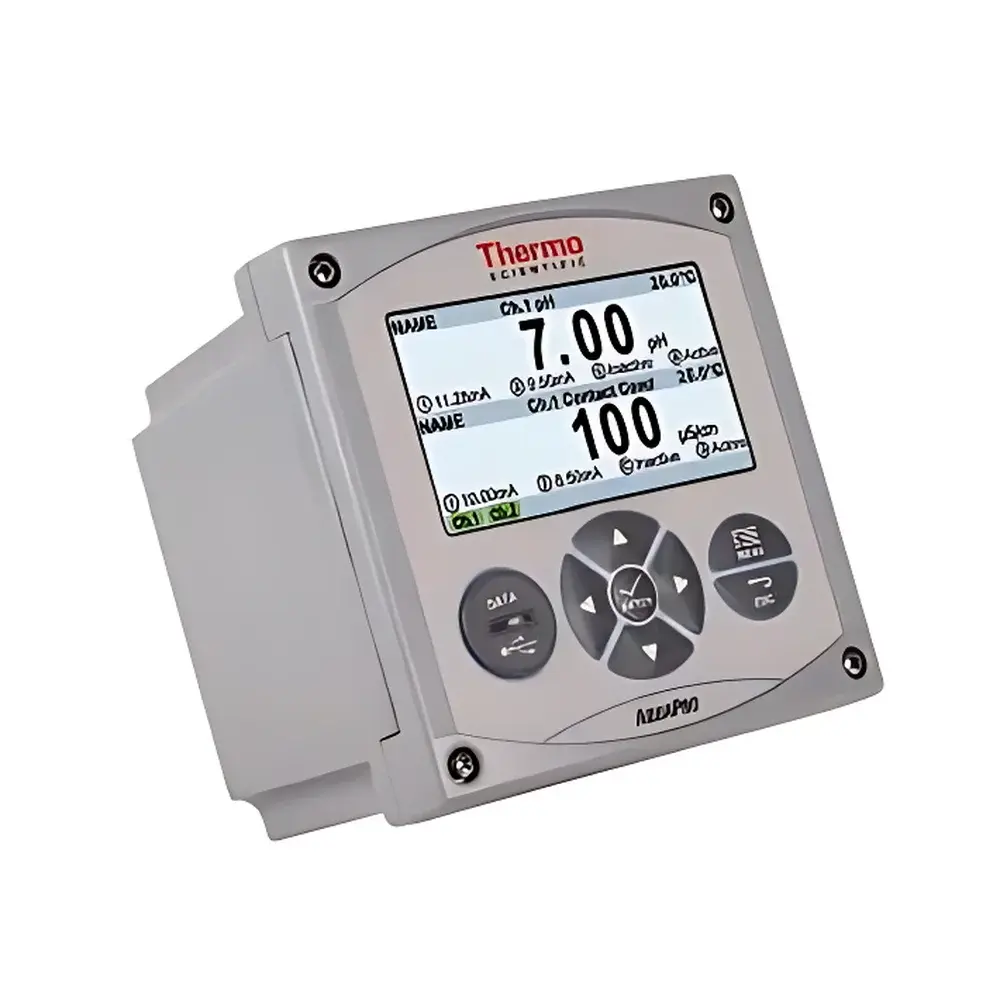
Thermo Scientific 2103PH Computational pH Analyzer
| Brand | Thermo Fisher |
|---|---|
| Origin | USA |
| Manufacturer | Thermo Fisher Scientific |
| Product Category | Imported Instrument |
| Model | Thermo Scientific 2103PH |
| Pricing | Upon Request |
Overview
The Thermo Scientific 2103PH Computational pH Analyzer is a high-precision, non-glass-electrode-based online pH measurement system engineered for continuous, stable monitoring of ultrapure water (UPW) and low-conductivity ammonia-containing streams in power generation, semiconductor manufacturing, and pharmaceutical water systems. Unlike conventional potentiometric pH sensors, the 2103PH employs a computational algorithm that derives pH from simultaneous, real-time measurements of specific conductivity (κ), cation conductivity (κc), and temperature—eliminating reliance on fragile glass membranes, reference junctions, or electrolyte fill solutions. This approach inherently avoids common sources of drift, poisoning, and calibration instability associated with traditional pH electrodes in AVT (All Volatile Treatment) and OT (Oxygenated Treatment) boiler feedwater environments. The instrument achieves an analytical uncertainty of < ±0.01 pH units under AVT conditions, with long-term stability validated per ASTM D5117 and IAPWS TR-10-03 guidelines for ultrapure water characterization.
Key Features
- Electrode-free pH computation: No glass membrane, no liquid junction, no KCl filling solution—enabling zero consumables and eliminating electrode replacement cycles.
- Integrated multi-parameter sensing: Simultaneous acquisition of pH (computed), specific conductivity, cation conductivity, and temperature using calibrated, temperature-stabilized conductivity cells.
- Intelligent temperature compensation: User-selectable temperature compensation curves—including IAPWS-95, ASTM D1125, and custom polynomial profiles—to ensure traceable accuracy across 5–95 °C operating range.
- Modular multi-channel architecture: Base unit supports up to three independent measurement channels; optional expansion for dissolved oxygen (DO), acid/base concentration, or turbidity via standardized analog/digital I/O interfaces.
- Ruggedized enclosure: NEMA 4X / IP66-rated housing with stainless steel mounting panel, suitable for outdoor or high-humidity industrial environments.
- Firmware-upgradable via USB: Field updates supported without external PC or proprietary software—ensuring compliance with evolving regulatory firmware validation requirements.
Sample Compatibility & Compliance
The 2103PH is specifically validated for low-conductivity aqueous matrices (0.05–1.0 µS/cm) containing volatile treatment agents (e.g., NH3, morpholine, ethanolamine). It meets design and performance criteria referenced in EP 2.2.43, USP , and ASTM D4582 for conductivity-based pH estimation in purified water systems. All internal wetted components—including cation exchange columns, flow cells, and temperature sensors—are constructed from high-purity PFA, quartz, and 316L stainless steel to prevent leaching and ensure material compatibility with Class I–III water per ISO 3696 and ASTM D1193. The system supports audit-ready data integrity per FDA 21 CFR Part 11 when integrated with compliant SCADA or LIMS platforms.
Software & Data Management
The embedded firmware provides local data logging of up to 1,000 timestamped measurement sets (pH, κ, κc, T), stored with millisecond-resolution timestamps and channel-specific metadata. Logged data are exportable via USB mass-storage mode in CSV format, compatible with Excel, LabVIEW, and statistical process control (SPC) software. Optional Modbus RTU/TCP and HART 7 communication protocols enable seamless integration into distributed control systems (DCS) and enterprise asset management (EAM) platforms. The user interface supports dual-language operation (English/Chinese) with configurable password-protected access levels (Operator, Technician, Administrator) aligned with GLP/GMP operational controls.
Applications
- Real-time pH monitoring of condensate, feedwater, and steam cycle samples in fossil and nuclear power plants operating under AVT(R), AVT(O), or OT chemistry regimes.
- In-line quality assurance of ultrapure water used in wafer cleaning, photolithography, and wet etching processes in semiconductor fabs.
- Continuous verification of purified water (PW) and water for injection (WFI) distribution loops in biopharmaceutical manufacturing facilities.
- Performance validation of cation exchange columns and degasifiers in high-purity water treatment trains.
- Regulatory-compliant trending and deviation reporting for ISO 9001, ISO 13485, and Annex 1 environmental monitoring programs.
FAQ
Does the 2103PH require calibration like conventional pH meters?
No—it performs computational pH derivation from conductivity inputs, which are calibrated annually per ASTM D1125 using NIST-traceable KCl standards. No daily pH buffer calibration is required.
Can it be installed in hazardous areas?
The base unit is rated for non-hazardous locations only (NEMA 4X/IP66); intrinsic safety barriers or purge systems must be implemented for Class I Div 1/Zone 1 installations.
Is cation conductivity measurement mandatory for pH computation?
Yes—the algorithm requires concurrent specific and cation conductivity readings to resolve ammonium ion contribution; omission invalidates the computed pH value.
How is temperature measurement performed?
A Pt1000 RTD sensor is integrated into the flow cell assembly, thermally coupled to the sample stream with <0.1 °C repeatability and certified traceability to ITS-90.
What is the minimum sample flow rate for stable operation?
100–300 mL/min at 1–3 bar pressure; lower flows may induce thermal lag or air entrapment errors in low-conductivity applications.







