
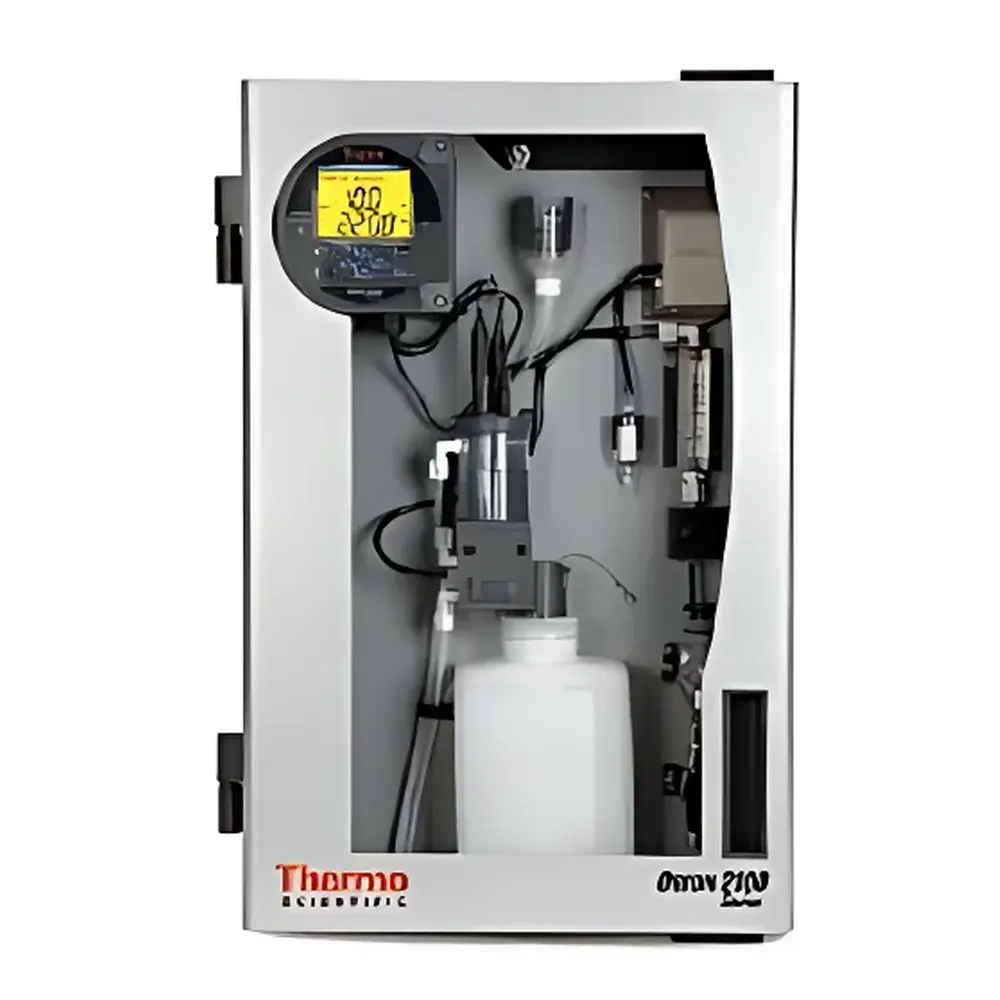
Thermo Scientific 2109XP Fluoride Analyzer
| Brand | Thermo Fisher |
|---|---|
| Origin | USA |
| Manufacturer | Thermo Fisher Scientific |
| Product Type | Imported |
| Model | Thermo Scientific 2109XP |
| Pricing | Upon Request |
Overview
The Thermo Scientific 2109XP Fluoride Analyzer is a dedicated, industrial-grade online analyzer engineered for continuous, real-time measurement of fluoride ion (F⁻) concentration in potable water, municipal drinking water distribution systems, bottled water production lines, food and beverage process streams, and agricultural irrigation sources. It operates on the principle of potentiometric detection using a solid-state, highly selective fluoride ion-selective electrode (ISE), coupled with integrated pH compensation and automatic sample conditioning. Unlike colorimetric or spectrophotometric methods, the 2109XP delivers stable, interference-resistant measurements without reagents, consumables, or optical components—making it ideal for unattended, long-term deployment in remote or space-constrained monitoring stations. Its design adheres to fundamental electrochemical measurement standards and supports compliance-driven operational workflows in regulated water supply environments.
Key Features
- Potentiometric fluoride detection with a proven solid-state ISE offering a detection limit of 10 ppb (0.01 mg/L) across a dynamic range of 0.01–10 mg/L F⁻
- Integrated, programmable acid dosing system for precise in-line pH adjustment (target pH 5.0–5.5), ensuring optimal electrode response and minimizing hydroxide and aluminum interference
- DKA (Double Known Addition) calibration protocol—enabling rapid, two-point standard addition calibration without manual dilution or offline preparation
- Backlit graphical LCD display with intuitive menu navigation, supporting multilingual interface options and real-time visualization of measured F⁻, temperature, pH (if configured), and diagnostic status
- No moving parts, peristaltic pumps, or reagent delivery systems—eliminating scheduled maintenance intervals associated with fluidic actuators and reducing total cost of ownership
- Fast stabilization time (< 90 seconds to ±0.02 mg/L repeatability) following sample introduction, enabling high-frequency sampling (up to 6 measurements/hour)
- Modular architecture supporting optional dual-channel configuration: primary F⁻ channel + secondary pH or conductivity channel via field-installable sensor module
- Digital communication expansion via optional RS-485/Modbus RTU or Ethernet/IP modules for integration into SCADA, DCS, or centralized water quality data management platforms
Sample Compatibility & Compliance
The 2109XP is validated for use with low-turbidity, non-oily aqueous samples typical of finished drinking water, spring water, reverse osmosis permeate, and treated surface water. It meets the functional requirements of EPA Method 300.0 (Ion Chromatography) and ASTM D4192-22 (Standard Guide for On-Line Monitoring of Water Quality) for continuous fluoride surveillance. While not a certified primary method instrument, its performance characteristics—including linearity (R² > 0.999), inter-laboratory reproducibility (< 3% RSD), and drift stability (< 0.05 mg/L/week)—support routine compliance verification under ISO/IEC 17025-accredited QA/QC programs. The analyzer’s firmware includes audit-trail logging (user actions, calibration events, fault codes) aligned with GLP and 21 CFR Part 11 data integrity expectations when paired with compliant data acquisition software.
Software & Data Management
Local operation is managed through an embedded microcontroller with non-volatile memory storing up to 30 days of 15-minute interval data (F⁻, temp, pH, status flags). All configuration parameters—including calibration history, alarm thresholds (high/low, rate-of-change), and maintenance reminders—are accessible via front-panel navigation or remote serial command set (ASCII-based). Optional Thermo Scientific Orion Link™ software enables secure PC-based configuration, historical trend review, PDF report generation (including calibration certificates), and export to CSV or MODBUS-compatible databases. Data timestamps are synchronized via NTP when Ethernet module is installed, ensuring traceability in multi-site deployments.
Applications
- Real-time fluoride dosing control at municipal water treatment plants to maintain regulatory compliance with WHO (1.5 mg/L) and US EPA MCL (4.0 mg/L) limits
- Quality assurance in bottled water bottling lines—verifying post-treatment fluoride residuals before filling
- Monitoring fluoride accumulation in recirculating cooling towers or irrigation reservoirs where fluoridated groundwater is used
- Process validation in dairy and beverage facilities where fluoride content impacts product stability or regulatory labeling
- Early-warning detection in groundwater-supplied rural utilities experiencing geogenic fluoride contamination
FAQ
What sample pretreatment is required prior to analysis?
No filtration or chemical pretreatment is needed for clear, low-suspended-solids water. A 50-µm inlet strainer is recommended to protect the flow cell. Turbid or particulate-laden samples require upstream clarification (e.g., cartridge filter or settling tank).
Can the 2109XP be used for wastewater effluent monitoring?
It is not recommended for raw or partially treated wastewater due to high levels of suspended solids, organics, and competing anions (e.g., sulfate, phosphate) that impair ISE selectivity and fouling resistance.
Is third-party certification available for regulatory reporting?
The 2109XP itself is not EPA-certified as a primary method instrument; however, its measurement output may be used for operational control and trend analysis within a validated laboratory QA framework per ISO 17025 or state primacy program guidelines.
How often does the fluoride electrode require replacement?
Under typical drinking water conditions, the solid-state electrode exhibits a service life of 12–18 months. Electrode health is continuously assessed via impedance diagnostics and slope monitoring during calibration.
Does the analyzer support automatic temperature compensation?
Yes—integrated Pt1000 RTD provides real-time temperature measurement, and Nernstian slope correction is applied automatically across 5–40 °C.
Related Products







