
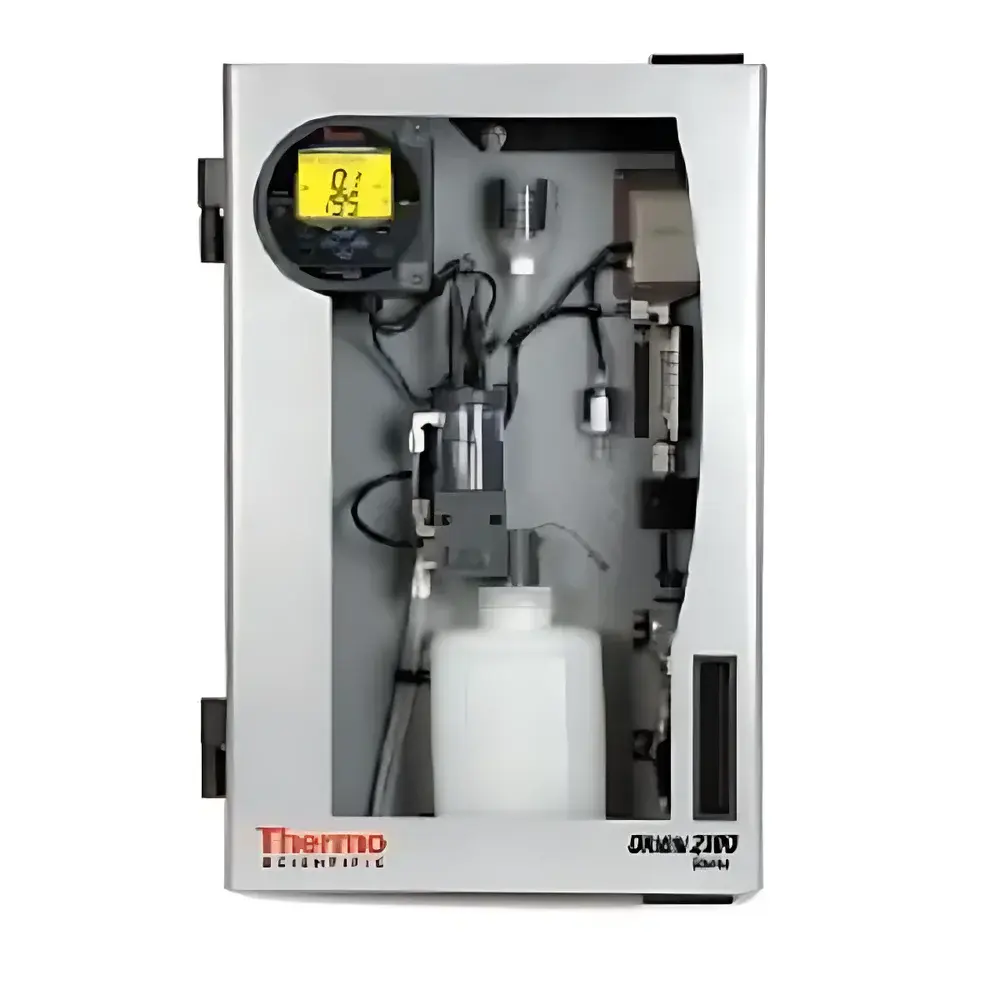
Thermo Scientific 2117HL High-Level Chloride Analyzer
| Brand | Thermo Fisher Scientific |
|---|---|
| Origin | USA |
| Model | 2117HL |
| Measurement Range | 75–1000 ppm Cl⁻ |
| Principle | Potentiometric measurement using solid-state chloride-selective electrode |
| Reagent-Free Operation | Yes |
| Display | Backlit LCD with graphical interface |
| Calibration Method | DKA (Dual-Point Known Addition) |
| Response Time (t₉₀) | < 2 minutes |
| Maintenance Requirements | No pumps, no reagents, no moving parts |
| Compliance | Designed for continuous industrial process monitoring in accordance with ASTM D4192, ISO 9297, and EPA Method 325B (adapted for on-line chloride detection) |
Overview
The Thermo Scientific 2117HL High-Level Chloride Analyzer is a robust, reagent-free online analyzer engineered for continuous, real-time measurement of chloride ion concentration in industrial water streams at elevated levels (75–1000 ppm Cl⁻). It employs a potentiometric detection principle based on a high-stability, solid-state chloride-selective electrode—eliminating reliance on liquid-filled reference systems or membrane-based sensors prone to drift and fouling. Unlike colorimetric or titrimetric analyzers, the 2117HL delivers direct, electrochemical quantification of free chloride activity under varying ionic strength conditions, making it particularly suited for applications where sample matrix complexity, temperature fluctuation, or suspended solids challenge conventional methods. Its design targets uninterrupted operation in demanding environments—including power plant blowdown loops, semiconductor ultrapure water (UPW) recirculation lines, food & beverage rinse water circuits, and pulp & paper mill process waters—where chloride-induced corrosion, scaling, or product contamination must be proactively managed.
Key Features
- Reagent-free operation: No chemical dosing, no waste generation, and no consumable reagents—reducing total cost of ownership and eliminating calibration drift caused by reagent degradation.
- Solid-state chloride-selective electrode: Engineered for long-term stability (>12 months typical service life), minimal sensitivity to pH shifts (pH 4–10), and resistance to sulfide, bromide, and cyanide interference within specified ranges.
- DKA (Dual-Point Known Addition) calibration protocol: Enables rapid, traceable calibration without standard solutions of precisely known concentration—only two incremental spikes of certified KCl standard are required, minimizing operator dependency and procedural error.
- Backlit graphical LCD interface: Supports multilingual menus (English, Spanish, Chinese, Korean), real-time trend plots, and intuitive navigation through measurement, diagnostics, and calibration screens.
- No moving parts or peristaltic pumps: Eliminates mechanical failure modes, reduces scheduled maintenance to quarterly visual inspection and electrode cleaning, and ensures >99.5% operational uptime over 12-month intervals.
- Integrated temperature compensation: Built-in Pt1000 RTD sensor enables automatic correction across 5–45 °C, maintaining measurement accuracy within ±2% of reading across the full range.
Sample Compatibility & Compliance
The 2117HL is validated for use with low-turbidity (<5 NTU), non-oily, non-viscous aqueous streams containing total dissolved solids (TDS) up to 5,000 mg/L. It meets functional requirements for continuous emission monitoring system (CEMS)-adjacent applications per ISO 17025-accredited laboratories’ validation protocols and supports GLP/GMP-aligned data integrity practices when integrated with compatible SCADA or DCS platforms. While not a certified EPA drinking water method instrument, its performance aligns with ASTM D4192 (Standard Test Method for Chloride Ion in Water by Potentiometric Titration) and ISO 9297 (Water Quality — Determination of Chloride — Potentiometric Method) for process control purposes. Output signals (4–20 mA, Modbus RTU, and optional HART 7) are compatible with third-party historian systems compliant with FDA 21 CFR Part 11 for electronic record retention and audit trail generation.
Software & Data Management
The analyzer operates firmware version 3.2+ with embedded data logging (up to 30 days of 1-minute interval records), configurable alarm thresholds (high/low, rate-of-change), and event-triggered snapshot capture (e.g., upon calibration start, electrode impedance alert, or signal deviation >5%). All calibration events—including date/time stamp, operator ID (via optional RFID badge reader), DKA spike volumes, and post-calibration verification residuals—are stored with cryptographic hashing to prevent tampering. When connected to Thermo Scientific’s Orion Connect™ cloud platform (optional), raw and processed data are transmitted via TLS 1.2-encrypted MQTT, enabling remote configuration, predictive maintenance alerts (based on electrode impedance trending), and automated report generation aligned with internal QA/QC SOPs.
Applications
- Power generation: Monitoring chloride breakthrough in condensate polishers and feedwater systems to prevent stress corrosion cracking (SCC) in steam turbines and boiler tubes.
- Semiconductor manufacturing: Controlling chloride ingress in UPW distribution loops where concentrations >10 ppb risk wafer surface defects and etch uniformity loss.
- Food & beverage processing: Ensuring final rinse water chloride remains below 50 ppm to avoid residual taste impact and stainless-steel pitting in CIP systems.
- Pulp & paper mills: Tracking chloride accumulation in closed-loop white water systems to mitigate corrosion in stainless steel piping and heat exchangers.
- Agricultural irrigation: Detecting saline intrusion or fertilizer leachate in reclaimed water sources prior to field application.
FAQ
What sample flow rate is required for optimal 2117HL performance?
A minimum continuous flow of 100 mL/min at 15–30 psig is recommended; lower flows may be accommodated with optional flow cell modification.
Can the 2117HL measure seawater-level chloride (19,000 ppm)?
No—the 2117HL is optimized for the 75–1000 ppm range; higher concentrations require dilution or alternative instrumentation such as ISE-based multi-range analyzers.
Is electrode replacement a field-serviceable task?
Yes—electrode replacement requires no tools and takes <3 minutes; all calibration and diagnostic history persists in non-volatile memory after swap.
Does the analyzer support automatic temperature compensation for non-aqueous samples?
No—temperature compensation is validated only for aqueous matrices; organic solvents or glycol blends require manual correction or alternate sensing technology.
How often should DKA calibration be performed in stable process conditions?
Typical interval is weekly for critical applications; monthly is acceptable for well-characterized, low-fouling streams—validated by daily zero-check spikes.
Related Products







