
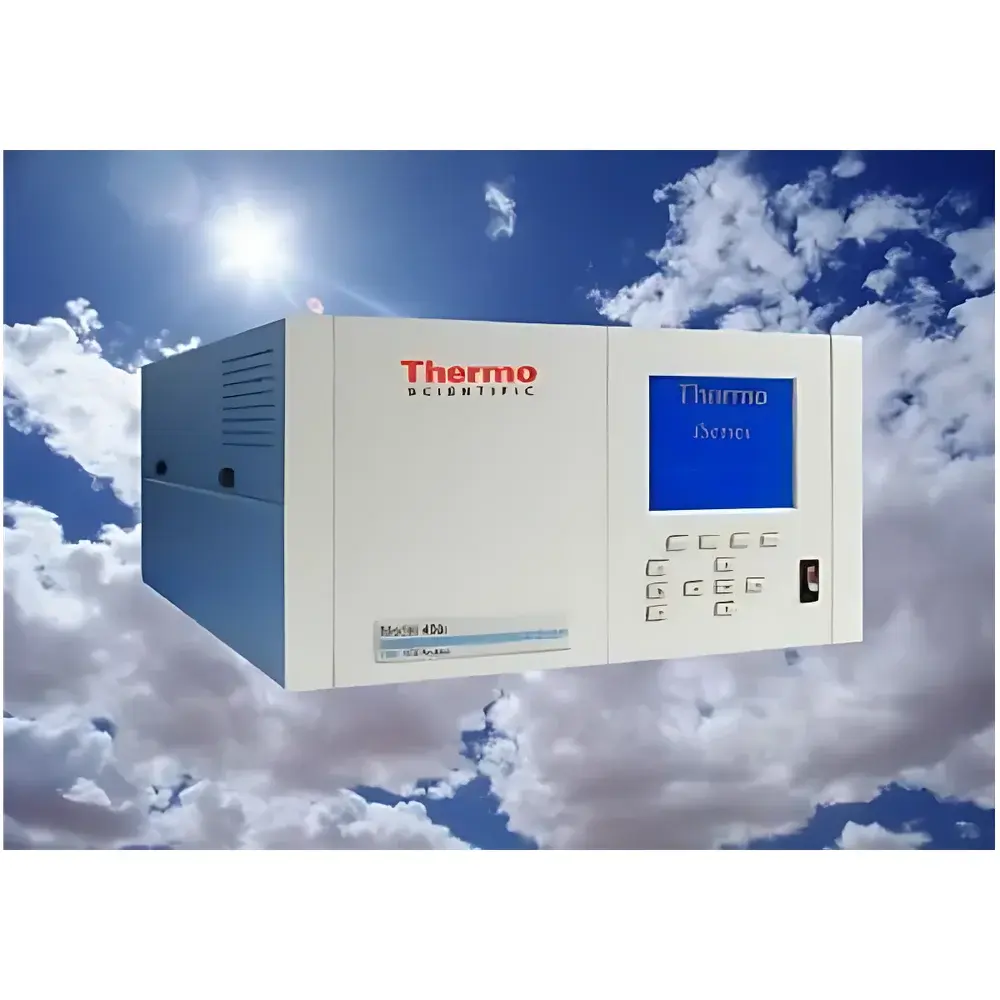
Thermo Scientific 450i H₂S and SO₂ Analyzer
| Brand | Thermo Fisher |
|---|---|
| Origin | USA |
| Model | 450i |
| Detection Principle | Pulsed UV Fluorescence (H₂S converted to SO₂ prior to measurement) |
| Measurement Range | 0–10 ppm / 0–25 mg/m³ (selectable spans) |
| Zero Noise | 1.0 ppb RMS (60-sec average) |
| Limit of Detection (LOD) | 2.0 ppb (60-sec average) |
| Zero Drift (24 h) | <1 ppb |
| Span Drift (30 days) | ±1% of full scale |
| Optical Filter Type | Reflective bandpass |
| Reaction Chamber | Temperature-stabilized |
| UV Source | Long-life, stable pulsed UV lamp |
| Data Storage | Onboard flash memory |
| Connectivity | Ethernet (remote data access, configuration, diagnostics) |
| Display | High-contrast graphical LCD showing primary measurement + five auxiliary parameters |
Overview
The Thermo Scientific™ 450i H₂S and SO₂ Analyzer is a high-precision, continuous ambient air monitoring instrument engineered for regulatory-grade measurement of hydrogen sulfide (H₂S) and sulfur dioxide (SO₂) in environmental and industrial settings. It employs pulsed ultraviolet (UV) fluorescence detection—a trace-level analytical technique standardized under EPA Method TO-15 and ASTM D5502—where H₂S is first catalytically oxidized to SO₂ in a high-temperature reaction chamber. The resulting SO₂ molecules are then excited by a pulsed UV light source at 214 nm; upon relaxation, they emit fluorescent photons at ~350 nm, which are isolated using a reflective bandpass optical filter and quantified by a low-noise photomultiplier tube (PMT). This dual-stage conversion and detection architecture ensures exceptional selectivity against common interferents (e.g., hydrocarbons, NOₓ, O₃), while the pulsed excitation enhances signal-to-noise ratio and extends UV lamp lifetime. Designed for unattended operation in Class I, Division 2 hazardous locations (optional), the 450i meets the performance requirements for U.S. EPA Federal Reference Method (FRM) equivalency and supports compliance with ISO 7935 (H₂S) and ISO 7934 (SO₂) standards.
Key Features
- Pulsed UV fluorescence detection with real-time H₂S-to-SO₂ catalytic conversion, enabling sub-ppb sensitivity and minimal cross-sensitivity
- Reflective bandpass optical filter assembly—reducing photochemical degradation of filter coatings and improving long-term spectral selectivity versus traditional transmissive filters
- Temperature-controlled reaction chamber (±0.1 °C stability) to ensure consistent oxidation efficiency across ambient temperature fluctuations
- High-stability, long-lifetime pulsed UV lamp with integrated intensity monitoring and automatic gain compensation
- Zero-point stability <1 ppb over 24 hours and span drift ≤±1% full-scale per month—validated per EPA Performance Specification 2 (PS-2) protocols
- Embedded 256 MB flash memory supporting >1 year of 1-minute averaged data (including diagnostics, calibration logs, and alarm events)
- Ethernet interface compliant with IPv4/IPv6, enabling secure remote access via HTTPS, SNMP v3, and Modbus TCP for integration into SCADA or central air quality management systems
- Configurable soft keys and customizable home screen—displaying primary concentration alongside five user-defined parameters (e.g., zero/span status, lamp energy, chamber temperature, flow rate, internal pressure)
Sample Compatibility & Compliance
The 450i is validated for continuous sampling of ambient air, stack effluent (with appropriate dilution and conditioning), and indoor workplace environments. Sample inlet accepts standard ¼-inch OD PTFE or stainless-steel tubing, with optional heated sample lines (up to 180 °C) to prevent H₂S adsorption on surfaces. All wetted materials—including the reaction furnace, quartz reactor tube, and PMT housing—are chemically inert and passivated to minimize memory effects. The analyzer complies with U.S. EPA Conditional Test Procedure (CTP) requirements for H₂S analyzers, fulfills EN 14625:2012 (ambient SO₂) and EN 15447:2007 (H₂S in waste gas), and supports audit-ready data integrity under FDA 21 CFR Part 11 when deployed with Thermo’s optional Traceable™ Software Suite (electronic signatures, change control, and immutable audit trails).
Software & Data Management
Instrument control, calibration scheduling, and diagnostic reporting are managed via the embedded web server interface—accessible from any modern browser without client installation. Raw analog outputs (0–10 VDC / 4–20 mA) and digital RS-232/RS-485 ports support legacy system integration. Data export formats include CSV, XML, and EPA-compliant .DAT files with embedded metadata (instrument ID, calibration certificate IDs, operator credentials). Firmware updates are delivered over-the-air via HTTPS with SHA-256 signature verification. Optional Thermo AirWatch™ cloud platform enables automated alerting (SMS/email) on out-of-spec conditions, trend visualization across multi-site deployments, and GLP/GMP-aligned electronic lab notebook (ELN) synchronization.
Applications
- Ambient air quality monitoring networks (AQN) for urban, industrial fence-line, and background stations
- Refinery, petrochemical, and wastewater treatment plant emissions compliance (e.g., NESHAP Subpart H, EU IED Directive)
- Landfill and biogas facility odor control and process optimization
- Occupational health and safety monitoring in pulp & paper mills, tanneries, and geothermal facilities
- Research applications requiring high-temporal-resolution H₂S kinetics or SO₂/H₂S ratio profiling in atmospheric chemistry studies
FAQ
How does the 450i differentiate between H₂S and SO₂ in mixed gas streams?
The 450i measures only SO₂ directly. For H₂S analysis, the sample stream passes through a dedicated catalytic converter (heated to 700 °C) that quantitatively oxidizes H₂S → SO₂. A second measurement channel—using the same optical path but with converter bypass—measures native SO₂. H₂S concentration is derived by difference, with stoichiometric correction applied in firmware.
Is field calibration required, and what standards are traceable?
Yes—daily zero checks and weekly span verification are recommended per EPA PS-2. Certified gas standards (NIST-traceable H₂S and SO₂ in nitrogen) are used; all calibrations are logged with timestamp, operator ID, and cylinder certification number.
Can the 450i operate in high-humidity environments?
Yes—integrated Nafion™ dryer and condensate trap maintain dew point <−10 °C at the reaction chamber inlet. Optional chilled mirror dew point monitor provides real-time humidity compensation.
What cybersecurity protocols are implemented?
The device supports TLS 1.2 encryption, role-based user authentication (admin/operator/viewer), disabled default accounts, and configurable firewall rules. It has undergone third-party penetration testing per IEC 62443-3-3 SL2.
Related Products







