
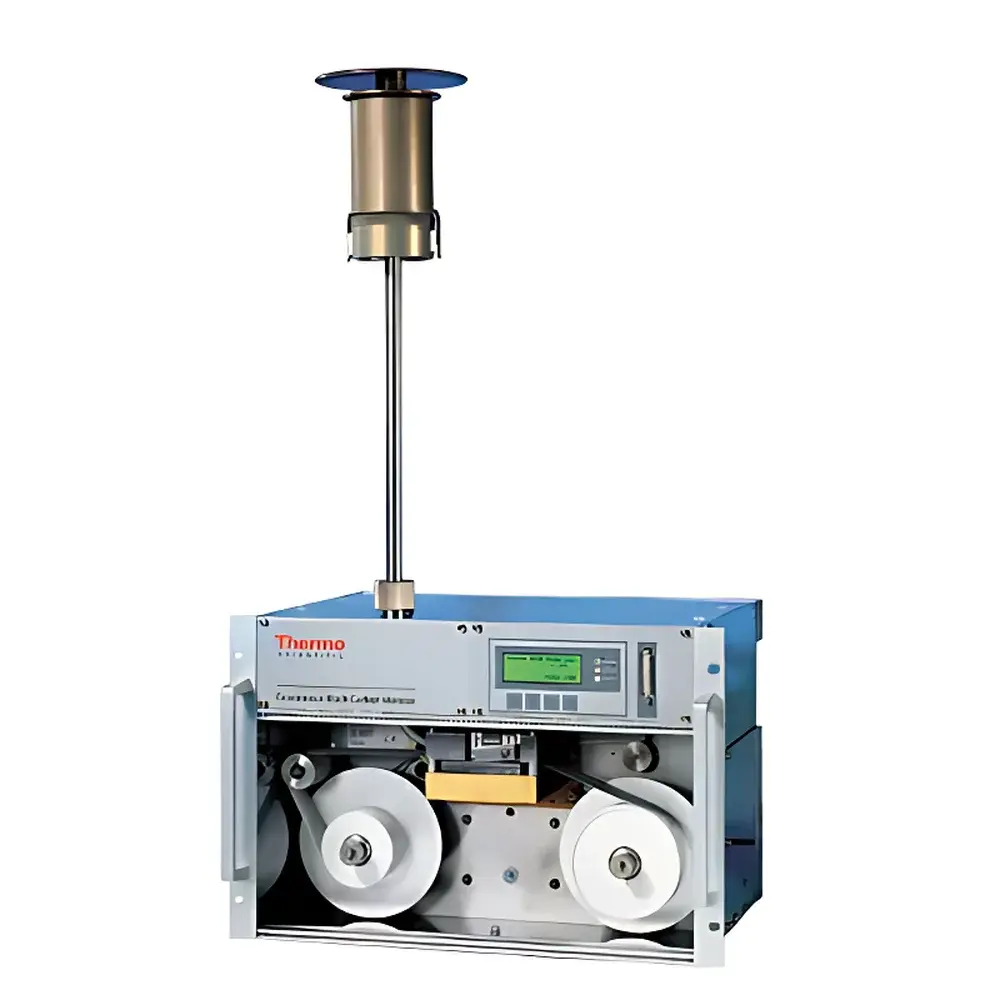
Thermo Scientific 5012 Multi-Angle Absorption Photometer (MAAP) Black Carbon Monitor
| Brand | Thermo Fisher |
|---|---|
| Origin | USA |
| Manufacturer Type | Original Equipment Manufacturer (OEM) |
| Product Origin | Imported |
| Model | Thermo Scientific 5012 MAAP |
| Measurement Principle | Multi-angle integrated light absorption photometry |
| Measured Parameter | Black Carbon (BC) mass concentration and aerosol absorption coefficient (Babs) |
| Measurement Range | 0–900 ng/m³ (2-min avg), 0–180 ng/m³ (10-min avg), 0–60 ng/m³ (30-min avg) |
| Detection Limit | <100 ng/m³ BC / <0.66 Mm⁻¹ Babs (2-min), <50 ng/m³ BC / <0.33 Mm⁻¹ Babs (10-min), <20 ng/m³ BC / <0.13 Mm⁻¹ Babs (30-min) |
| Sample Flow Rate | 1 m³/h (16.7 L/min) |
| Environmental Correction | Real-time humidity and pressure compensation |
| Compliance | Designed to support EPA, EEA, and GAW reference-equivalent black carbon monitoring protocols |
Overview
The Thermo Scientific 5012 Multi-Angle Absorption Photometer (MAAP) is a research-grade, continuous black carbon (BC) monitor engineered for long-term, unattended operation in ambient air quality networks, atmospheric research stations, and regulatory compliance monitoring sites. Unlike single-wavelength or filter-based optical attenuation instruments, the 5012 MAAP employs multi-angle integrated photometry — a physically robust method based on quantitative measurement of light absorption by deposited aerosol layers on a quartz fiber filter tape. By simultaneously detecting transmitted and reflected light across multiple angular configurations, the instrument corrects for scattering artifacts and filter-loading effects, enabling trace-level BC quantification with high reproducibility and minimal calibration drift. Its optical design follows the principles outlined in ISO/CD 12103-1 and aligns with the theoretical framework of the “mass absorption cross-section” (MAC) approach recommended by the World Meteorological Organization’s Global Atmosphere Watch (GAW) program.
Key Features
- Multi-angle absorption photometry with dual-detector architecture for simultaneous transmission and reflection signal acquisition
- Real-time environmental compensation: integrated temperature, relative humidity, and barometric pressure sensors enable automatic correction of optical path length and filter density effects
- Automated filter tape advancement with programmable sampling intervals (1–60 minutes) and built-in tape position tracking
- High-flow sampling system operating at 1 m³/h (16.7 L/min), optimized for low-pressure drop and stable laminar flow across the filter medium
- Onboard data logging with internal memory supporting >1 year of 1-minute resolution BC and Babs records
- Ruggedized enclosure rated IP54, suitable for outdoor deployment with optional climate-controlled shelters and inlet heating modules
Sample Compatibility & Compliance
The 5012 MAAP is validated for ambient PM2.5 aerosol matrices containing elemental carbon (EC), brown carbon (BrC), and mixed organic-inorganic particulate matter. It operates under standard reference conditions (25 °C, 101.325 kPa) and conforms to harmonized methodologies used by national air quality networks including the U.S. EPA Interagency Monitoring of Protected Visual Environments (IMPROVE) program and the European Environment Agency’s (EEA) Air Quality e-Reporting platform. While not a direct regulatory compliance device per se, its output is traceable to NIST-traceable BC reference materials and supports GLP-aligned data integrity requirements when paired with audit-ready software configurations compliant with 21 CFR Part 11 (electronic records and signatures).
Software & Data Management
Data acquisition and instrument control are managed via Thermo Scientific QL-View™ software, which provides remote configuration, real-time status monitoring, and automated report generation. Raw optical signals, corrected BC mass concentrations (ng/m³), and aerosol absorption coefficients (Mm⁻¹) are exported in ASCII or netCDF format compatible with atmospheric modeling frameworks such as WRF-Chem and CAMx. The system supports secure FTP/SFTP upload, Modbus TCP integration into SCADA environments, and optional cloud-based dashboard visualization through Thermo’s AirWatch™ telemetry service. All calibration events, maintenance logs, and environmental metadata are embedded within each data file to ensure full chain-of-custody documentation.
Applications
- Long-term trend analysis of black carbon in urban, rural, and remote background sites
- Source apportionment studies using BC/CO or BC/PM2.5 ratio diagnostics
- Validation of satellite-derived aerosol absorption products (e.g., from PACE, TROPOMI)
- Health impact assessment campaigns requiring high-temporal-resolution BC exposure metrics
- Field intercomparison exercises coordinated by ACTRIS, EUSAAR, or the Black Carbon Climate Initiative (BCCI)
- Indoor air quality assessments in transportation hubs, tunnels, and near-port industrial zones
FAQ
What is the fundamental difference between MAAP and Aethalometer technology?
The MAAP uses multi-angle integrated photometry to decouple absorption from scattering contributions, whereas Aethalometers rely on single-wavelength attenuation with empirical compensation algorithms. This gives the MAAP superior accuracy under high-humidity or mixed-aerosol conditions.
Does the 5012 require periodic calibration with BC reference standards?
Yes — initial factory calibration is performed using NIST-traceable graphite aerosol standards. Field recalibration is recommended annually or after major maintenance; Thermo provides certified BC reference filters and traceable calibration kits.
Can the instrument operate continuously without manual intervention?
Yes — with standard filter tape capacity (120 m), it supports up to 30 days of unattended operation at 5-minute averaging intervals. Optional extended-capacity tapes and automated tape loaders further extend autonomy.
Is the 5012 compatible with existing air monitoring station infrastructure?
It supports RS-232, RS-485, Ethernet, and analog 4–20 mA outputs, enabling seamless integration into legacy environmental monitoring networks and modern IoT architectures.
How does humidity affect measurement accuracy, and how is it mitigated?
Humidity-induced filter hygroscopic growth alters optical path length and scattering properties. The 5012 incorporates real-time RH and temperature measurements to apply empirically validated correction functions derived from laboratory chamber studies.
Related Products







