
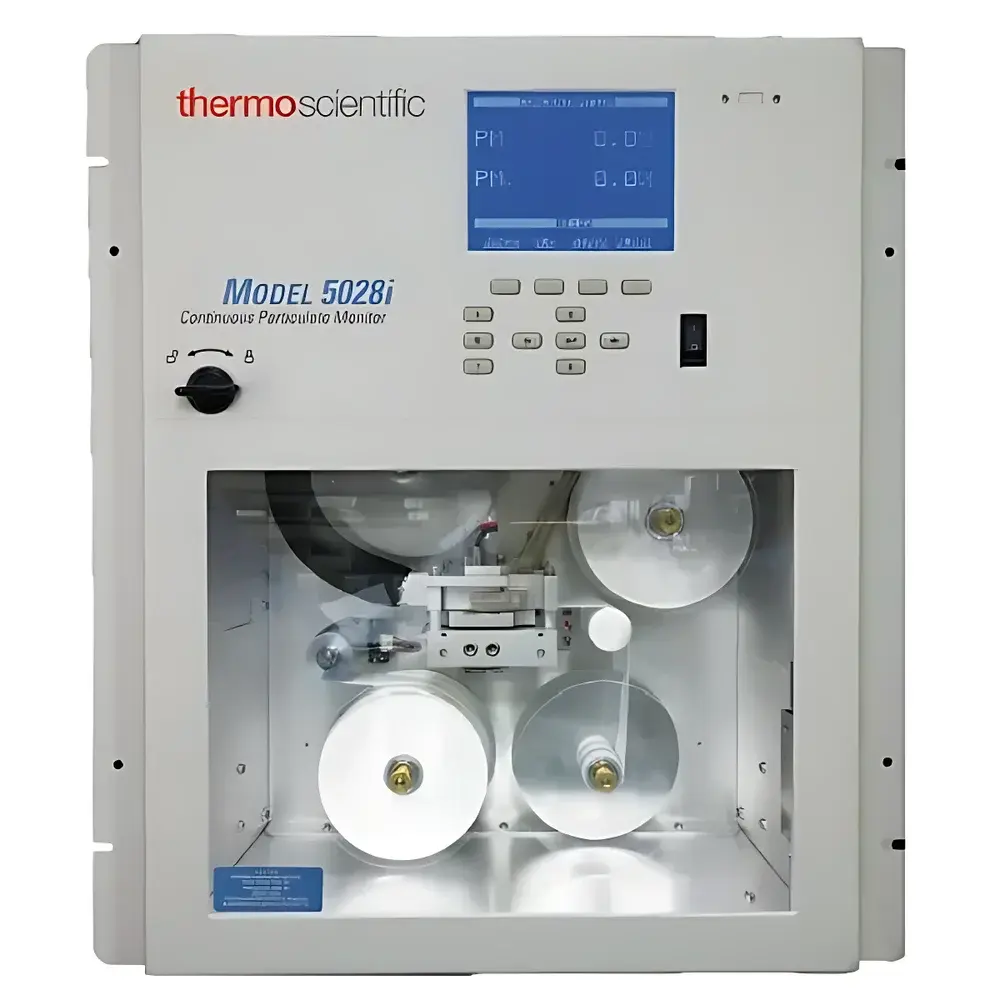
Thermo Scientific 5028i Continuous Particulate Matter Monitor
| Brand | Thermo Fisher |
|---|---|
| Origin | USA |
| Model | 5028i |
| Measurement Principle | Beta-ray Attenuation |
| Measured Parameters | PM₁₀ and PM₂.₅ |
| Measurement Range | 0–10 mg/m³ (0–10,000 µg/m³) |
| Sampling Flow Rate | 1 m³/h |
| Detection Limit | <1 µg/m³ (24-hour average) |
| Flow Stability | High stability |
| Regulatory Compliance | U.S. EPA EQPM for PM₁₀ (EQPM1102-150) and PM₂.₅ (EQPM0609-183) |
Overview
The Thermo Scientific™ Model 5028i Continuous Particulate Matter Monitor is an EPA-equivalent method-certified instrument engineered for high-accuracy, long-term ambient air monitoring of PM₁₀ and PM₂.₅ mass concentrations. It employs beta-ray attenuation spectroscopy — a gravimetrically traceable technique in which beta particles emitted from a ¹⁴C source pass through a continuously advancing filter tape loaded with collected particulate matter. The degree of radiation attenuation correlates directly with the deposited mass, enabling real-time, non-destructive quantification of airborne particulate loading. Integrated into Thermo Scientific’s i-series platform, the 5028i delivers robust architecture, field-proven reliability, and compliance-ready operation across regulatory, research, and networked monitoring applications.
Key Features
- Dual independent sampling channels — each equipped with dedicated inlet, size-selective cyclone (PM₁₀ or PM₂.₅), filter tape path, and beta detection system — enabling truly simultaneous, non-interfering measurement of both fractions.
- EPA-designated equivalent methods: certified under EQPM1102-150 (PM₁₀) and EQPM0609-183 (PM₂.₅), meeting U.S. Federal Reference Method (FRM) and Federal Equivalent Method (FEM) requirements for regulatory reporting.
- Dynamic heating control system — programmable temperature and relative humidity setpoints allow optimization of sample conditioning to minimize volatilization losses and hygroscopic artifacts, particularly critical for organic carbon and semi-volatile species.
- Extended-life filter tape cassette — supports up to 30 days of unattended operation under typical urban background conditions (assuming 1 m³/h flow and average PM₂.₅ ≈ 15 µg/m³), reducing maintenance frequency and field intervention.
- Unidirectional tape advancement — eliminates mechanical stepping and back-and-forth motion, minimizing particle resuspension and improving mass retention fidelity during transport and measurement.
- Internal rechargeable battery — maintains clock integrity and enables rapid thermal and flow stabilization following AC power interruption, supporting continuity of data capture during brief outages.
Sample Compatibility & Compliance
The 5028i is designed for ambient outdoor air sampling in fixed-site monitoring stations, mobile laboratories, and near-roadway or industrial fence-line deployments. Its dual-channel configuration accommodates standard PM₁₀ and PM₂.₅ inertial impactors per ISO 25500, EN 12341, and EPA Method PS-11. All internal wetted surfaces are constructed from inert, low-outgassing materials (e.g., stainless steel, PTFE-lined tubing) to prevent adsorption or catalytic degradation of reactive compounds. Data output conforms to EPA Appendix A to 40 CFR Part 53 and supports audit-ready metadata tagging including flow calibration logs, tape position timestamps, heater status, and pressure/temperature compensation flags. Instrument firmware complies with 21 CFR Part 11 requirements for electronic records and signatures when operated with validated data acquisition software.
Software & Data Management
Data acquisition and instrument control are managed via Thermo Scientific’s iSeries Command Center software — a secure, role-based interface supporting remote configuration, diagnostic logging, and real-time telemetry. Raw beta counts, flow-corrected volume, temperature/humidity readings, and tape advance events are stored internally with millisecond-level timestamp resolution. Export formats include CSV, XML, and EPA-compliant .DAT files compatible with AQS (Air Quality System) ingestion protocols. Optional integration with cloud-based platforms enables automated QA/QC flagging (e.g., flow deviation >±5%, heater fault, tape end-of-life warning), trend visualization, and cross-instrument correlation analysis. Audit trails record all parameter changes, user logins, and calibration events — essential for GLP/GMP-aligned environmental laboratories.
Applications
- Federal, state, and local air quality monitoring networks requiring FRM/FEM compliance for regulatory reporting to EPA AQS or EEA AirBase.
- Long-term epidemiological studies where precise, artifact-minimized PM₂.₅ exposure assessment is critical for health outcome correlation.
- Source apportionment campaigns utilizing co-located elemental analyzers (e.g., XRF, IC) on shared filter substrates enabled by synchronized tape positioning.
- Industrial hygiene assessments at manufacturing facilities, power plants, and construction sites where simultaneous coarse and fine fraction characterization informs exposure modeling.
- Calibration transfer studies between reference-grade monitors and lower-cost sensor networks, leveraging the 5028i’s traceable mass concentration output as a field reference standard.
FAQ
Does the 5028i require external calibration gases or reference aerosols for routine operation?
No — the beta-ray attenuation principle is inherently absolute and does not rely on gas-phase calibrants; however, periodic flow verification using a NIST-traceable primary standard (e.g., dry gas meter or sonic nozzle) is required per EPA guidance.
Can the instrument report both actual and standard-condition concentrations simultaneously?
Yes — configurable output modes include actual ambient conditions (°C, kPa) and standardized conditions (25°C, 101.325 kPa), with automatic temperature/pressure compensation applied in real time.
What maintenance intervals are recommended for routine field operation?
Filter tape replacement every 15–30 days depending on ambient loading; annual flow sensor recalibration; biannual beta source activity verification per manufacturer protocol.
Is the 5028i suitable for indoor air quality monitoring?
It is optimized for ambient outdoor environments; indoor use is possible but requires careful evaluation of sampling representativeness, humidity control, and potential interference from localized sources not captured by standard inlet designs.
How is data integrity ensured during extended power outages?
The internal rechargeable battery sustains clock functionality and retains volatile memory for ≥72 hours; upon AC restoration, the system resumes operation without data loss and auto-synchronizes timestamps with network time protocol (NTP).







