
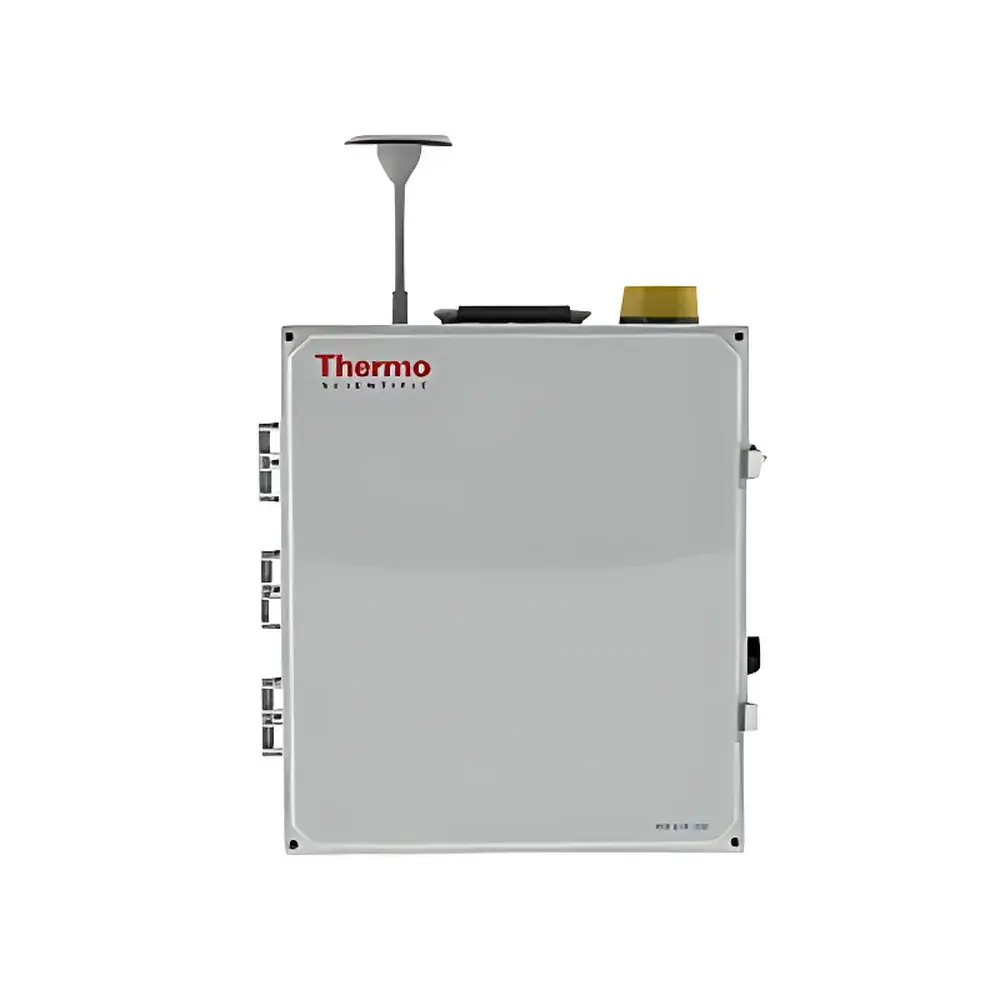


Thermo Scientific ADR-1500 Atmospheric Particulate Matter Monitor
| Brand | Thermo Fisher |
|---|---|
| Origin | USA |
| Manufacturer | Thermo Fisher Scientific |
| Product Type | Imported Instrument |
| Model | Thermo Scientific ADR-1500 |
| Measurement Principle | Optical Light Scattering (Nephelometry) |
| Measured Parameters | PM₁₀, PM₂.₅, PM₄, PM₁ |
| Measurement Range | 0.001–400 mg/m³ (Auto-ranging) |
| Detection Limit | 0.1 µg/m³ |
| Sampling Flow Rate | 1.0–3.5 L/min |
| Flow Stability | ±2% of reading or ±0.005 mg/m³ (whichever is greater), 1-s averaging |
| Accuracy | ±5% of reading (traceable to SAE test standards) |
| Precision | ±2% (1 s), ±0.5% (10 s), ±0.2% (60 s) |
| Scatter Coefficient Range | 1.1×10⁻⁶ to 0.6 m⁻¹ (@ λ = 880 nm) |
| Aerodynamic Particle Size Cut Points | 1.0–10 µm (with optional cyclone cutters: GK2.05 for PM₄–PM₁₀ |
| Operating Environment | IP65-rated weatherproof enclosure |
| Power Options | AC, external DC, or internal rechargeable battery (up to 100 h continuous operation) |
| Data Connectivity | Wireless/3G, USB, RS-232, analog output |
| Onboard Display | Dual-line LCD showing real-time concentration, start time, date, average concentration, and runtime |
| Temperature & Humidity Compensation | Integrated heated sensor assembly with RH/T correction |
| True Volumetric Flow Control | Enabled via digital feedback from barometric pressure, temperature, and calibrated orifice ΔP sensors |
Overview
The Thermo Scientific ADR-1500 Atmospheric Particulate Matter Monitor is a high-performance, field-deployable optical nephelometer engineered for regulatory-grade, real-time measurement of airborne particulate mass concentrations across multiple aerodynamic size fractions—including PM₁, PM₂.₅, PM₄, and PM₁₀. Utilizing precision light scattering photometry at 880 nm, the ADR-1500 quantifies particle concentration by detecting the intensity of scattered light within a precisely controlled sample chamber. This principle—validated against U.S. EPA reference methods and widely deployed in the Thermo pDR series—ensures linear response over six orders of magnitude (0.001–400 mg/m³) while maintaining traceability to SAE-certified calibration standards. Unlike fixed-flow instruments, the ADR-1500 implements true volumetric flow control through closed-loop digital regulation of sampling flow using concurrent inputs from an onboard barometric pressure sensor, temperature sensor, and differential pressure across a NIST-traceable critical orifice. This architecture guarantees accurate volumetric sampling and stable aerodynamic cutoff performance—even under fluctuating ambient conditions—enabling reliable compliance monitoring in construction sites, urban roadways, industrial perimeters, and other unattended outdoor environments.
Key Features
- True volumetric flow control with ±2% flow stability (1-s averaging), eliminating density-dependent errors common in mass-flow-based systems
- High-sensitivity 880-nm nephelometric detection with 0.1 µg/m³ minimum detection limit and sub-second response time
- Multi-fraction capability: configurable measurement of PM₁, PM₂.₅, PM₄, and PM₁₀ using interchangeable cyclone impactors (GK2.05 for PM₄–PM₁₀; SCC1.062 for PM₁–PM₄)
- Integrated heated RH/T sensor assembly to minimize hygroscopic bias during high-humidity conditions
- IP65-rated rugged enclosure designed for continuous outdoor operation across -20 °C to 50 °C and >95% RH (non-condensing)
- Flexible power architecture supporting AC mains, external DC input, or internal rechargeable battery (100 h runtime at nominal flow)
- Real-time dual-line LCD display showing instantaneous concentration, cumulative runtime, date/time stamp, and 1-/10-/60-s averaged values
Sample Compatibility & Compliance
The ADR-1500 meets the physical and operational requirements for ambient air quality monitoring under multiple international frameworks. Its aerodynamic sizing performance aligns with ISO 7708:1995 and EN 481:1993 definitions for inhalable, thoracic, and respirable dust fractions. When equipped with EPA-equivalent cyclones (e.g., GK2.05, SCC1.062), its PM₂.₅ and PM₁₀ measurements demonstrate strong correlation with U.S. EPA Federal Reference Methods (FRM) and Federal Equivalent Methods (FEM), supporting data use in regulatory reporting contexts. The instrument’s flow control system complies with EPA 40 CFR Part 53 requirements for volumetric accuracy in continuous ambient monitors. All firmware and calibration protocols are structured to support GLP-compliant audit trails, including timestamped calibration logs, sensor diagnostics, and configuration change records.
Software & Data Management
Data acquisition and remote management are supported via embedded communication interfaces: 3G/Wi-Fi for secure cloud upload to Thermo’s proprietary Environmental Data Platform (EDP), or local transfer via USB, RS-232, or 4–20 mA analog output. EDP enables role-based user access, automated QA/QC flagging (e.g., flow deviation alerts, heater fault detection), and export to CSV, NetCDF, or EPA-compatible AQS formats. Firmware supports over-the-air updates and configurable averaging intervals (1 s to 24 h). All data streams include embedded metadata: GPS coordinates (when paired with optional GNSS module), ambient T/RH, barometric pressure, flow rate, and instrument status flags—ensuring full chain-of-custody integrity for regulatory submissions.
Applications
- Construction site dust compliance monitoring per local ordinances (e.g., California Rule 1403, UK CDM Regulations)
- Real-time roadside PM₂.₅/PM₁₀ assessment for traffic emission studies and urban airshed modeling
- Industrial fence-line monitoring for fugitive dust emissions (cement plants, aggregate facilities, bulk material handling)
- Temporary deployment during demolition, excavation, or remediation projects requiring rapid setup and low-maintenance operation
- Research-grade exposure assessment in occupational hygiene and environmental epidemiology field studies
FAQ
Does the ADR-1500 require routine factory recalibration?
No—its optical path is sealed and drift-compensated via internal reference photodiodes; annual verification against NIST-traceable aerosol standards is recommended per ISO/IEC 17025 laboratory practice.
Can the ADR-1500 operate without cellular connectivity?
Yes—it functions autonomously with local data logging (≥30 days at 1-min intervals) and supports offline retrieval via USB or SD card.
Is the instrument compatible with third-party SCADA or IoT platforms?
Yes—Modbus RTU over RS-485 and MQTT over TLS are available via firmware upgrade; API documentation is provided under NDA.
What maintenance is required for long-term field deployment?
HEPA filter replacement every 6–12 months (depending on dust loading); quarterly visual inspection of inlet nozzle and cyclone integrity; annual cleaning of optical windows using certified lint-free wipes and isopropyl alcohol.
How does humidity compensation work?
The integrated heated RH sensor maintains a constant dew point offset (~5 °C above ambient), and algorithmic correction applies Mie-scattering-derived humidity response curves validated across 20–95% RH.







