
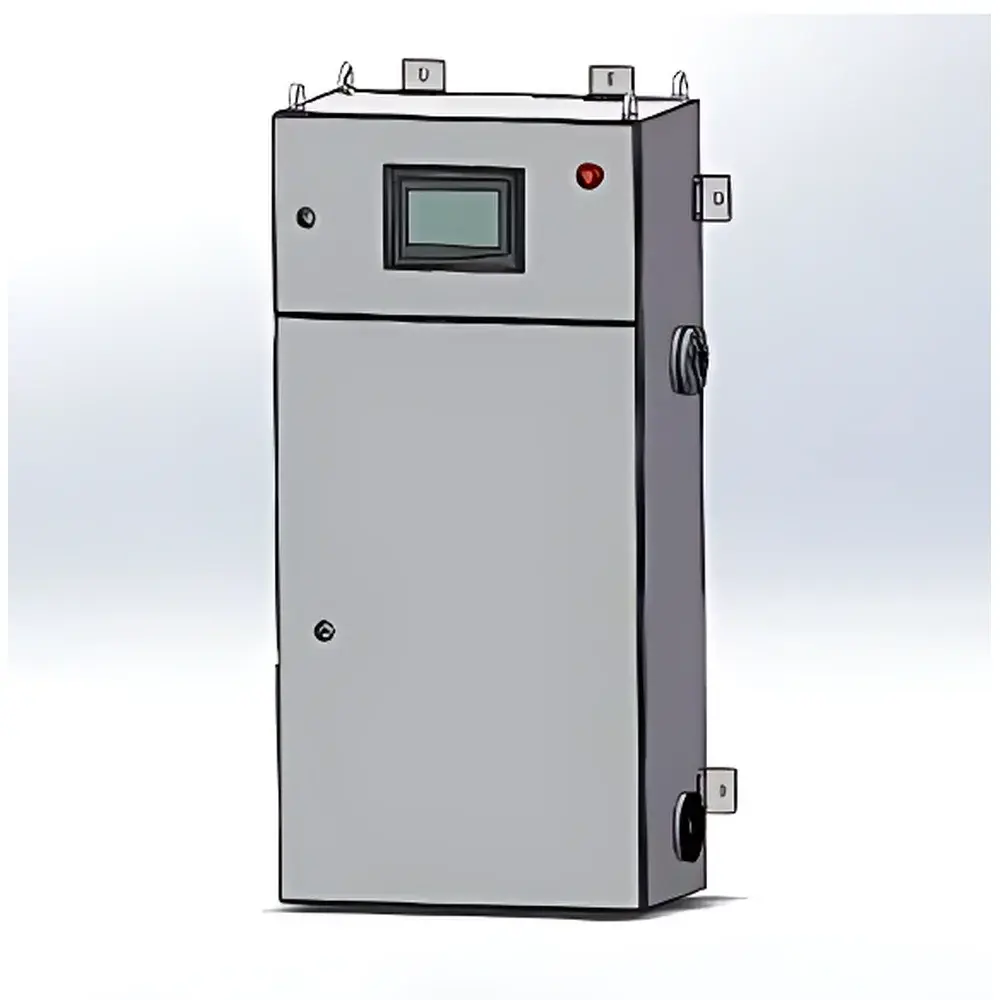
Thermo Scientific AM16 Marine Scrubber Water Quality Monitoring System
| Brand | Thermo Fisher Scientific |
|---|---|
| Origin | USA |
| Manufacturer | Yes |
| Import Status | Imported |
| Model | Thermo Scientific AM16 |
| Pricing | Upon Request |
Overview
The Thermo Scientific AM16 Marine Scrubber Water Quality Monitoring System is an integrated, real-time analytical platform engineered for continuous compliance monitoring of exhaust gas cleaning system (EGCS) washwater in maritime applications. Designed to meet the stringent requirements of IMO Resolution MEPC.259(68), the system delivers reliable, traceable measurements of critical water quality parameters—pH, turbidity, polycyclic aromatic hydrocarbons (PAH), and temperature—before and after scrubber treatment. Its operational principle centers on robust in-line sensor integration, pressure-stabilized sample conditioning, and automated interference mitigation (e.g., bubble removal, air purging), ensuring measurement integrity under dynamic marine conditions including variable flow, salinity, temperature gradients (up to 60 °C), and high particulate load. The AM16 is not a standalone analyzer but a purpose-built process monitoring system—fully compliant with the verification and data retention expectations of classification societies (e.g., DNV, LR, ABS) and port state control authorities enforcing MARPOL Annex VI.
Key Features
- Full compliance with IMO MEPC.259(68) washwater discharge criteria, including mandatory PAH quantification (fluorescence-based detection), pH limits (6.5–7.5), turbidity thresholds (<25 NTU), and temperature differential reporting
- Universal EGCS compatibility—validated for open-loop, closed-loop, and hybrid scrubber configurations with seamless integration into existing vessel automation networks (e.g., via Modbus TCP or RS-485)
- Simultaneous, synchronized measurement of four core parameters: pH (±0.1 unit accuracy), turbidity (0–100 NTU range, ISO 7027-compliant optical path), PAH (detection limit ≤0.5 µg/L naphthalene-equivalent), and temperature (−5 °C to +60 °C, ±0.3 °C)
- Pressure-rated U-PVC wetted piping with DIN/ISO flange interfaces; fully sealed, pressurized sample loop capable of sustaining up to 6 bar operating pressure and handling flow rates from 0.5 to 5 L/min without bypass or dilution
- IP65-rated 316 stainless steel enclosure with vertical hydraulic-electrical separation; corrosion-resistant construction validated for salt fog exposure (IEC 60068-2-52), mechanical shock (IEC 60068-2-27), and vibration per ISO 1996-2
- Brushless DC centrifugal pump with >20,000-hour MTBF, engineered for low-pulsation, maintenance-free operation under continuous duty cycles
- Integrated de-bubbling module using laminar-flow phase separation and residence-time optimization to eliminate air entrainment prior to optical and electrochemical sensing
- Programmable air-purge cycle for sensor face cleaning—reducing fouling frequency by >70% compared to passive systems and extending calibration intervals to ≥14 days
- Fail-safe pressure relief architecture with dual-stage mechanical relief valves and real-time pressure monitoring to prevent over-pressurization during thermal expansion or flow blockage
- 7-inch industrial-grade capacitive touchscreen HMI running embedded Linux OS; supports multilingual UI (EN/DE/FR/JP), audit-trail-enabled configuration logging, and configurable alarm thresholds with relay outputs
Sample Compatibility & Compliance
The AM16 is calibrated and validated for direct analysis of seawater-based scrubber effluent containing suspended solids (≤500 mg/L), residual alkalinity (CaCO₃ equivalent), chloride (≤20,000 ppm), and complex organic matrices typical of heavy fuel oil combustion byproducts. All sensors comply with relevant IEC standards: pH electrodes conform to IEC 60746-1, turbidity sensors to ISO 7027-1:2016, and PAH fluorescence modules to ASTM D5847 (modified for marine matrix). Data records—including raw sensor outputs, timestamps, calibration history, and system health logs—are stored locally for ≥30 days and exported in CSV/JSON formats compliant with IMO’s Electronic Record Keeping (ERK) guidance. The system supports GLP-aligned operation with user-accessible audit trails, electronic signatures (via optional PKI integration), and alignment with FDA 21 CFR Part 11 principles where required by flag-state regulations.
Software & Data Management
The AM16 embeds Thermo Scientific ScrubberView™ firmware—a deterministic, real-time operating environment optimized for deterministic sampling scheduling, drift-compensated signal processing, and multi-parameter correlation analytics. Raw sensor data undergoes adaptive filtering (Kalman-based noise suppression) and matrix-effect correction (e.g., salinity compensation for pH, color correction for turbidity). All measurement events are time-synchronized to GPS or NTP sources with microsecond-level precision. Data export supports OPC UA, MQTT, and Modbus protocols for integration into vessel management systems (VMS) or shore-side cloud platforms. Remote diagnostics, firmware updates, and parameter reconfiguration are enabled via secure TLS 1.2–encrypted SSH or HTTPS sessions. Optional cloud gateway modules provide automatic upload to Thermo’s FleetConnect™ portal for fleet-wide compliance dashboards, trend analytics, and regulatory report generation (e.g., EU MRV, CII scoring support).
Applications
- Continuous washwater compliance verification for IMO Tier III and ECA-bound vessels
- Performance validation of scrubber desulfurization efficiency (SO₂ removal rate estimation via pH/alkalinity correlation)
- Early detection of scrubber media degradation or caustic dosing failure through PAH/pH anomaly trending
- Supporting Port State Control (PSC) inspections with tamper-evident, timestamped digital records
- Integration into Class-approved Condition Monitoring Systems (CMS) for predictive maintenance of EGCS components
- Enabling Environmental, Social, and Governance (ESG) reporting with auditable emissions-related water quality data
FAQ
Does the AM16 meet the PAH measurement requirements of MEPC.259(68)?
Yes—the system employs UV-excited fluorescence detection with wavelength-selective emission filtering and built-in matrix compensation algorithms, achieving detection limits below 0.5 µg/L for naphthalene equivalents across saline, turbid, and organically loaded washwater samples.
Can the AM16 be retrofitted onto existing scrubber installations?
Yes—its modular design supports flange-mounted installation with minimal vessel downtime; standard interfaces include DN50/DN65 U-PVC flanges and 24 VDC power input, with electrical connections meeting IEC 60092-501 marine wiring standards.
How is calibration traceability maintained?
Each sensor includes NIST-traceable calibration certificates; field calibration is performed using certified reference materials (CRM) traceable to NIST SRM 1640a (turbidity), NIST SRM 186c (pH), and EPA Method 8310 PAH standards, with full documentation stored in the onboard audit log.
Is remote software update supported?
Yes—secure over-the-air (OTA) firmware updates are delivered via encrypted HTTPS channels with cryptographic signature verification and rollback capability to ensure system integrity and regulatory continuity.
What cybersecurity standards does the AM16 adhere to?
The system complies with IEC 62443-3-3 SL2 requirements for industrial automation and control systems, including role-based access control, disabled default accounts, TLS 1.2 encryption, and periodic security patching aligned with Thermo Fisher’s Product Security Incident Response Team (PSIRT) policy.







