
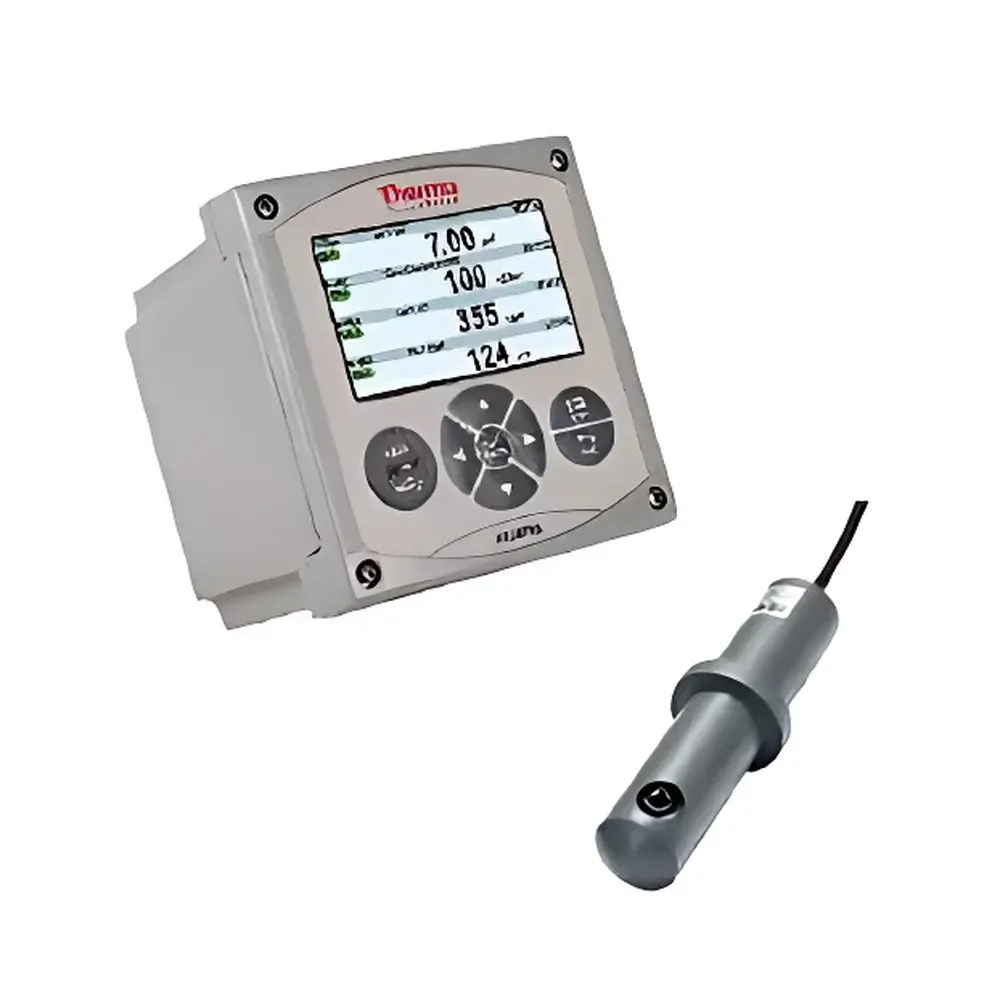
Thermo Scientific APDPHYL500 Online Chlorophyll-a Analyzer
| Brand | Thermo Fisher |
|---|---|
| Origin | USA |
| Manufacturer | Thermo Fisher Scientific |
| Product Type | Imported Instrument |
| Model | APDPHYL500 |
| Pricing | Upon Request |
Overview
The Thermo Scientific APDPHYL500 Online Chlorophyll-a Analyzer is a field-deployable, submersible fluorometric sensor engineered for continuous, real-time quantification of chlorophyll-a concentration in natural and treated water systems. It operates on the principle of excitation-emission fluorescence spectroscopy: chlorophyll-a molecules absorb light at specific wavelengths (typically ~435 nm and ~625 nm) and re-emit energy as near-infrared fluorescence (~685 nm). The intensity of this emitted signal is linearly proportional to the concentration of photosynthetically active phytoplankton biomass—primarily green algae and diatoms—in the sampled water column. Unlike wet-chemical or HPLC-based laboratory methods, the APDPHYL500 delivers in-situ, reagent-free measurement with no sample filtration, extraction, or preservation required. Its design adheres to the fundamental photophysical behavior of chlorophyll-a in aqueous media, enabling direct correlation to algal biovolume under controlled optical path conditions.
Key Features
- Reagent-free, non-destructive fluorescence detection—no consumables, zero chemical waste, minimal maintenance
- True in-situ operation: submersible probe with IP68-rated housing, rated for continuous deployment up to 10 m depth
- Dual-range optical detection system: automatic switching between low-range (0–50 µg/L) and high-range (0–500 µg/L) channels to maintain linearity across eutrophic and oligotrophic conditions
- Integrated temperature and pressure compensation algorithms to correct for thermal quenching and hydrostatic effects on fluorescence yield
- Onboard data logging capacity: stores up to 1,000 timestamped measurement records with UTC synchronization
- Firmware upgrade capability via USB-C interface; supports configuration cloning across multiple units for fleet-wide consistency
- Multi-parameter expansion architecture: accepts up to four additional smart electrodes (e.g., pH/ORP, conductivity, RDO, turbidity, suspended solids, free chlorine, ozone) on a shared digital bus
- Support for Modbus RTU/ASCII, SDI-12, and optional Ethernet/IP protocols—enabling seamless integration into SCADA, PLC, and centralized telemetry platforms
Sample Compatibility & Compliance
The APDPHYL500 is validated for use in freshwater, brackish, and low-salinity estuarine environments—including raw intake water, reservoirs, rivers, lakes, and drinking water distribution networks. It is not intended for full-seawater applications due to spectral interference from dissolved organic matter and algal pigment variants (e.g., divinyl-chlorophyll-a in marine cyanobacteria). The instrument complies with ASTM D3731-22 (Standard Test Method for Determination of Chlorophyll-a in Water by Fluorometric Measurement) and aligns with EPA Method 445.0 principles for in-vivo chlorophyll-a estimation. All firmware and data handling routines support audit-trail functionality compliant with GLP and 21 CFR Part 11 requirements when deployed in regulated drinking water utilities.
Software & Data Management
Data acquisition and configuration are managed through Thermo Scientific’s AquaManager™ Desktop Suite (v3.2+), a Windows-based application supporting sensor calibration validation, trend visualization, alarm threshold definition (e.g., >100 µg/L sustained over 48 h), and automated PDF report generation. Raw fluorescence counts, compensated concentration values, diagnostic flags (e.g., fouling index, signal-to-noise ratio), and auxiliary sensor readings are stored in CSV and SQLite formats. Remote access is enabled via secure TLS-encrypted MQTT or HTTP(S) endpoints—allowing cloud ingestion into time-series databases such as InfluxDB or AWS Timestream. Firmware updates include cryptographic signature verification to ensure integrity during over-the-air (OTA) or local USB deployment.
Applications
- Early-warning monitoring of cyanobacterial blooms at raw water intakes for municipal drinking water facilities
- Trend-based forecasting of phytoplankton dynamics in reservoir management and watershed modeling
- Performance verification of UV disinfection and coagulation-flocculation processes where algal load impacts treatment efficiency
- Regulatory compliance reporting for Total Algal Biomass under state-level Harmful Algal Bloom (HAB) response frameworks
- Research-grade longitudinal studies of eutrophication drivers in limnological and climate adaptation projects
- Integration with automated sampling stations equipped with robotic samplers and lab-on-valve analyzers for hybrid lab-field workflows
FAQ
Does the APDPHYL500 require periodic calibration with standard chlorophyll-a solutions?
Yes—field calibration is recommended every 30 days using NIST-traceable chlorophyll-a standards in filtered natural matrix water; factory calibration certificates are provided with each unit.
Can the sensor distinguish between live and dead algal cells?
It measures only *in-vivo* fluorescence from intact, photosynthetically competent chlorophyll-a; significant cell lysis or pigment degradation reduces signal amplitude, providing an indirect viability indicator.
Is the probe compatible with existing Thermo Scientific multi-parameter platforms such as the Orion AQUAfast series?
Yes—the APDPHYL500 uses the same digital communication protocol and mechanical mounting interface as the AQUAfast sensor family, enabling plug-and-play integration.
What anti-fouling measures are built into the sensor design?
The optical window incorporates a hydrophobic nano-coating and optional wiper module (sold separately); onboard fouling diagnostics trigger automated cleaning alerts based on signal drift and baseline noise metrics.
How does the instrument handle variable turbidity or colored dissolved organic matter (CDOM)?
It employs dual-wavelength excitation and reference-channel subtraction to minimize scattering and inner-filter effects; CDOM correction is applied using user-defined absorption coefficients derived from concurrent spectrophotometric characterization.







