
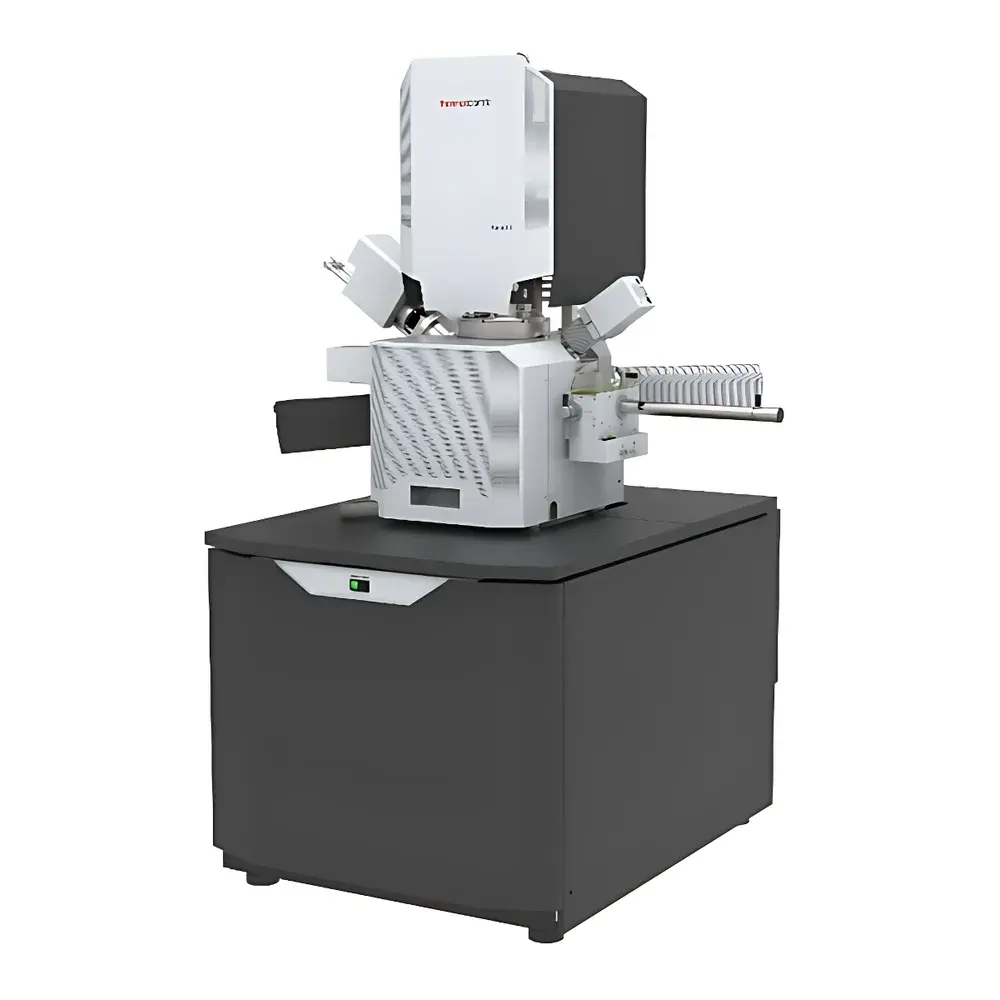
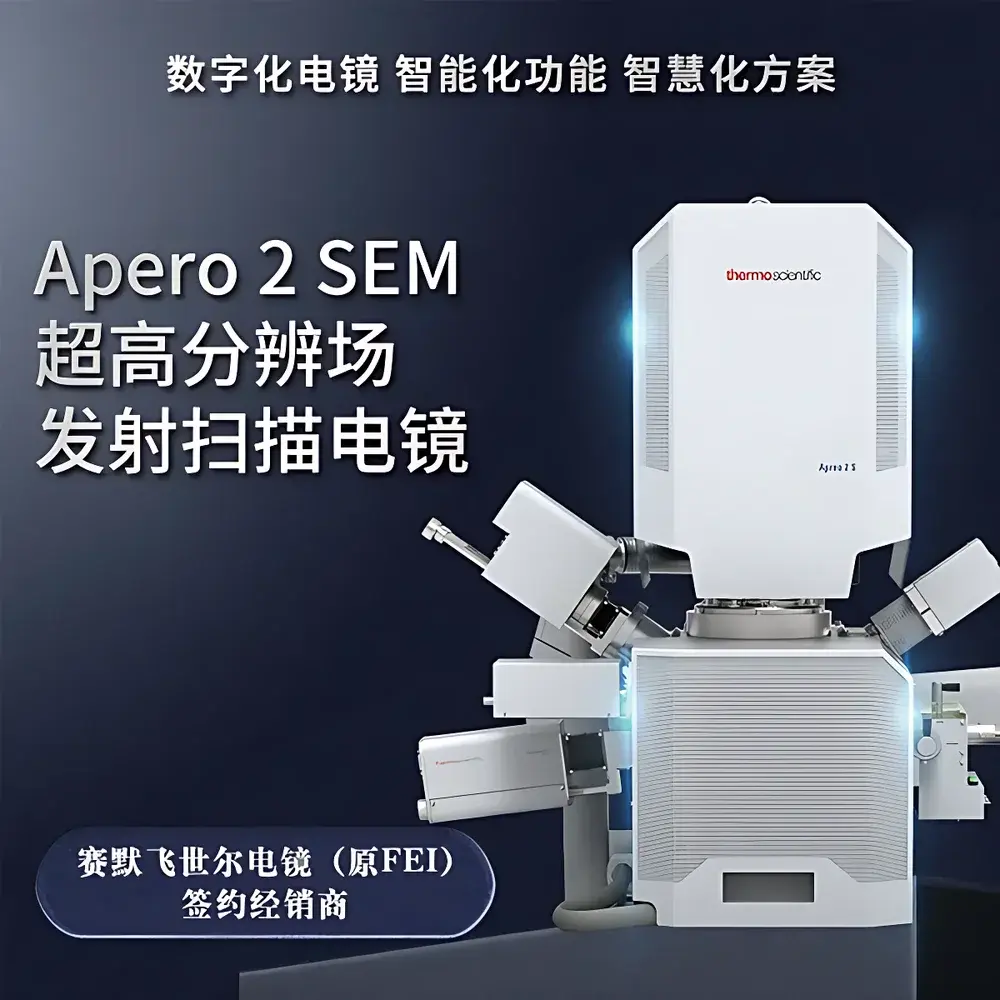
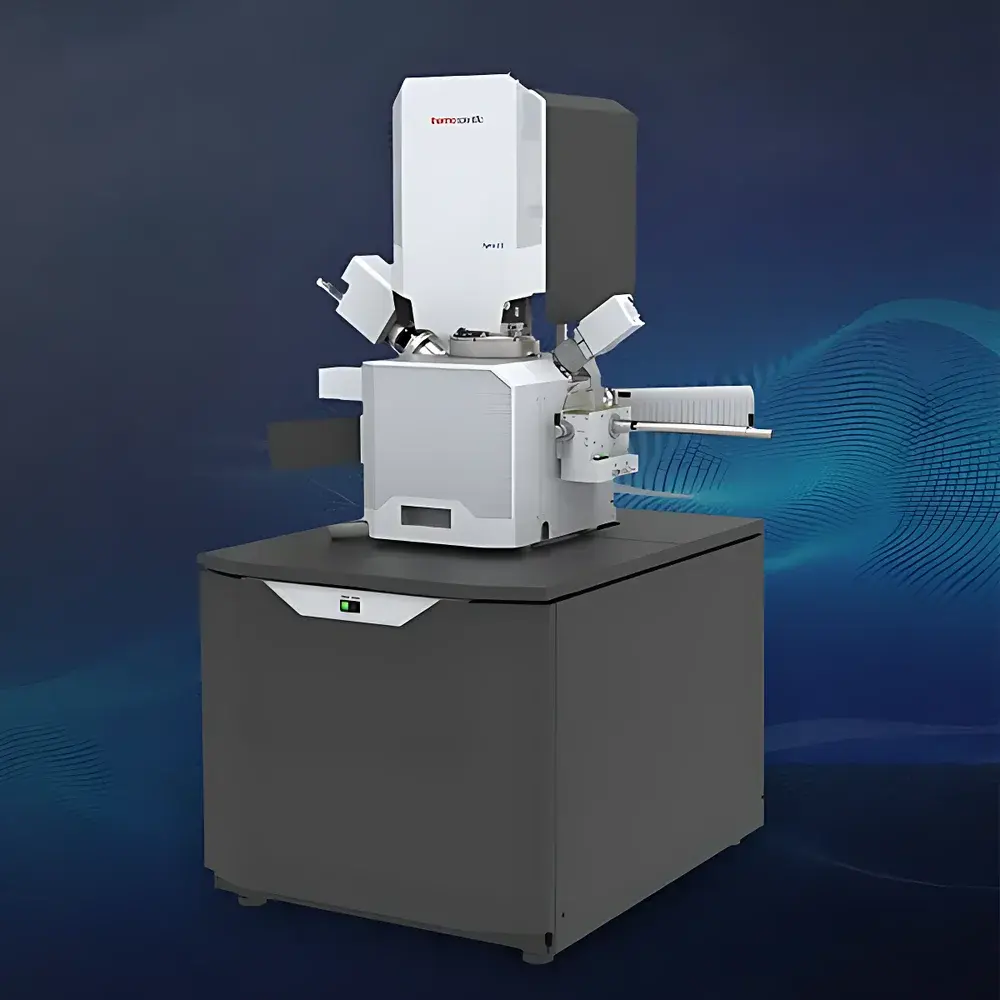
Thermo Scientific Apreo 2 High-Resolution Field-Emission Scanning Electron Microscope
| Brand | Thermo Fisher |
|---|---|
| Origin | Czech Republic |
| Model | Apreo 2 |
| Instrument Type | Floor-standing SEM |
| Electron Gun | Schottky Field Emission |
| Microscope Class | Ultra-High-Resolution FE-SEM |
| Magnification Range | 5× to 1,000,000× |
| Accelerating Voltage | 200 V – 30 kV |
| Maximum Sample Width | 340 mm (horizontal chamber dimension) |
| Expandable Chamber Ports | 12 total, including 3 EDS-compatible ports (2 at 180° opposing positions) |
| Stage | 5-axis motorized eucentric stage (X = 110 mm, Y = 110 mm, Z = 65 mm, Tilt = −15° to +90°, Rotation = 360° continuous) |
| Standard Detectors | In-chamber Everhart-Thornley SE detector (ETD), in-column backscattered electron detector (T1), in-column secondary electron detector (T2) |
Overview
The Thermo Scientific Apreo 2 is an ultra-high-resolution field-emission scanning electron microscope engineered for nanoscale characterization across diverse materials science, semiconductor, life science, and industrial R&D applications. Built upon a robust electrostatic compound lens architecture with a high-stability Schottky field-emission electron source, the Apreo 2 delivers sub-nanometer resolution at both high and low landing energies—achieving ≤0.5 nm at 15 kV and ≤0.8 nm at 1 kV under standard operating conditions. Its unique optical design enables true high-resolution imaging at extended working distances: it remains the only commercial SEM capable of maintaining 1.0 nm resolution at a 10 mm working distance, eliminating the traditional trade-off between analytical flexibility and spatial resolution. This capability supports simultaneous high-resolution imaging, energy-dispersive X-ray spectroscopy (EDS), and cathodoluminescence (CL) without compromising signal fidelity or geometric accuracy.
Key Features
- SmartAlign™ Auto-Optimization: Fully automated alignment of condenser and objective lenses, stigmator correction, and focus calibration—executed via intuitive mouse-driven workflow, reducing operator dependency and training time.
- FLASH™ Real-Time Tuning: Dynamic image optimization engine that performs real-time astigmatism correction, focus refinement, and contrast/brightness balancing during acquisition—enabling rapid parameter iteration and reproducible results across users and sessions.
- ColorSEM™ Real-Time Elemental Mapping: Integrated EDS acquisition synchronized with SEM imaging, delivering quantitative elemental distribution maps directly overlaid on secondary electron images—no post-acquisition correlation required, compliant with ASTM E1508 and ISO 16575 workflows.
- Multi-Detector Signal Integration: Simultaneous acquisition from in-column SE (T2/T3), BSE (T1), and chamber-mounted ETD detectors—enabling material contrast, topographic contrast, and compositional contrast in a single scan.
- Eucentric 5-Axis Motorized Stage: Precision-engineered stage with ±0.1 µm repeatability, supporting full 360° continuous rotation and tilt up to +90°—essential for tomography, cross-section analysis, and crystallographic orientation mapping (EBSD-ready).
- Modular Chamber Architecture: 12 standardized flange ports—including three dedicated EDS ports (two diametrically opposed at 180°) and optional CL, EBIC, or gas injection system (GIS) integration—facilitating multi-technique correlative analysis under vacuum or low-vacuum conditions.
Sample Compatibility & Compliance
The Apreo 2 accommodates a broad spectrum of specimen types without requiring conductive coating, including insulating ceramics, beam-sensitive polymers, hydrated biological tissues (under low-vacuum mode), and ferromagnetic alloys. Its low-voltage imaging capability (down to 200 eV) minimizes charging and surface damage, while the variable pressure mode (up to 100 Pa) enables direct observation of non-conductive or outgassing samples. The system complies with IEC 61000-6-3 (EMC), CE marking requirements, and supports GLP/GMP audit readiness through integrated electronic logbooks, user access controls, and FDA 21 CFR Part 11–compliant software modules (optional). All detector signals are digitized at ≥16-bit depth with hardware-based dead-time correction for EDS quantification traceability per ISO 14705 and ASTM E456 standards.
Software & Data Management
Controlled via Thermo Scientific SmartSEM software on Windows 10, the Apreo 2 provides a customizable GUI supporting up to four synchronized live image windows—including Nav-Cam+™ optical navigation, IR-CCD stage height monitoring, and real-time ColorSEM overlays. The software includes non-destructive undo/redo functionality, batch acquisition scripting (Python API), automated map stitching (Maps module), and native support for TIFF, BMP, and HDF5 export formats. Raw data—including detector voltages, lens currents, and stage coordinates—is stored with metadata in vendor-neutral formats to ensure long-term archival integrity and third-party analysis compatibility (e.g., DigitalMicrograph, HyperSpy, or MATLAB).
Applications
- Nanoparticle morphology and size distribution analysis in catalysis and battery electrode materials
- Defect inspection and critical dimension metrology in advanced logic and memory devices
- Fractography and phase identification in metallurgical failure analysis
- 3D serial sectioning and electron tomography of composite microstructures
- In-situ heating/cooling experiments using compatible holders (−185 °C to +1000 °C)
- Correlative light-electron microscopy (CLEM) via Nav-Cam+™ optical registration
FAQ
What is the minimum detectable feature size achievable with the Apreo 2 under routine operation?
The Apreo 2 achieves ≤0.5 nm resolution at 15 kV in high-vacuum mode using the in-column T2 detector—verified per ISO 16700 Annex A using Au/Pt resolution test samples.
Can the Apreo 2 perform EBSD analysis?
Yes—the eucentric stage, 180° opposing EDS ports, and precise tilt/rotation control meet the mechanical requirements for EBSD; detector integration requires optional EBSD hardware and license.
Is remote operation supported?
Full remote desktop access and instrument control are enabled via secure VPN or Thermo Fisher’s Cloud Connect service—subject to local IT policy and network configuration.
How is calibration traceability maintained?
All magnification, stage position, and energy scale calibrations are linked to NIST-traceable reference standards (e.g., SRM 2090a), with certificates stored in the instrument’s audit trail.
What vacuum levels are supported across operational modes?
High vacuum: ≤1 × 10⁻⁷ mbar (electron column); Low vacuum: 1–100 Pa (specimen chamber); differential pumping ensures column integrity during variable-pressure imaging.




