
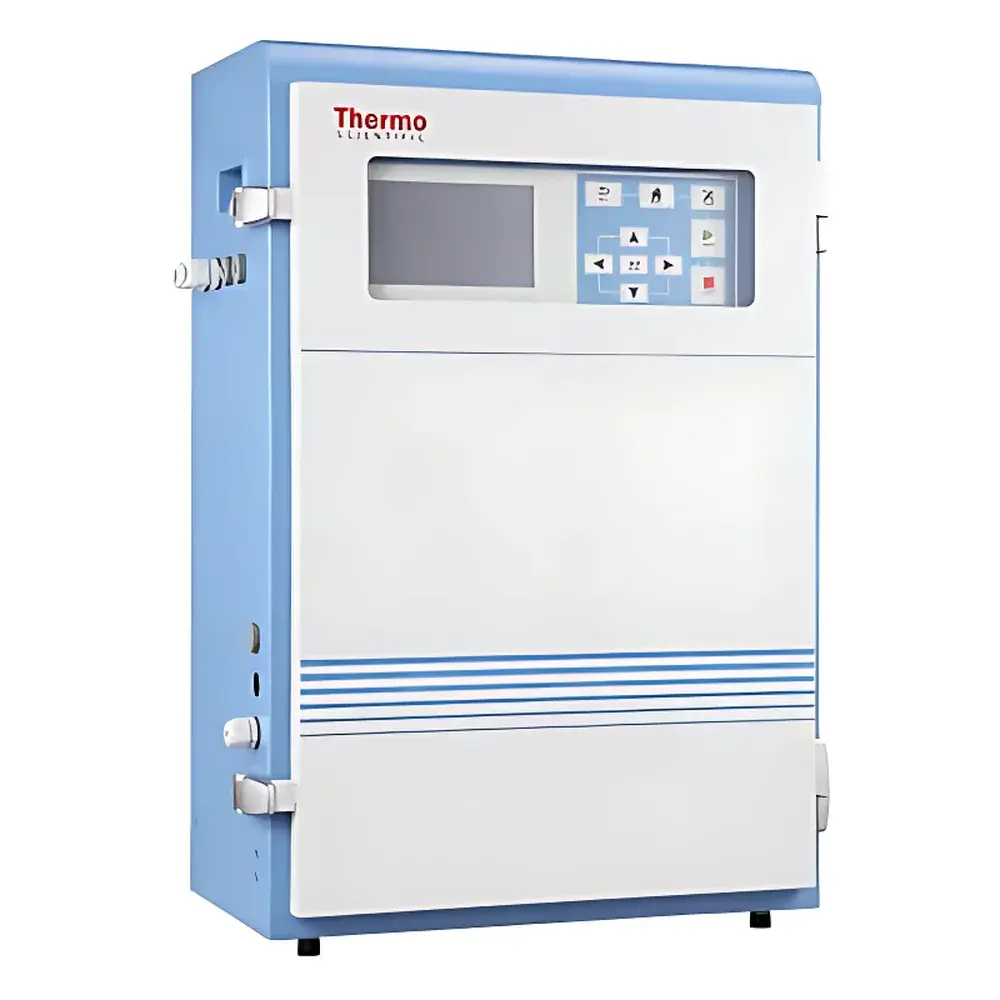
Thermo Scientific AquaEZ 3110TP Total Phosphorus Online Analyzer
| Brand | Thermo Fisher |
|---|---|
| Origin | Shanghai, China |
| Manufacturer Type | Original Equipment Manufacturer (OEM) |
| Country of Origin | China |
| Model | 3110TP |
| Measurement Parameter | Total Phosphorus (TP) |
| Instrument Type | Online Analyzer |
| Measurement Principle | Acid Digestion + Molybdenum Blue Colorimetry |
| Measurement Ranges | 0–1 / 0–2 / 0–10 / 0–50 mg/L as P |
| Accuracy | <5% for standard solutions |
| Detection Limit | 0.01 mg/L |
| Resolution | < ±5% of Full Scale (F.S.) |
| Repeatability | <5% of reading |
| Data Storage Capacity | 20,000 records with auto-rollover |
| Power Supply | 100–240 V AC, 50/60 Hz |
| Operating Temperature | 5–45 °C |
| Relative Humidity | ≤95% RH (non-condensing) |
| Enclosure Rating | IP66 / NEMA 4X |
| Dimensions (W×H×D) | 510 × 775 × 330 mm |
| Weight | 40 kg (instrument only) |
Overview
The Thermo Scientific AquaEZ 3110TP Total Phosphorus Online Analyzer is an industrial-grade, fully automated system engineered for continuous, unattended monitoring of total phosphorus (TP) concentration in aqueous matrices. It operates on the internationally recognized acid digestion–molybdenum blue colorimetric principle: samples undergo high-temperature persulfate oxidation to convert all phosphorus species—including orthophosphate, condensed phosphates, and organically bound phosphorus—into reactive orthophosphate; the resulting orthophosphate then forms a phosphomolybdate complex under acidic conditions, which is reduced to yield a stable blue-colored chromophore measurable at 880 nm. This method complies with ISO 6878:2004, ASTM D515-89 (reapproved 2020), and EPA Method 365.1, ensuring regulatory traceability across municipal wastewater, industrial effluent, surface water, and process water applications.
Key Features
- Robust dual-filtration sampling system with integrated multi-position selection valve, enabling reliable operation in high-turbidity, high-suspended-solid environments (e.g., raw sewage or stormwater runoff)
- Constant-speed peristaltic pump with precision flow control, minimizing volumetric drift over extended deployment cycles
- Thermally stabilized digestion and reaction modules maintaining ±0.5 °C setpoint accuracy, mitigating ambient temperature-induced calibration drift
- IP66/NEMA 4X-rated enclosure with corrosion-resistant wetted materials (PVDF, PTFE, borosilicate glass), suitable for outdoor or harsh industrial installations
- Self-diagnostic architecture with discrete fault logging for reagent depletion, liquid leakage, valve actuation failure, sample aspiration interruption, and out-of-range measurement events
- Programmable maintenance routines—including scheduled tubing cleaning, post-analysis rinse cycles, and automatic system initialization after power recovery—to ensure long-term metrological stability
- 7-inch TFT color touchscreen (800 × 480 resolution, 70,000-color display) supporting intuitive operator navigation, real-time trend visualization, and on-device event review
Sample Compatibility & Compliance
The AquaEZ 3110TP accepts influent and effluent streams from diverse sources: municipal wastewater treatment plants (primary, secondary, and tertiary stages), industrial discharge points (electroplating, textile dyeing, semiconductor rinsing, pharmaceutical manufacturing), cooling tower and boiler feedwater circuits, and natural surface waters subject to nutrient loading assessment. All fluidic pathways employ chemically inert, low-adsorption materials to prevent phosphorus loss or contamination. The analyzer supports GLP-compliant data integrity through time-stamped audit trails, user-role-based access control (Operator/Technician levels with individual password authentication), and tamper-evident event tagging (M = Maintenance, C = Calibration, D = Diagnostic). Data output conforms to EPA 40 CFR Part 136 and EU Water Framework Directive (WFD) Annex V reporting requirements.
Software & Data Management
Data acquisition and instrument control are managed via embedded firmware supporting Modbus RTU (RS485) and ASCII (RS232) protocols, alongside isolated 4–20 mA analog output for integration into existing SCADA or DCS platforms. Internal non-volatile memory retains up to 20,000 timestamped measurement records, with FIFO overwrite logic preserving continuity during extended offline periods. Power-loss resilience includes EEPROM-backed configuration retention and automatic cold-start sequence execution upon mains restoration. Remote supervision is enabled through optional Ethernet gateway modules supporting SNMP v2c/v3, HTTP/HTTPS RESTful API endpoints, and secure TLS 1.2 encrypted data transmission—fully compatible with FDA 21 CFR Part 11 electronic record and signature requirements when paired with validated LIMS interfaces.
Applications
- Real-time compliance monitoring at NPDES or EU IED permit discharge points
- Process optimization in biological nutrient removal (BNR) systems via feedback control of phosphate dosing or sludge wasting
- Trend analysis of eutrophication drivers in reservoirs, lakes, and estuaries under WFD or USGS monitoring programs
- Validation of tertiary filtration or adsorption media performance in advanced water reuse facilities
- Long-term research-grade TP profiling in watershed-scale hydrological studies requiring sub-daily temporal resolution
- Automated QA/QC for laboratory reference methods (e.g., validation against APHA Standard Methods 4500-P E)
FAQ
What digestion method does the AquaEZ 3110TP use, and is it compliant with international standards?
It employs high-temperature alkaline persulfate digestion followed by molybdenum blue spectrophotometry, aligned with ISO 6878:2004, ASTM D515-89, and EPA Method 365.1.
How frequently does the system require calibration, and what calibration options are supported?
Calibration can be performed manually, on fixed time intervals (e.g., every 24 h), or triggered by user-defined events; both single-point and multi-point calibration routines are configurable.
Can the instrument operate reliably in high-turbidity wastewater with suspended solids?
Yes—the dual-stage mechanical filtration and self-cleaning sample introduction path enable stable operation in samples with turbidity exceeding 500 NTU and total suspended solids (TSS) up to 1,000 mg/L.
Is remote firmware update and diagnostic support available?
Firmware updates and remote diagnostics are supported via secure HTTPS-based web interface or Modbus TCP when deployed with optional Ethernet communication module.
What is the minimum detectable TP concentration, and how is detection limit verified?
The method detection limit (MDL) is 0.01 mg/L, determined per EPA Guidance Document 365.1 using 7 replicate analyses of a low-level spiked matrix and calculated as 3.14 × standard deviation.
Related Products







