
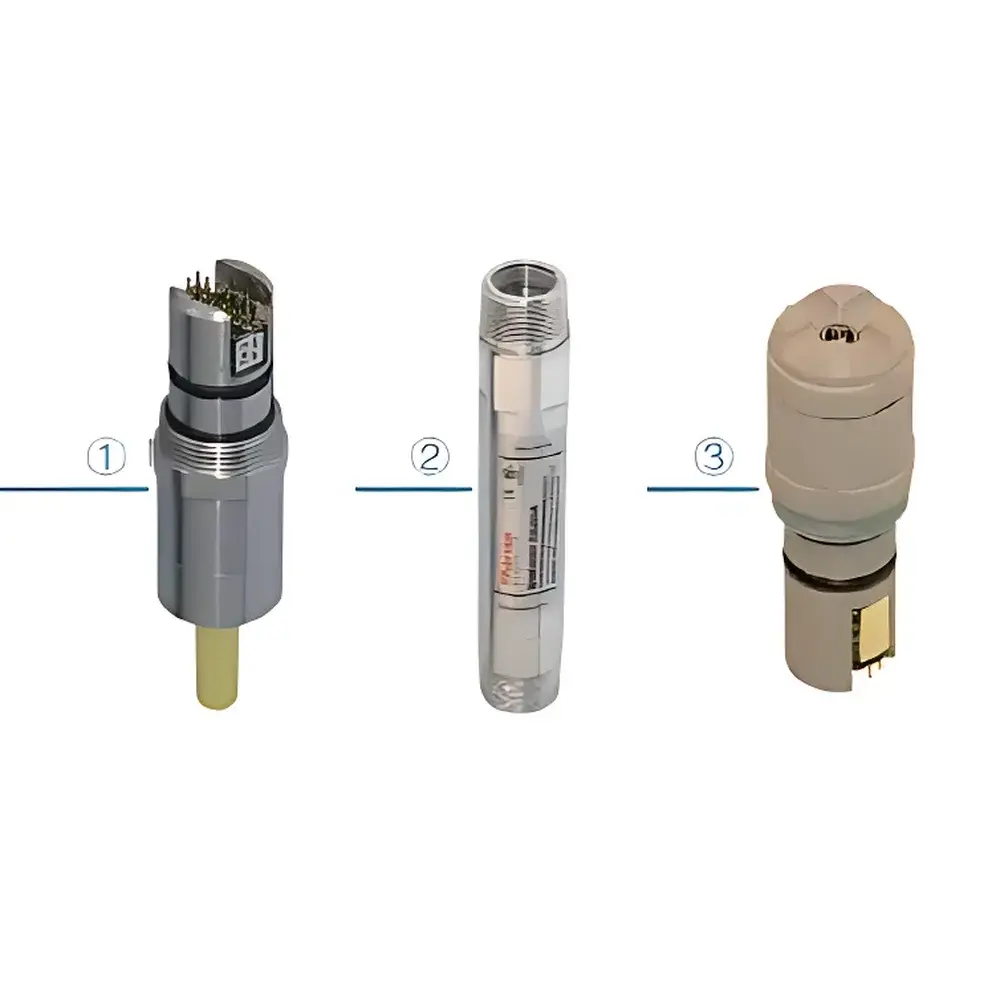
Thermo Scientific AquaSensors DataStick Digital Sensor System
| Brand | Thermo Fisher |
|---|---|
| Origin | USA |
| Manufacturer | Thermo Fisher Scientific |
| Import Status | Imported |
| Model | DataStick Digital Sensor |
| Pricing | Upon Request |
Overview
The Thermo Scientific AquaSensors DataStick Digital Sensor System is a modular, field-deployable platform engineered for continuous, high-integrity water quality monitoring in municipal drinking water distribution networks, wastewater treatment plants, industrial effluent streams, and environmental surface water stations. Built upon a standardized digital architecture, the system employs a three-tiered design—comprising the DataStick sensor probe, universal electrode carrier (DataStick Electrode Rod), and intelligent communication interface (DataStick Communication Adapter)—to decouple sensor measurement, signal conditioning, and system integration. This architecture enables deterministic calibration traceability, eliminates analog signal degradation over distance, and supports plug-and-play replacement without reconfiguration of host controllers. The system operates on the principle of digital transduction: each sensor probe embeds a calibrated microcontroller that digitizes raw electrochemical or optical signals at the point of measurement, stores NIST-traceable calibration coefficients, and reports temperature-compensated values via deterministic serial protocols.
Key Features
- Digital sensor architecture with embedded calibration memory: All sensor probes store factory-applied, temperature-compensated calibration parameters—including slope, zero offset, and thermal response coefficients—in non-volatile memory, eliminating manual calibration entry and reducing configuration errors.
- Integrated Pt1000 temperature sensor: Each probe incorporates a Class A Pt1000 RTD for real-time, high-accuracy temperature measurement (±0.15 °C from 0–50 °C), enabling automatic temperature compensation for pH, conductivity, dissolved oxygen, ORP, turbidity, and chloride measurements.
- Universal electrode rod platform: The DataStick Electrode Rod accepts interchangeable sensor heads across multiple measurement modalities (e.g., glass pH, ISFET, galvanic DO, amperometric chlorine, capacitive conductivity) while maintaining consistent mechanical mounting, electrical interface, and thermal mass characteristics.
- Multi-protocol communication adapter: The DataStick Communication Adapter supports simultaneous protocol translation between sensor-native digital output and industry-standard control interfaces—including Modbus RTU (RS-232/RS-485), ASCII over RS-232, USB-CDC, Ethernet/IP (TCP/UDP), CANopen, DeviceNet, and PROFIBUS DP—enabling seamless integration into SCADA, DCS, and PLC environments without gateway hardware.
- Wide-input DC power range: The adapter accepts 10–36 V DC input, accommodating both battery-backed field enclosures and industrial 24 V DC control cabinets, with reverse-polarity and overvoltage protection compliant with IEC 61000-4-5 Level 3 surge immunity.
Sample Compatibility & Compliance
The AquaSensors DataStick platform is validated for use in potable water (per EPA Method 150.1, ISO 10523, ISO 7888), wastewater (ISO 5814, ISO 5815-1), and ambient surface water (ISO 5667-3). Sensor probes comply with IP68 submersion rating (up to 10 m for 30 days), EN 61326-1 (EMC for industrial environments), and RoHS 2011/65/EU. Calibration certificates issued with each probe conform to ISO/IEC 17025 requirements when performed at Thermo Fisher’s accredited calibration laboratories. The system supports audit-ready data integrity per FDA 21 CFR Part 11 when deployed with compliant SCADA software featuring electronic signatures, change control logs, and secure user access tiers.
Software & Data Management
Sensor data is transmitted as structured ASCII or Modbus registers containing primary measurement values, diagnostic flags (e.g., sensor fouling index, signal noise ratio, temperature deviation), and metadata (probe ID, firmware version, last calibration date). When integrated with Thermo Fisher’s AquaManager™ software (or third-party platforms supporting OPC UA or MQTT), the system enables automated calibration validation, drift trending, predictive maintenance alerts, and batch export of time-stamped datasets compliant with ASTM D5119-20 (Standard Guide for Data Quality Objectives for Water Monitoring Programs). All configuration changes are logged with timestamp, operator ID, and pre/post values—meeting GLP/GMP documentation requirements for regulated utilities.
Applications
- Real-time compliance monitoring at drinking water entry points and distribution nodes (pH, residual chlorine, turbidity per USEPA Stage 2 Disinfectants and Disinfection Byproducts Rule)
- Biological nutrient removal (BNR) process control in activated sludge systems via dissolved oxygen and oxidation-reduction potential (ORP) profiling
- Industrial pretreatment verification for heavy metals (via ion-selective electrode variants) and organic load (via UV254 absorbance add-ons)
- Early-warning detection of contamination events in reservoirs and rivers using multi-parameter anomaly correlation algorithms
- Long-term ecological monitoring campaigns requiring low-maintenance, battery-operated deployments with cellular or LoRaWAN telemetry integration
FAQ
Can the DataStick sensor probe be recalibrated in the field?
Yes—using Thermo Fisher’s AquaCalibrator handheld unit or compatible PC software, users may perform two-point pH, single-point DO, or conductivity span adjustments; all new coefficients are written to the probe’s onboard memory and supersede factory defaults.
Is firmware upgrade supported over the communication interface?
Yes—field-upgradable firmware is delivered via ASCII command sequence or Modbus register write; upgrades preserve existing calibration data and require no physical probe removal.
Does the system support redundant communication paths?
The Ethernet-enabled Communication Adapter supports dual-port 10/100BASE-TX with link aggregation (IEEE 802.3ad) and automatic failover, ensuring uninterrupted data flow during network topology changes.
What is the maximum cable length between probe and adapter?
Up to 100 m using shielded twisted-pair (STP) cable rated for industrial environments; signal integrity is maintained due to digital transmission eliminating analog attenuation concerns.
Are explosion-proof housings available for hazardous area installation?
Yes—ATEX-certified (II 2G Ex db IIB T4 Gb) and IECEx-compliant enclosures are offered for the Communication Adapter and junction box assemblies, suitable for Zone 1 gas environments.
Related Products







