
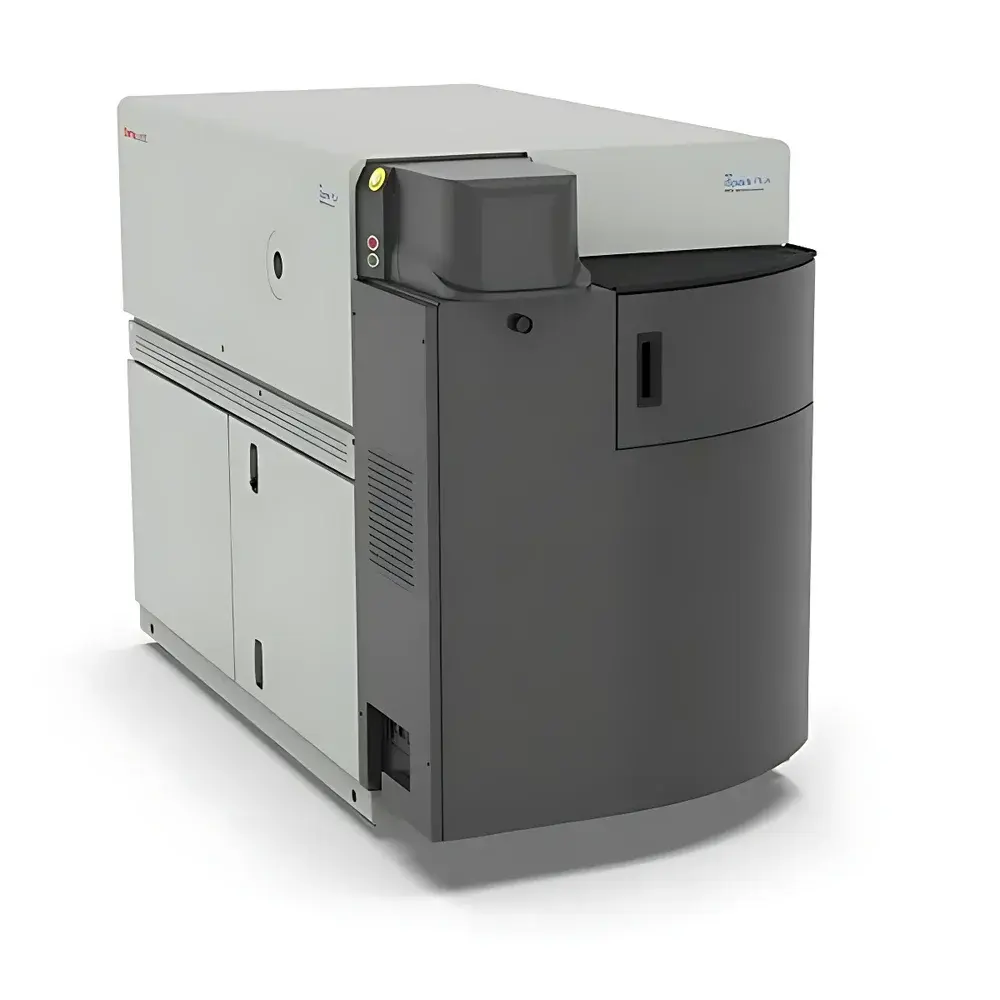
Thermo Scientific ARL™ iSpark Plus Series OES Direct-Reading Spectrometer
| Brand | Thermo Fisher |
|---|---|
| Origin | Shanghai, China |
| Manufacturer Type | Authorized Distributor |
| Regional Classification | Domestic (China-manufactured) |
| Model | ARL™ iSpark Plus Series |
| Pricing | Upon Request |
Overview
The Thermo Scientific ARL™ iSpark Plus Series is a high-performance Optical Emission Spectrometry (OES) instrument engineered for precise, rapid, and robust elemental analysis of metallic samples in demanding industrial environments. Operating on the principle of spark-induced optical emission—where a controlled high-energy spark vaporizes and excites atoms at the sample surface—the instrument detects characteristic atomic emission lines across the UV-Vis-NIR spectrum (typically 130–800 nm) using a high-resolution Paschen-Runge optical system with photomultiplier tube (PMT) detectors. Designed specifically for metallurgical laboratories and production floors, the ARL iSpark Plus delivers quantitative multi-element analysis (including C, P, S, N, B, Sn, Pb, As, and trace metals) in solid conductive metals—ferrous and non-ferrous alloys alike—with sub-ppm detection limits and excellent long-term stability. Its architecture supports continuous operation under variable ambient conditions, making it suitable for primary metal production, foundry QA/QC, aerospace component certification, automotive casting validation, and scrap metal sorting.
Key Features
- High-stability PMT-based optical system with sealed argon-purged spectrometer housing for minimal spectral drift and optimal UV transmission
- Revolutionary intelliSource™ dual Current-Controlled Spark (CCS) generator enabling matrix-specific energy delivery, improved precision, and reduced electrode wear
- Innovative spark stand design with optimized argon flow dynamics, low-memory-effect electrodes, and automatic sample alignment for reproducible ablation
- Single-spark acquisition with diffusion spark intensity correction algorithm—enhancing signal-to-noise ratio and improving quantification accuracy for light elements (e.g., C, P, S)
- Intelligent argon management system featuring dynamic argon-saving mode, reducing consumption by up to 40% during standby and inter-sample intervals
- Extended maintenance intervals (30% longer than previous-generation iSpark models) and simplified consumable replacement (e.g., electrodes, lenses, purge filters)
- Modular hardware architecture supporting field-upgradable detectors, optics, and source electronics to accommodate evolving analytical requirements
Sample Compatibility & Compliance
The ARL iSpark Plus accommodates flat, cylindrical, and irregularly shaped conductive metal samples (diameter ≥ 10 mm, thickness ≥ 4 mm), including cast iron, stainless steels, aluminum alloys, copper brasses, titanium grades, and nickel-based superalloys. It complies with international standard test methods including ASTM E415 (carbon steel), ASTM E1086 (stainless steel), ISO 11573 (aluminum alloys), and EN 10315 (steel castings). Instrument software supports full audit trail functionality aligned with GLP and GMP principles, and optional 21 CFR Part 11 compliance packages are available for regulated contract laboratories and OEM manufacturing sites requiring electronic record integrity.
Software & Data Management
Controlled via Thermo Scientific ARL QUANTOM™ software, the platform provides intuitive method setup, automated calibration validation, real-time spectral monitoring, and multivariate statistical process control (SPC) dashboards. The software integrates seamlessly with LIMS and MES systems through OPC UA and ASTM E1382-compliant data export protocols. All analytical sessions—including spark parameters, background correction logs, drift correction events, and calibration history—are timestamped and stored with user-level access controls. Remote diagnostics and predictive maintenance alerts are enabled via Thermo Connect™ cloud service (optional subscription), facilitating proactive service planning without onsite intervention.
Applications
- Routine grade identification and alloy verification in incoming raw material inspection
- Final product certification for aerospace (AMS, NADCAP), automotive (IATF 16949), and pressure vessel (ASME Section II) applications
- Trace element monitoring in high-purity specialty steels and superalloys for fatigue resistance and corrosion performance
- On-line inclusion analysis in killed steels using calibrated spark intensity profiles for oxide/sulfide size distribution estimation
- Scrap metal sorting and recycling yield optimization through rapid multi-element fingerprinting
- Research-grade compositional mapping for metallurgical process development and heat treatment validation
FAQ
Does the ARL iSpark Plus require external cooling water or compressed air?
No—it operates with internal thermoelectric cooling for the optical bench and uses ambient air convection for power electronics; only high-purity argon (≥99.996%) is required as the purge and spark gas.
Can the instrument analyze non-conductive samples such as ceramics or coatings?
Not directly; it is designed exclusively for conductive metallic solids. Non-conductors require alternative techniques (e.g., LA-ICP-OES or XRF) or conductive coating pre-treatment, which is not supported by this platform.
What is the typical calibration lifetime under routine use?
With stable environmental conditions and regular QC checks using certified reference materials (CRMs), calibration validity typically extends 8–12 weeks for major alloy families; drift correction frequency is reduced by >50% compared to legacy OES systems due to thermal and electronic stability enhancements.
Is method transfer possible from older ARL iSpark models?
Yes—ARL QUANTOM™ software includes backward-compatible method import tools and auto-mapping of spectral lines and integration windows, enabling seamless migration from iSpark 8820, 8860, or Classic platforms.
How does the instrument handle surface contamination or oxide layers?
The intelliSource CCS generator automatically adjusts pre-spark cleaning cycles based on material type and surface condition, ensuring consistent ablation depth and minimizing bias from mill scale or oxidation—validated per ISO 11573 Annex B protocols.




