
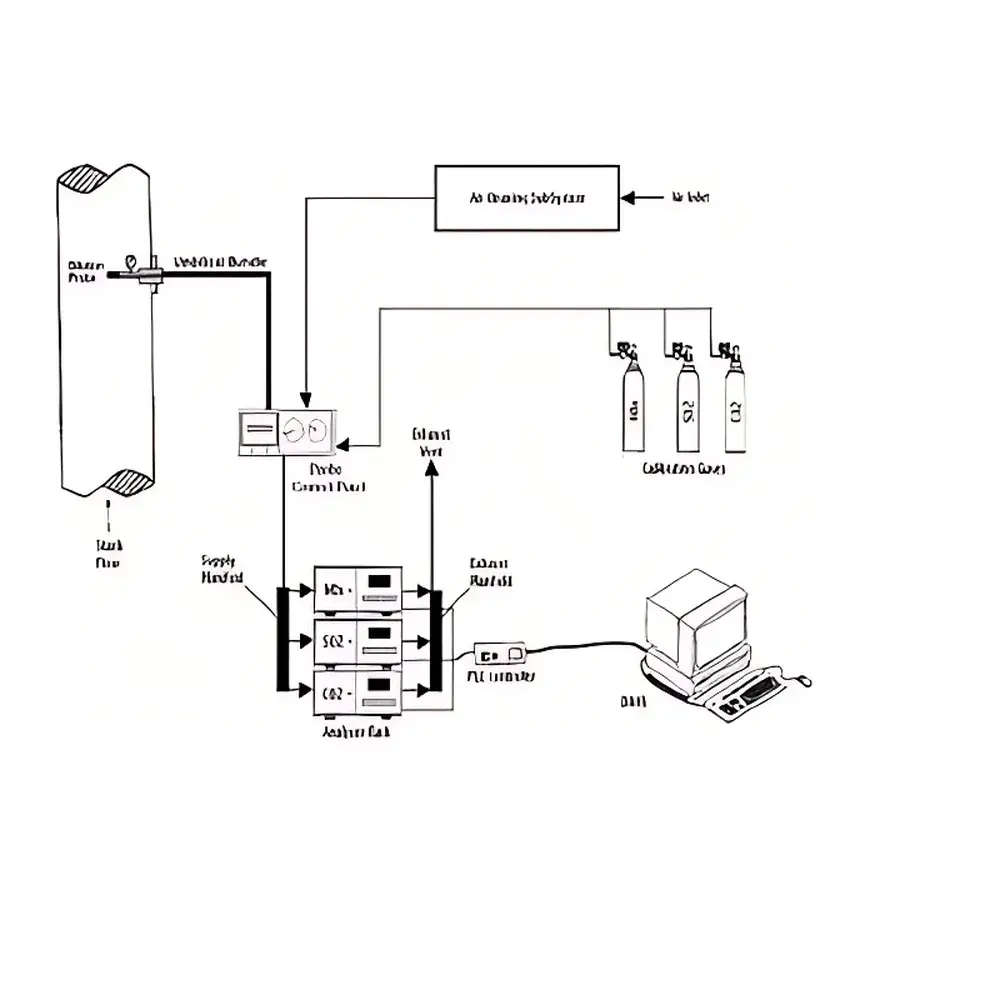
Thermo Scientific CEMS Dilution-Based Continuous Emission Monitoring System
| Brand | Thermo Fisher |
|---|---|
| Origin | USA |
| Manufacturer Type | Original Equipment Manufacturer (OEM) |
| Product Category | Imported Instrument |
| Model | CEMS |
| Instrument Type | Continuous Emission Monitoring System (CEMS) |
| Measurement Principle | In-situ dilution sampling with wet-gas analysis |
| Compliance | EPA Reference Method 10, ASTM D6522, ISO 12039, EN 14181, US EPA PS-11 & PS-2 |
| Certifications | ISO 9001, China National Environmental Protection Agency (MEP) Certification, China National Technical Supervision Bureau Certification |
| Calibration | Full-system dynamic calibration (probe-to-analyzer) per EPA requirements |
Overview
The Thermo Scientific CEMS Dilution-Based Continuous Emission Monitoring System is an engineered solution for regulatory-grade, long-term measurement of gaseous pollutants—including SO2, NOx, CO2, NH3, and O2—in high-temperature, high-dust flue gas streams from industrial combustion sources. Unlike extractive hot-wet or cold-dry systems, this CEMS employs a proven in-probe dilution sampling methodology, where representative flue gas is drawn through a sonic orifice at the probe tip and instantaneously mixed with ultra-dry, purified instrument air (dilution ratio: 16:1 to 250:1). This process lowers the dew point of the sample below ambient installation temperatures while preserving its native moisture content—enabling true wet-gas analysis. As defined in U.S. EPA Reference Method 10 and endorsed in PS-11, this approach eliminates condensation-induced analyte loss (e.g., SO2 dissolution), corrosion, and filter clogging—critical advantages in coal-fired power plants, cement kilns, waste incinerators, and SCR/SNCR deNOx applications.
Key Features
- Dilution Probe Architecture: Constructed from Inconel 600, Hastelloy C276, or 304 stainless steel with Pyrex glass components; rated for continuous operation up to 540 °C; incorporates a 52-inch downward-tilted sampling lance to promote inertial dust deposition prior to filtration.
- Sonic Orifice Flow Control: Gas flow regulated by a critical-flow venturi; maintains constant dilution ratio independent of upstream pressure or temperature fluctuations—no electrical power required at the probe.
- Low-Flow Sampling: Nominal sample draw rate of 50–300 mL/min, reducing particulate loading on the 0.1 µm Teflon-coated glass fiber filter and extending maintenance intervals.
- Integrated Back-Pulse Cleaning: Programmable high-pressure air purge system clears accumulated dust from both probe lance and filter surface without manual intervention.
- Non-Heated Sample Transport: Four PTFE-lined sample lines (dilution air, calibration gas, diluted sample, vacuum monitoring) operate at ambient temperature—eliminating trace heating, associated energy consumption, and thermal failure points.
- Full-System Dynamic Calibration: EPA-compliant calibration injects certified gases directly at the probe tip, validating the entire analytical train—including probe filter, sample line, controller, and analyzer modules.
Sample Compatibility & Compliance
This CEMS is validated for use across diverse emission sources characterized by elevated particulate loadings (up to 100+ g/m³), flue gas temperatures exceeding 400 °C, and reactive species such as NH3. The dilution strategy suppresses ammonium salt formation (e.g., NH4HSO3, (NH4)2SO3) by lowering partial pressures and mitigating wall adsorption effects. It meets mandatory performance specifications under U.S. EPA Performance Specifications PS-11 (SO2/NOx) and PS-2 (O2), and conforms to EN 14181 QA/QC tiers for European compliance. All system-level accuracy, precision, and drift metrics are traceable to NIST-certified standards and documented per FDA 21 CFR Part 11 and GLP/GMP audit requirements when integrated with Thermo’s certified data acquisition software.
Software & Data Management
The embedded Data Acquisition and Handling System (DAHS) provides real-time visualization, automated reporting, and regulatory-compliant data validation per EPA 40 CFR Part 75 and China’s HJ 75-2017. It performs automatic zero/span verification, detects out-of-specification events, flags invalid data using EPA-defined criteria (e.g., 7-day calibration drift >2% FS), and supports electronic signature workflows. Audit trails record all configuration changes, calibration actions, and data edits with user ID, timestamp, and reason code—fully compliant with 21 CFR Part 11 electronic records and signature requirements. Remote access via secure HTTPS enables off-site diagnostics, firmware updates, and calibration scheduling without physical site visits.
Applications
- Coal- and biomass-fired power generation units subject to MATS, CSAPR, or China’s Ultra-Low Emission Standards
- Cement rotary kilns and clinker coolers with high-alkali, high-dust exhaust
- Municipal solid waste and hazardous waste incinerators requiring NH3 slip monitoring post-SCR
- Refinery FCC units and sulfur recovery plants demanding robust SO2 and H2S tracking
- Steel sintering plants and coke ovens operating under variable load and temperature conditions
- Biogas and syngas combustion facilities requiring simultaneous CO2/CH4/O2 quantification
FAQ
Why does dilution-based sampling eliminate the need for heated sample lines?
Because dilution reduces the sample dew point to below ambient installation temperature—typically −10 °C to −25 °C—preventing condensation throughout the transport path.
How does the system ensure calibration validity across the entire sampling train?
By injecting certified calibration gases at the probe tip, it validates not only the analyzer but also probe filter integrity, sample line permeability, and controller response—fulfilling EPA PS-11’s full-system calibration requirement.
What materials are used in the probe to resist NH3-induced corrosion?
Inconel 600 and Hastelloy C276 alloys provide exceptional resistance to ammonium bisulfite attack and chloride-induced stress corrosion cracking in high-NH3 environments.
Is wet-basis reporting supported without additional humidity sensors?
Yes—the system reports all concentrations and flow rates on a wet basis by design, eliminating the need for separate humidity measurement and associated correction algorithms.
Can the system meet China’s HJ 75-2017 and HJ 76-2017 technical specifications?
Yes—certified by China’s Ministry of Ecology and Environment (MEE) and National Technical Supervision Bureau, with documented test reports verifying 7-day drift, linearity, and interference rejection per national standard requirements.







