
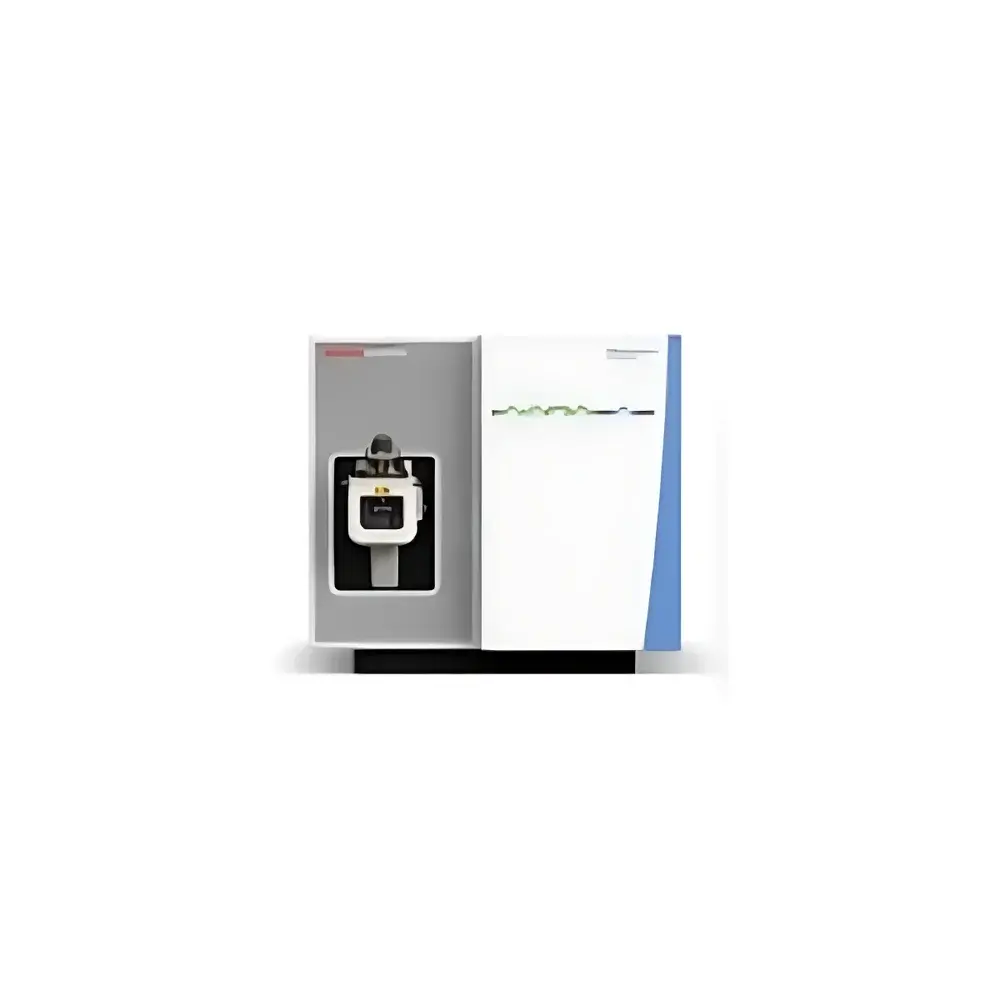
Thermo Scientific Q Exactive UHMR Hybrid Quadrupole-Orbitrap Mass Spectrometer
| Brand | Thermo Fisher |
|---|---|
| Origin | Shanghai, China |
| Manufacturer Type | Authorized Distributor |
| Product Origin | Domestic (China-manufactured) |
| Model | Thermo Scientific Q Exactive UHMR Hybrid Quadrupole-Orbitrap Mass Spectrometer |
| Pricing | Upon Request |
| Mass Range | 350–80,000 m/z |
| Mass Accuracy (External Calibration) | <3 ppm RMS (CsI cluster ions) |
| Max Resolution | 200,000 @ m/z 400 |
| Scan Rate | up to 12 Hz @ m/z 400 with R = 12,500 |
| Dynamic Range | >5,000:1 |
| Precursor Selection Range | up to 25,000 m/z |
| Ion Transmission Mode | In-source trapping for enhanced desolvation and transmission efficiency |
| Detection Mode | Synchronous Charge Detection enabled for Direct Mass Technology™ |
Overview
The Thermo Scientific Q Exactive UHMR Hybrid Quadrupole-Orbitrap Mass Spectrometer is engineered for high-fidelity native mass spectrometry of large biomolecular assemblies. It integrates a high-transmission quadrupole mass filter, an advanced Orbitrap mass analyzer with ultra-high mass range (UHMR) capability, and Thermo Scientific Direct Mass Technology™—a charge-detection-enabled acquisition mode that delivers unambiguous mass determination for heterogeneous, high-m/z species without reliance on charge-state deconvolution. This architecture enables robust analysis of intact protein complexes, membrane proteins, viral capsids, and synthetic macromolecular therapeutics under non-denaturing conditions. Unlike conventional top-down or native LC-MS platforms, the Q Exactive UHMR achieves simultaneous high resolution (>200,000 @ m/z 400), wide dynamic range (>5,000:1), and extended mass coverage (up to 80,000 m/z), making it uniquely suited for structural biology, biopharmaceutical characterization, and next-generation modalities including multispecific antibodies, ADCs, and nucleic acid–protein conjugates.
Key Features
- Hybrid quadrupole-Orbitrap architecture with in-source trapping for optimized ion transmission and desolvation of labile, high-mass complexes
- Precursor selection up to 25,000 m/z via high-transmission quadrupole filtering—enabling targeted MS2 and pseudo-MS3 workflows on intact assemblies
- Direct Mass Technology™ with synchronous charge detection: decouples mass measurement from charge-state assignment, eliminating ambiguity in heterogeneous samples
- Ultra-high resolution (200,000 @ m/z 400) and sub-3 ppm external mass accuracy (validated on CsI cluster ions) for confident identification of post-translational modifications, ligand binding, and stoichiometric variations
- HCD cell optimized for controlled activation—supporting both subunit release (for top-down sequencing) and gentle dissociation (to preserve native ligand–protein interactions)
- Full compatibility with native electrospray ionization (nESI), nanoESI, and SEC-LC-MS interfaces for solution-phase conformational analysis
Sample Compatibility & Compliance
The Q Exactive UHMR supports analysis of intact macromolecular systems ranging from ~350 Da to 80,000 m/z—including monoclonal antibodies (mAbs), antibody–drug conjugates (ADCs), virus-like particles (VLPs), ribonucleoprotein complexes, and membrane protein–nanodisc assemblies. Its native-mode operation aligns with ICH Q5E and USP guidelines for higher-order structure assessment of biologics. Data acquisition and processing comply with 21 CFR Part 11 requirements when deployed with Thermo Scientific Chromeleon CDS software (v7.3+), supporting audit trails, electronic signatures, and role-based access control. Instrument qualification protocols conform to ASTM E2691 and ISO/IEC 17025 standards for analytical instrument validation in regulated environments.
Software & Data Management
Data acquisition is controlled via Thermo Scientific Tune software (UHMR Edition), which includes dedicated methods for Direct Mass Technology™, native MS, and top-down fragmentation. Raw files are processed using BioPharma Finder™ 4.0 or Protein Metrics Byos™ for automated deconvolution, stoichiometry quantification, and modification mapping. All workflows support GLP/GMP-compliant reporting with full traceability of calibration history, method parameters, and raw-to-result transformations. Integration with Thermo Scientific Cloud services enables secure, encrypted data backup and cross-site collaboration—critical for multi-center structural proteomics initiatives.
Applications
- Native mass analysis of intact therapeutic proteins and their variants (e.g., glycoforms, oxidation products, truncations)
- Stoichiometric quantification of ligand binding (e.g., drug molecules, cofactors, nucleotides) to megadalton-scale complexes
- Top-down sequencing of non-covalent subunits released via controlled HCD activation
- Characterization of membrane proteins reconstituted in nanodiscs or amphipols
- Comparative analysis of biosimilar higher-order structure relative to reference products
- Monitoring aggregation states and conformational heterogeneity during formulation development
FAQ
What distinguishes Direct Mass Technology™ from conventional charge deconvolution?
Direct Mass Technology™ uses real-time charge detection to assign absolute mass values independent of charge-state distribution—eliminating errors introduced by incomplete deconvolution or overlapping charge envelopes in heterogeneous samples.
Can the Q Exactive UHMR perform tandem MS on species above 10,000 m/z?
Yes—the quadrupole precursor filter supports isolation up to 25,000 m/z, and the HCD cell delivers reproducible fragmentation across the full UHMR range under optimized activation conditions.
Is source-side collision-induced dissociation (CID) supported for native analysis?
No—native workflows rely exclusively on HCD for controlled, tunable activation; CID is not implemented in the UHMR configuration to preserve instrument stability and mass accuracy at high m/z.
How is calibration performed for high-mass accuracy in native mode?
External calibration uses CsI cluster ions (m/z 1,329–22,000) with automated lock-mass correction; internal calibration is available via co-infused calibrants compatible with native solvents (e.g., ammonium acetate).
Does the system support integration with size-exclusion chromatography (SEC)?
Yes—fully compatible with microflow and nano-flow SEC-LC-MS configurations; Tune software includes pre-optimized methods for online native separation coupled to UHMR detection.





