


Thermo Scientific FGD-CEMS Flue Gas Continuous Emission Monitoring System
| Brand | Thermo Scientific |
|---|---|
| Origin | USA |
| Manufacturer Type | Original Equipment Manufacturer (OEM) |
| Import Status | Imported |
| Model | FGD-CEMS |
| Instrument Type | Continuous Emission Monitoring System (CEMS) |
| Measurement Principle | Dilution Extraction with UV/IR Absorption and Paramagnetic/O2 Electrochemical Detection |
| Key Parameters | SO₂, NOₓ, CO, O₂, Flow Rate, Temperature, Static Pressure, Particulate Matter (PM), Relative Humidity, Total Reduced Sulfur (TRS), H₂S |
| Compliance Framework | EPA Performance Specifications (PS-2, PS-3, PS-5, PS-15), EN 15267, ISO 14001, US EPA Method 6C, Method 7E, Method 10, Method 3A, ASTM D6522, ASTM D5197 |
| Data Integrity | 21 CFR Part 11–compliant audit trail, GLP/GMP-ready reporting |
Overview
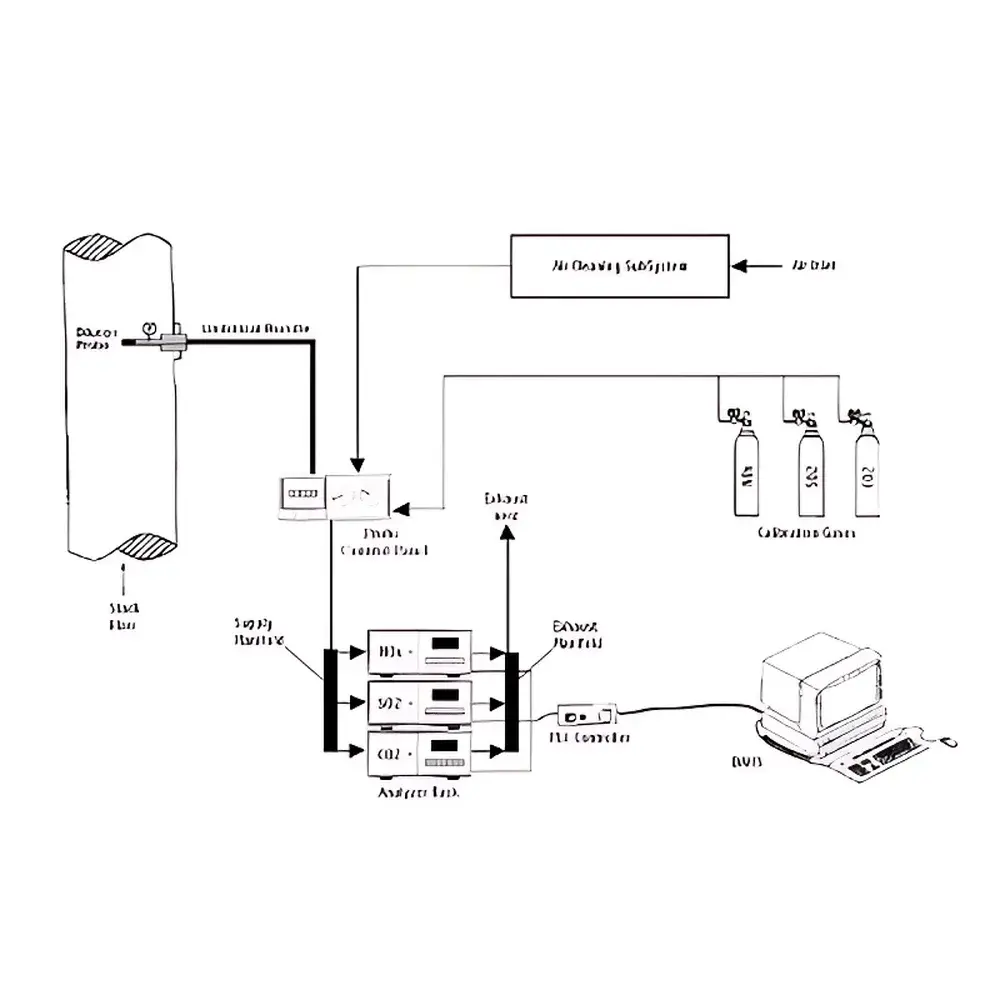
The Thermo Scientific FGD-CEMS is a fully integrated, EPA-certified Continuous Emission Monitoring System engineered for high-reliability, long-term operation in demanding flue gas environments—particularly at coal-fired power plants, steel mill boilers, and pulp & paper recovery furnaces. It employs a heated, extractive dilution sampling methodology to condition hot, wet, and particulate-laden flue gas prior to analysis. By introducing clean, dry instrument air to dilute the sample stream (typically at 50:1 or 100:1 dilution ratios), the system eliminates condensation-related artifacts—including SO₂ dissolution in condensed water, filter clogging, and analyzer corrosion—ensuring trace-level accuracy even under low-concentration, high-humidity conditions typical of FGD outlet ducts. The core analytical architecture combines UV absorption spectroscopy for SO₂ and NOₓ, non-dispersive infrared (NDIR) for CO, paramagnetic or electrochemical cells for O₂, and certified reference methods for flow (pitot tube or ultrasonic), temperature (Pt100 RTD), static pressure (capacitive transducer), and moisture (chilled mirror or tunable diode laser). All subsystems are housed in NEMA 4X-rated enclosures with climate control, meeting IEC 61508 SIL2 requirements for safety-critical environmental monitoring.
Key Features
- Dilution-extractive sampling with heated probe, Teflon-lined sample lines, and precision mass flow controllers to maintain constant dilution ratio ±0.5% over ambient temperature ranges (−20 °C to +50 °C)
- Multi-gas analyzers calibrated per EPA PS-2 (SO₂), PS-3 (NOₓ), PS-15 (CO), and PS-4 (O₂), with zero/span drift ≤1% FS/24 h
- Integrated particulate monitor using light scattering (nephelometry) compliant with EPA Method 9 and EN 13284-1
- Redundant data acquisition architecture with dual industrial PCs, hot-swappable storage, and automatic failover to local SD card logging during network interruption
- Real-time calculation of desulfurization efficiency, mass emission rates (kg/h), and 30-day rolling averages aligned with EU LCP BREF and U.S. Clean Air Act Title IV reporting requirements
- Modular design supporting field expansion: TRS measurement via GC-PFPD (gas chromatography–pulsed flame photometric detection) for pulp mill applications; H₂S quantification via lead acetate tape or electrochemical sensor options
Sample Compatibility & Compliance
The FGD-CEMS accommodates flue gas matrices across diverse combustion sources: bituminous and anthracite coal, blast furnace gas, coke oven gas, black liquor, and lime kiln exhaust. Its dilution probe operates continuously at stack temperatures up to 250 °C and particulate loadings ≤10 g/Nm³. All gas measurements meet the minimum detectable limits required by regulatory frameworks: SO₂ ≤0.5 ppm (1.4 mg/m³), NOₓ ≤0.2 ppm (0.4 mg/m³), CO ≤1 ppm (1.3 mg/m³), O₂ ±0.1% absolute. The system complies with U.S. EPA 40 CFR Part 60 Appendix B PS-2 through PS-15, European EN 14181 (QAL1–QAL3), and ISO/IEC 17025-accredited calibration traceability. Full validation documentation—including RATA (Relative Accuracy Test Audit), CEMS Performance Evaluation Reports, and Certificate of Conformance—is provided upon commissioning.
Software & Data Management
Thermo Scientific CEMS Manager v5.x provides browser-based configuration, real-time visualization, alarm management, and automated report generation (hourly/daily/monthly emissions summaries, exceedance logs, QA/QC trending). The software supports OPC UA and Modbus TCP protocols for seamless integration into plant DCS/SCADA systems. All data handling conforms to FDA 21 CFR Part 11: electronic signatures, role-based access control, immutable audit trails covering user logins, configuration changes, calibration events, and data exports. Historical data is retained for ≥5 years on redundant NAS storage with SHA-256 hashing and daily encrypted backups. Remote diagnostics and firmware updates are performed via TLS 1.2–secured channels with certificate-based authentication.
Applications
- Coal-fired power plants: Inlet/outlet FGD monitoring for SO₂ removal efficiency verification and Title V compliance reporting
- Integrated steelworks: Multi-fuel boiler stacks (coal, BF gas, LDG) requiring simultaneous SO₂, CO, and O₂ tracking under variable load and transient combustion conditions
- Pulp & paper mills: Recovery boiler and lime kiln monitoring with specialized TRS and H₂S modules; external dry-dilution probe minimizes maintenance in high-alkali, high-moisture streams
- Cement kilns and waste-to-energy facilities: High-dust, high-NOₓ environments where traditional extractive systems suffer frequent downtime
- Independent power producers (IPPs): Modular CEMS deployment with scalable channel count (up to 16 gas parameters) and optional weather station integration for fugitive emission modeling
FAQ
What regulatory standards does the FGD-CEMS satisfy for U.S. power plant compliance?
It meets all applicable requirements of 40 CFR Part 60 Appendix B (PS-2 through PS-15), including quarterly RATA, daily calibration checks, and annual QAL3 testing per EN 14181. Certification reports are issued by third-party EPA-accredited test bodies.
How does the dilution method improve SO₂ measurement accuracy at FGD outlet ducts?
By eliminating water vapor condensation upstream of the analyzer, it prevents SO₂ absorption losses that cause negative bias in direct-extract systems—particularly critical when measuring sub-10 ppm SO₂ in >15% RH flue gas.
Can the system be retrofitted to existing stack interfaces?
Yes. Standardized ANSI B16.5 flanges (Class 150/300), configurable probe lengths (0.5–4.5 m), and modular analyzer cabinets allow installation without structural modification to existing ductwork.
Is TRS measurement available as a factory-installed option?
Yes. The TRS module includes GC-PFPD with cryogenic preconcentration, automated calibration gas delivery, and speciation capability for methyl mercaptan, dimethyl sulfide, and hydrogen sulfide per EPA Method 1666.
What cybersecurity measures are implemented for remote data transmission?
All communications use TLS 1.2+ encryption, hardware-enforced MAC address binding, and firmware signed with Thermo’s private key—fully aligned with NIST SP 800-82 and ISA/IEC 62443-3-3 Level 2 requirements.







