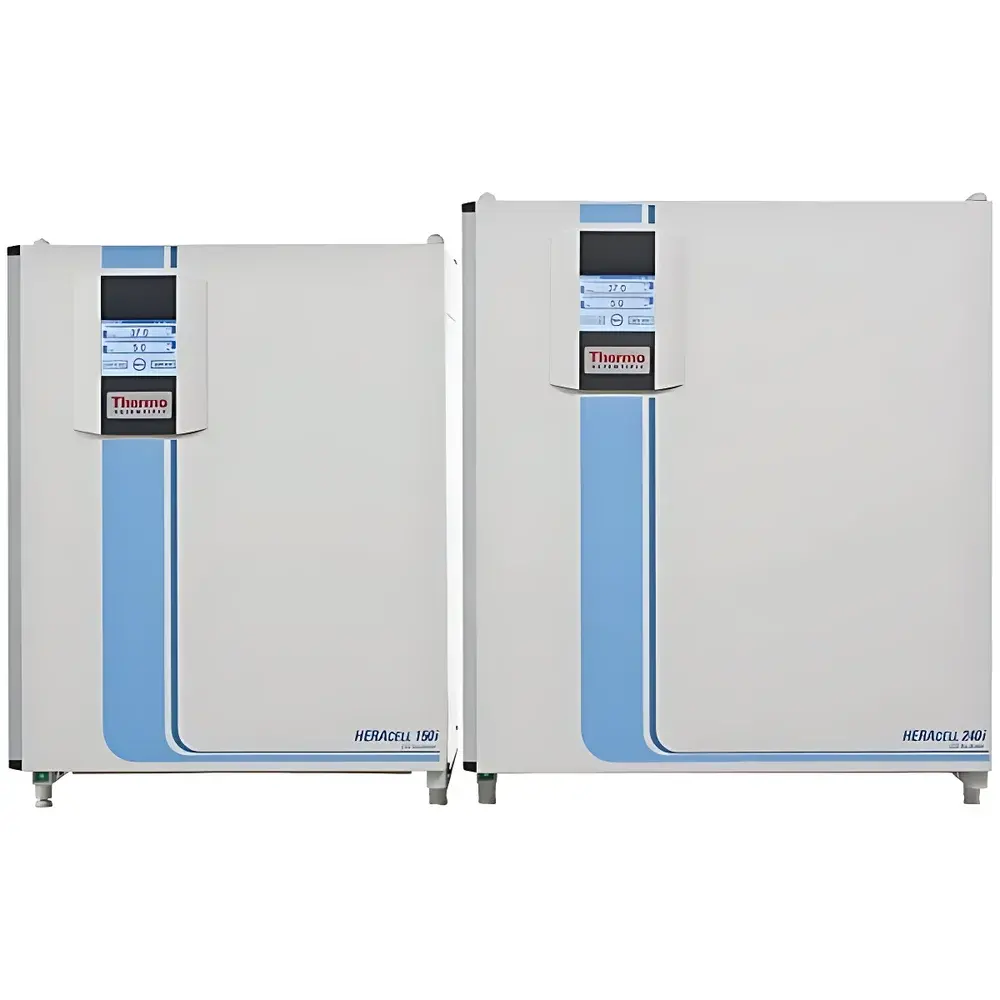
Thermo Scientific Heracell 150i and 240i CO₂ Incubators with Copper Interior Chamber
| Brand | Thermo Fisher |
|---|---|
| Origin | USA |
| Manufacturer | Thermo Fisher Scientific |
| Product Category | Imported Instrument |
| Model Numbers | 51026281 (Heracell 150i), 50116049 (Heracell 240i) |
| Price Range | USD 13,500 – 68,000 |
Overview
The Thermo Scientific Heracell 150i and 240i CO₂ incubators are precision-engineered environmental control systems designed for reliable, long-term mammalian cell culture under strictly regulated physiological conditions. These units employ a copper-lined inner chamber — a material selected for its intrinsic antimicrobial properties and superior thermal conductivity — to minimize microbial contamination risk and ensure uniform temperature distribution across the entire working volume. Both models operate on a triple-gas (CO₂, O₂, N₂) compatible architecture (O₂ control optional), with standard CO₂ regulation achieved via either thermal conductivity (TC) or infrared (IR) sensing technology. The IR sensor utilizes a dual-beam optical design that compensates for ambient fluctuations in temperature and relative humidity, delivering high-accuracy CO₂ concentration control (±0.1% CO₂ setpoint deviation) even during frequent door openings or environmental transients. Temperature stability is maintained at ±0.1 °C throughout the chamber, supported by microprocessor-controlled Peltier-assisted preheating of incoming air and a patented direct-heating water reservoir system.
Key Features
- Copper-clad stainless steel interior chamber — inhibits bacterial and fungal colonization while enhancing thermal homogeneity and corrosion resistance
- iCAN™ intuitive touchscreen interface with multi-language support (English, German, French, Spanish, Chinese, Japanese) and contextual on-screen guidance for setup, monitoring, and alarm acknowledgment
- Dual CO₂ sensing options: factory-calibrated thermal conductivity (TC) sensor for cost-effective routine use; or high-stability infrared (IR) sensor with beam-splitting optics for applications demanding trace-level CO₂ accuracy under dynamic humidity/temperature conditions
- Direct-heating humidification system featuring a large-capacity, thermostatically controlled water reservoir — achieves >95% RH recovery in ≤15 minutes post-door opening, up to 5× faster than conventional passive water pans
- Integrated water level monitoring with audible and visual alerts to prevent desiccation-induced culture failure
- Real-time environmental logging: continuous timestamped recording of CO₂ concentration, temperature, humidity, door status, and alarm events stored internally for ≥30 days
- Comprehensive alarm architecture including over-temperature, low-humidity, CO₂ deviation, door-open duration, and sensor fault detection — all configurable via touchscreen
Sample Compatibility & Compliance
These incubators accommodate standard tissue culture formats including T-flasks (up to T225), multiwell plates (6–384-well), Petri dishes, roller bottles, and cryoboxes. The uniform airflow design — optimized via CFD-simulated laminar distribution — avoids turbulence-induced shear stress on adherent monolayers. All models comply with IEC 61010-1 (Safety Requirements for Electrical Equipment for Measurement, Control, and Laboratory Use) and meet ISO 13485:2016 requirements for medical device manufacturing environments. Data integrity features include password-protected user levels, electronic audit trails for all parameter changes, and exportable CSV logs compatible with FDA 21 CFR Part 11-compliant LIMS integration when paired with Thermo Fisher’s Connect software suite.
Software & Data Management
The embedded firmware supports secure data export via USB flash drive or Ethernet connection. Environmental logs — including setpoints, actual values, alarms, and operator actions — are stored with ISO 8601 timestamps and SHA-256 hash verification to ensure immutability. Optional Thermo Fisher Connect platform enables remote monitoring, centralized fleet management, automated report generation, and integration with enterprise quality management systems (QMS). Audit trail functionality satisfies GLP and GMP documentation requirements, capturing user ID, action type, timestamp, and pre-/post-change values for every configuration modification.
Applications
- Primary and immortalized mammalian cell line maintenance (e.g., HEK293, CHO, HeLa, iPSCs)
- Stem cell expansion and differentiation protocols requiring stringent CO₂ and humidity fidelity
- Co-culture experiments involving multiple cell types with divergent microenvironmental sensitivities
- Regulatory-grade bioproduction workflows compliant with USP , ISO 5, and Annex 1 standards
- Long-term toxicity assays and pharmacokinetic modeling where culture stability directly impacts endpoint reproducibility
- Biobanking and cryopreservation workflow staging areas requiring validated environmental continuity
FAQ
What is the difference between the TC and IR CO₂ sensors?
The TC sensor measures CO₂-induced thermal conductivity changes in the gas mixture and is ideal for stable, low-frequency usage. The IR sensor uses wavelength-specific absorption spectroscopy with reference and measurement beams, enabling real-time compensation for humidity and temperature drift — recommended for high-throughput labs with frequent access.
Can these incubators be validated per IQ/OQ/PQ protocols?
Yes. Factory-provided validation documentation includes as-delivered temperature mapping reports, CO₂ calibration certificates traceable to NIST standards, and IQ/OQ templates aligned with ASTM E2500 and EU GMP Annex 15 guidelines.
Is O₂ control available as an upgrade?
O₂ modulation (0.1–20% range) is supported on both models via optional Tri-Gas configuration — requires separate order of gas mixing module and sterile filtration accessories.
How often does the copper chamber require cleaning or passivation?
Copper surfaces do not require chemical passivation. Routine decontamination using 70% ethanol or approved sporicidal agents is sufficient; no abrasive cleaners or chlorine-based solutions should be used to preserve surface integrity.
Does the system support network time protocol (NTP) synchronization?
Yes — Ethernet-connected units automatically synchronize internal clocks with user-defined NTP servers to ensure temporal consistency across distributed lab environments.