
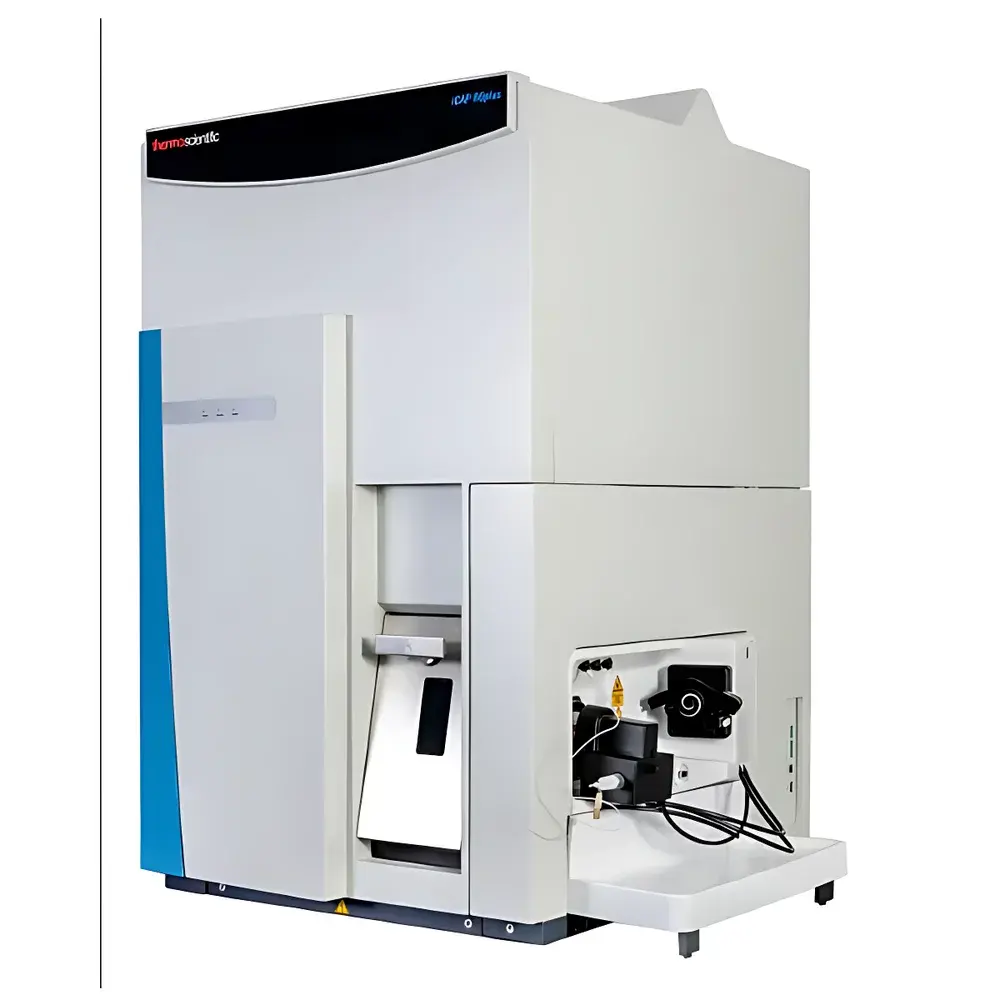
Thermo Scientific iCAP™ RQplus Inductively Coupled Plasma Mass Spectrometer
| Brand | Thermo Fisher |
|---|---|
| Origin | Shanghai, China |
| Manufacturer Type | Authorized Distributor |
| Product Origin | Domestic (China-manufactured) |
| Model | iCAP™ RQplus ICP-MS |
| Pricing | Available upon Request |
Overview
The Thermo Scientific iCAP™ RQplus ICP-MS is a high-performance, quadrupole-based inductively coupled plasma mass spectrometer engineered for robust, routine trace element and isotopic analysis across highly variable sample matrices. Operating on the fundamental principle of ion generation in a high-temperature Ar plasma (~7,000–10,000 K), followed by mass separation via a radiofrequency-driven quadrupole mass filter and detection using a dual-mode electron multiplier, the system delivers sub-femtogram-per-liter detection capabilities with high mass resolution and low polyatomic interference. Designed for laboratory environments requiring regulatory compliance and operational continuity—particularly in environmental monitoring, pharmaceutical quality control, battery materials characterization, and food safety testing—the iCAP RQplus integrates hardware stability, intelligent diagnostics, and workflow automation to minimize operator dependency while maintaining analytical rigor.
Key Features
- Advanced Argon Gas Dilution (AGD) Technology: Enables direct analysis of high-salt, high-matrix samples—including seawater, brines, digested biological tissues, and Li-ion battery electrolytes—without offline dilution, thereby eliminating contamination risk and improving throughput.
- EasyClick Peristaltic Pump System: Tool-free, single-action tubing loading ensures consistent nebulization and sample introduction; reduces setup time and inter-operator variability.
- Hawk™ Instrument Performance & Consumables Monitoring: Real-time tracking of torch condition, cone wear, vacuum integrity, and detector aging provides predictive maintenance alerts aligned with GLP/GMP documentation requirements.
- One-Touch Instrument Readiness Check: Automated pre-run validation verifies sensitivity (e.g., 115In signal intensity), stability (RSD ≤ 3% over 10 min), and robustness (CeO+/Ce+ ≤ 1.5%) prior to sample analysis—ensuring data integrity from first acquisition.
- Qtegra ISDS Software Integration: Supports full method development, real-time spectral visualization, isotope ratio calculation, and audit-trail-enabled reporting compliant with FDA 21 CFR Part 11 and ISO/IEC 17025 requirements.
Sample Compatibility & Compliance
The iCAP RQplus accommodates liquid samples introduced via concentric or microflow nebulizers, as well as laser ablation solid sampling when interfaced with compatible LA systems. It meets ASTM D5673 (trace metals in water), USP / (elemental impurities in pharmaceuticals), and ISO 17294-2 (water quality—determination of elements by ICP-MS). Its AGD modes support matrix tolerance up to 25% total dissolved solids (TDS), enabling direct analysis of undiluted seawater, geological digests, and spent catholyte solutions. All performance verification protocols align with ICH Q2(R2) guidelines for analytical method validation.
Software & Data Management
Qtegra ISDS software provides a modular, role-based interface supporting instrument control, data acquisition, processing, and secure export. It includes embedded calibration curve fitting (linear, quadratic, weighted), internal standard correction (e.g., 115In, 187Re), and automated drift correction. Audit trails record all user actions, parameter changes, and calibration events with timestamped, non-erasable entries. Data files are stored in vendor-neutral .raw format and can be exported to LIMS via ASTM E1384-compliant interfaces. Optional IQ/OQ/PQ documentation packages support installation and operational qualification under regulated environments.
Applications
- Environmental: Quantification of U, Pu, Sr, and rare earth elements (REEs) in groundwater, soil leachates, and atmospheric particulates per EPA Method 6020B.
- Pharmaceutical: Elemental impurity screening in active pharmaceutical ingredients (APIs) and excipients per ICH Q3D thresholds.
- Food & Beverage: Detection of toxic elements (As, Cd, Pb, Hg) in infant formula, wine, and seafood at EU Commission Regulation (EU) No 2023/915 levels.
- Battery Materials: Multi-element profiling of Ni, Co, Mn, Li, Al, and transition metal contaminants in NMC cathodes and electrolyte formulations.
- Sustainable Fuels: Trace metal catalyst residue analysis (e.g., Fe, Ni, V) in biojet fuel feedstocks per ASTM D7845.
FAQ
Is the iCAP RQplus manufactured in China compliant with international regulatory standards?
Yes—units produced at Thermo Fisher’s Shanghai facility undergo identical design verification, factory acceptance testing (FAT), and quality assurance protocols as globally distributed instruments, including ISO 9001-certified manufacturing and adherence to IEC 61010-1 safety standards.
Does the system support isotopic ratio measurements for geochemical or nuclear applications?
While optimized for high-precision quantitative trace analysis, the iCAP RQplus supports stable isotope ratio determination (e.g., 87Sr/86Sr) with appropriate tuning and calibration; however, for ultra-high-precision isotope ratio work (e.g., TIMS-level accuracy), a multi-collector ICP-MS is recommended.
How does the ACT Environmental Impact Label apply to this instrument?
The iCAP RQplus carries the My Green Lab ACT label, verifying third-party assessed metrics across manufacturing energy use, packaging recyclability, product lifespan, and end-of-life serviceability—enabling sustainability-conscious procurement decisions without compromising analytical performance.
Can the system be integrated into an existing LIMS environment?
Yes—via Qtegra’s configurable ODBC and ASTM E1384-compliant data export modules, supporting structured transfer of raw spectra, processed results, QC flags, and instrument metadata directly into enterprise LIMS platforms.
What maintenance intervals are recommended for routine operation?
Hawk™ monitoring establishes dynamic service schedules; typical preventive maintenance includes quarterly cone cleaning/replacement, biannual vacuum pump oil change, and annual RF generator calibration—documented in the included Service Logbook module within Qtegra.
Related Products






