
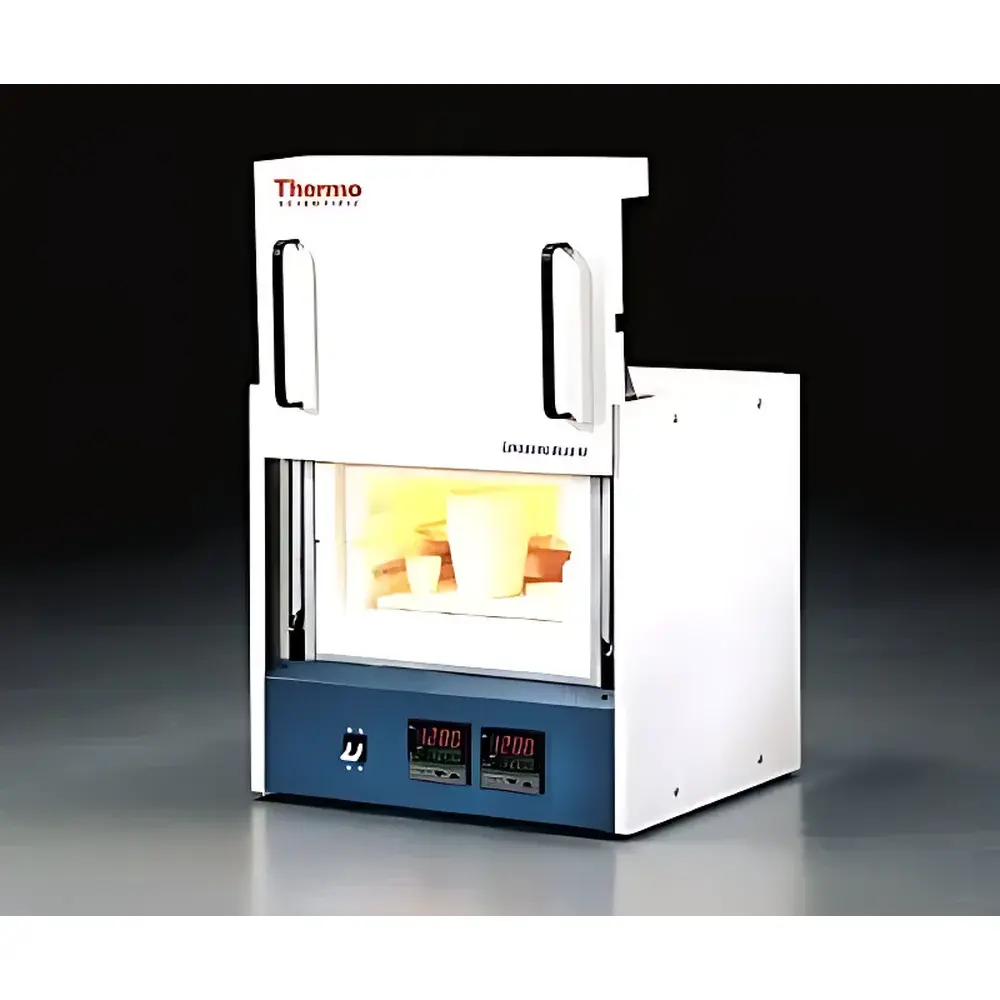
Thermo Scientific Lindberg/Blue M High-Performance Muffle Furnace
| Brand | Thermo Fisher Scientific |
|---|---|
| Origin | USA |
| Manufacturer | Thermo Fisher Scientific |
| Product Line | Lindberg/Blue M |
| Temperature Range | 1100°C to 1700°C |
| Construction | Dual-wall steel housing with patented Moldatherm® ceramic fiber insulation |
| Heating Element | Patented LGO™ (Light Gauge Overbend) resistance wire |
| Controller Options | Integrated or remote-mounted microprocessor-based temperature controller |
| Compliance | Designed for GLP/GMP environments |
| Safety | Surface temperature ≤70% of industry-standard comparables under full-load operation |
Overview
The Thermo Scientific Lindberg/Blue M High-Performance Muffle Furnace is a rigorously engineered laboratory and industrial furnace system designed for precise, repeatable, and thermally stable high-temperature processing. Operating on resistive heating principles within a fully isolated muffle chamber—physically and thermally decoupled from the heating elements—the furnace ensures uniform thermal distribution, minimal atmospheric contamination, and exceptional process reproducibility. Its core architecture integrates advanced thermal management strategies, including vacuum-formed ceramic fiber insulation and low-mass LGO™ heating elements, enabling rapid thermal ramping (up to 15°C/min typical), controlled cooling profiles, and stable isothermal holds across its full operational range (1100°C–1700°C). This design meets the stringent thermal stability requirements of materials synthesis, ash content determination (ASTM D3174, ISO 1171), sintering of ceramics and metal oxides, heat treatment of alloys (annealing, tempering, austenitizing), and controlled-atmosphere reactions (e.g., N₂, Ar, forming gas, or air).
Key Features
- Dual-wall structural integrity: Robust outer and inner steel casings provide mechanical durability, thermal containment, and operator safety—surface temperatures remain ≤70% of conventional furnaces at maximum setpoint.
- Patented Moldatherm® insulation: Vacuum-formed, high-purity ceramic fiber modules deliver superior thermal efficiency, reduced energy consumption (~25% less than standard brick-lined units), and enhanced temperature uniformity (±3°C at 1200°C in 12″×12″×12″ chamber).
- LGO™ (Light Gauge Overbend) heating elements: Precision-wound, low-inertia resistance wires ensure rapid thermal response, extended service life (>5,000 cycles at 1500°C), and consistent power delivery across multi-zone configurations.
- Modular controller architecture: Choice of integrated front-panel controllers (compact, slot-mount design) or remotely mounted microprocessor units supporting up to 99-segment programmable ramps, soak profiles, and real-time deviation alarms.
- Configurable chamber geometry: Available as box-type (horizontal/vertical door), tube-type (single- or triple-zone horizontal/vertical), and crucible-type (top- or bottom-loading) variants—each optimized for specific sample handling, atmosphere control, and throughput demands.
Sample Compatibility & Compliance
The Lindberg/Blue M furnace series accommodates diverse sample formats—including ceramic green bodies, metallurgical coupons, polymer composites, geological specimens, pharmaceutical excipients, and catalyst precursors—within standardized alumina, silicon carbide, or molybdenum disilicide (MoSi₂) crucibles and trays. All models support inert, oxidizing, reducing, or vacuum-compatible atmospheres when interfaced with optional gas manifolds and pressure-rated seals. Units are constructed and documented to align with quality system requirements for regulated environments: traceable calibration records, configurable alarm thresholds, and optional 21 CFR Part 11-compliant data logging (via Thermo Fisher’s optional FurnaceLink™ software) facilitate FDA, ISO 17025, and GLP audits. Standard compliance includes ASTM E220 (thermocouple calibration), ISO/IEC 17025 Annex A.2 (equipment qualification), and IEC 61000-6-3 (EMC emission standards).
Software & Data Management
Furnace operation is managed via embedded firmware supporting manual setpoint control, multi-step ramp-soak programs, and real-time monitoring of chamber temperature, thermocouple status, and power draw. Optional FurnaceLink™ software enables PC-based configuration, automated data export (CSV/TXT), digital signature authentication, electronic batch records, and time-stamped audit trails—including user login events, parameter changes, and alarm triggers. When deployed in networked lab environments, controllers support Modbus RTU/TCP communication for integration into centralized SCADA or MES platforms. All firmware updates undergo rigorous regression testing per IEC 62304 Class B medical device software standards, ensuring deterministic behavior under continuous thermal cycling.
Applications
- Ash content analysis per AOAC 942.05, EPA Method 1684, and ISO 21669 for food, environmental, and pharmaceutical matrices.
- Sintering of ZrO₂, Al₂O₃, and Si₃N₄ ceramics under controlled O₂ partial pressure.
- Thermal gravimetric pre-treatment of catalysts prior to BET surface area measurement (ISO 9277).
- Heat treatment of stainless steel and titanium alloys per AMS 2750E pyrometry requirements.
- Crystallization studies of amorphous metal oxides and chalcogenide glasses.
- Pre-firing of refractory coatings and investment casting shell molds.
FAQ
What temperature uniformity can be expected across the working chamber?
Typical radial and axial uniformity is ±3°C at 1200°C and ±5°C at 1700°C for standard box-type models—verified per ASTM E220 Annex A3 using a 9-point thermocouple mapping protocol.
Is vacuum operation supported?
Yes—select models (e.g., 1700°C Box Furnace w/ Integral Vacuum Flange) accommodate rough vacuum (10⁻² mbar) with optional diffusion pump integration and quartz viewing windows.
Can multiple furnaces be controlled from a single interface?
Absolutely—the remote controller architecture supports daisy-chained RS-485 networks or Ethernet-based supervision, enabling synchronized programming and centralized event logging for up to 32 units.
What thermocouple types are supported?
Standard configuration uses Type S (Pt/Pt–10% Rh) for ≥1200°C applications; Type K is available for lower-temperature variants. All inputs comply with NIST-traceable calibration standards.
How is temperature calibration performed and documented?
Each unit ships with a factory calibration certificate (NIST-traceable reference standard), and field recalibration is supported using external dry-block calibrators or fixed-point cells (e.g., Ag, Cu, Al freezing points) per ISO/IEC 17025 procedures.



