
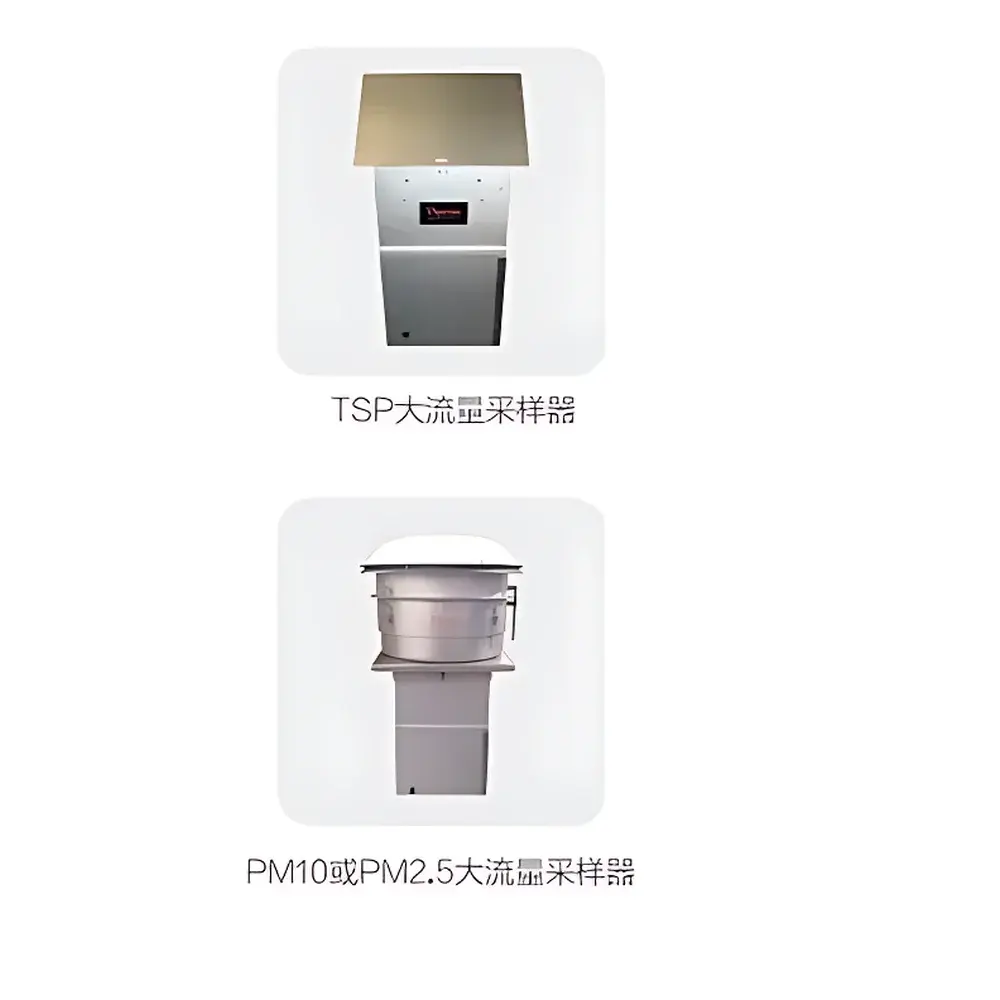
Thermo Scientific Model 5030 SHARP Particulate Monitor with High-Volume Sampling Module
| Brand | Thermo Fisher |
|---|---|
| Origin | USA |
| Manufacturer | Thermo Fisher Scientific |
| Import Status | Imported |
| Model | Thermo Scientific 5030 SHARP (High-Volume Sampling Configuration) |
| Instrument Type | High-Volume Ambient Air Sampler |
| Sampling Path | Single-Channel |
| Flow Range | PM₁₀ & PM₂.₅: 40 SCFM (1,133 L/min) |
| Flow Accuracy | Mass Flow Control: ±2.5% deviation over 24 h |
| Volumetric Flow Control | <1% deviation over 24 h |
| Power | 750 W (Mass Flow) / 840 W (Volumetric Flow) |
| Motor | 0.6 HP (Mass Flow) / 0.1 HP (Volumetric Flow) |
| Compliance | EPA Reference Method for PM₁₀/PM₂.₅ (40 CFR Part 53), ISO 12103-1, ASTM D1424 |
Overview
The Thermo Scientific Model 5030 SHARP Particulate Monitor—configured with its integrated high-volume sampling module—is an EPA-designated reference method instrument engineered for regulatory-grade ambient air monitoring of respirable and inhalable particulate matter. It operates on the tapered element oscillating microbalance (TEOM) principle coupled with a high-flow inertial separation system to deliver real-time, gravimetrically traceable mass concentration measurements for PM₂.₅, PM₁₀, and total suspended particulates (TSP). The high-volume sampling architecture ensures representative atmospheric sampling across diverse meteorological conditions and urban/rural deployment scenarios, meeting the stringent volumetric throughput requirements defined in 40 CFR Part 53 for federal reference methods (FRM) and federal equivalent methods (FEM). Its dual-mode flow control architecture—supporting both mass flow and volumetric flow configurations—enables compliance flexibility across evolving regulatory frameworks requiring either temperature/pressure-corrected or uncorrected volumetric sampling protocols.
Key Features
- Regulatory-compliant high-volume sampling at 40 SCFM (1,133 L/min) for PM₂.₅ and PM₁₀, with extended TSP range (20–60 SCFM) in mass flow mode and fixed 44 SCFM in volumetric mode
- Two precision flow control architectures: mass flow controller (±2.5% 24-h stability) with integrated thermal mass sensor and volumetric flow controller (<1% 24-h deviation) using critical orifice + pressure/temperature compensation
- Modular mechanical design enabling rapid field service: replaceable inlet assemblies, filter holder cartridges, and pump modules reduce mean time to repair (MTTR) by >40% versus legacy systems
- Enhanced operator interface with backlit graphical LCD, intuitive menu navigation, and embedded diagnostics—including real-time flow validation, motor current monitoring, and filter loading alerts
- Integrated communication suite supporting RS-232, RS-485, and optional Ethernet/IP for seamless integration into centralized environmental data acquisition networks (e.g., AQS, AIRNow)
- Robust industrial enclosure rated IP55 for outdoor deployment; operating temperature range: −30 °C to +50 °C with internal thermal management
Sample Compatibility & Compliance
The instrument is validated for use with standard 8″ × 10″ (20.3 cm × 25.4 cm) quartz fiber or PTFE membrane filters per EPA Method IO-3.3 and ISO 12103-1 (A2 test dust). It supports sequential multi-fraction sampling via optional cyclone or impactor stages compliant with ISO 7708 for aerodynamic cut-points at 10 µm (PM₁₀), 2.5 µm (PM₂.₅), and coarse mode (>2.5 µm). All firmware and data handling workflows adhere to EPA QA Handbook Volume II and support full audit trails required under 40 CFR Part 58 Subpart C for SLAMS and NCore sites. The system meets GLP data integrity requirements including electronic signature capability, user access controls, and immutable raw data storage.
Software & Data Management
Data acquisition and configuration are managed via Thermo Scientific E-Solutions™ software—a Windows-based platform compliant with FDA 21 CFR Part 11 for electronic records and signatures. The software provides automated calibration scheduling, remote firmware updates, and batch export of time-stamped concentration logs (µg/m³), flow profiles (L/min), temperature/pressure metadata, and diagnostic flags. Raw TEOM oscillation frequency data and filter mass change curves are stored in vendor-neutral CSV and NetCDF formats for third-party modeling (e.g., CMAQ, CAMx). Internal memory retains ≥30 days of second-by-second measurement history with battery-backed clock synchronization.
Applications
- Federal and state air quality monitoring networks (AQS) conducting FRM/FEM-compliant PM₂.₅ and PM₁₀ surveillance
- Long-term trend analysis in EPA NCore and SEARCH sites requiring high temporal resolution and low detection limits (≤0.5 µg/m³)
- Source apportionment studies utilizing co-located elemental carbon (EC)/organic carbon (OC) analyzers and metal speciation instruments
- Health effects research cohorts requiring exposure assessment with spatially resolved, gravimetrically verified particulate mass concentrations
- Industrial fence-line monitoring where continuous, maintenance-resilient sampling under variable ambient pressure conditions is critical
FAQ
What regulatory standards does this high-volume sampler meet?
It is designated as an EPA Federal Equivalent Method (FEM) for PM₂.₅ and PM₁₀ under 40 CFR Part 53, and complies with ISO 12103-1, ASTM D1424, and EN 12341 for particulate sampling performance validation.
Can the instrument operate unattended for extended periods?
Yes—it supports fully autonomous operation for up to 30 days with scheduled filter changes, onboard power failure recovery, and watchdog-timer–driven system reset logic.
Is volumetric flow correction applied in real time?
In volumetric mode, temperature and barometric pressure inputs from integrated sensors are used for continuous flow correction per ISO 5167; raw and corrected flow values are logged simultaneously.
How is data security and traceability ensured?
All measurement events are timestamped with NTP-synchronized clocks; audit logs record every user action, parameter change, and calibration event with digital signature and role-based access control per 21 CFR Part 11.
What maintenance intervals are recommended?
Pump oil replacement every 6 months; critical orifice inspection quarterly; annual full metrological verification against NIST-traceable flow standards is advised for regulatory reporting continuity.







