
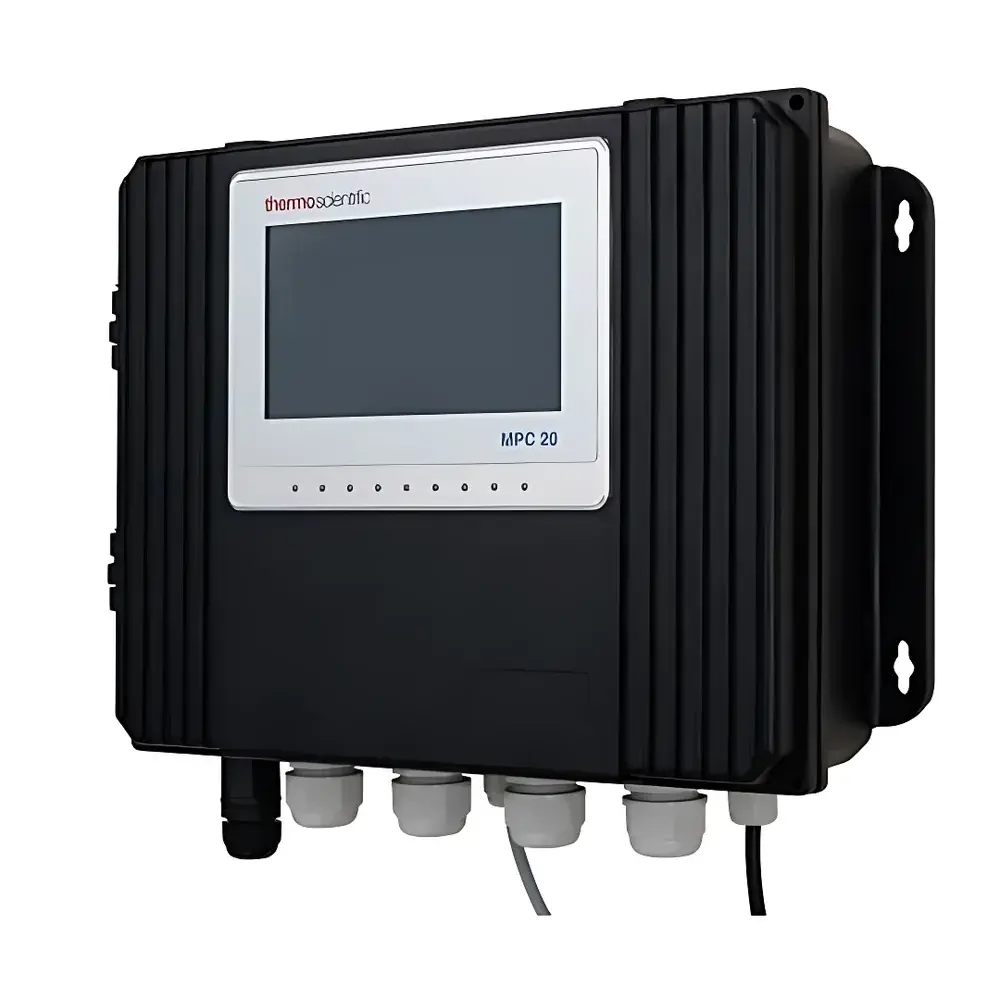
Thermo Scientific MPC 20 Online Multi-Parameter Universal Controller
| Brand | Thermo Fisher |
|---|---|
| Origin | USA |
| Manufacturer | Thermo Fisher Scientific |
| Product Category | Imported Instrument |
| Model | Thermo Scientific MPC 20 |
| Pricing | Upon Request |
Overview
The Thermo Scientific MPC 20 Online Multi-Parameter Universal Controller is an industrial-grade, field-deployable control and data acquisition platform engineered for continuous, real-time water quality monitoring in demanding environmental and process applications. Built upon Thermo Fisher Scientific’s decades of expertise in analytical instrumentation and regulatory-compliant water monitoring systems, the MPC 20 implements a modular architecture that supports simultaneous integration of up to 10 primary sensors plus N auxiliary inputs—enabling concurrent measurement of parameters such as pH, ORP, conductivity, dissolved oxygen (DO), turbidity, ammonium, nitrate, chloride, and temperature. Its core operating principle relies on standardized analog signal conditioning (4–20 mA, 0–5/10 V), digital sensor interface protocols (e.g., RS-485), and embedded firmware-driven calibration management. Designed for deployment in municipal drinking water treatment plants, wastewater influent/effluent streams, aquaculture facilities, industrial process loops, and integrated environmental monitoring networks, the MPC 20 serves as a centralized hub for sensor aggregation, local logic control, data logging, and secure telemetry—fully aligned with Industry 4.0 interoperability requirements.
Key Features
- Scalable multi-sensor architecture supporting up to 10 primary sensor channels + N auxiliary inputs (e.g., flow, level, pressure) via configurable analog/digital interfaces
- Integrated temperature compensation engine applied universally across all connected sensors, ensuring traceable thermal correction per ISO 7027 (turbidity), ISO 5814 (DO), and ASTM D1293 (pH)
- IP66-rated enclosure certified for outdoor and harsh indoor environments—resistant to dust ingress and powerful water jets
- Onboard non-volatile memory capable of storing ≥1 year of second-resolution time-stamped data (including measurements, events, alarms, and calibration logs) at default 1-minute sampling intervals
- Dual communication pathways: isolated 10/100 Mbps Ethernet (Modbus TCP, HTTP API, SNMP v2c) and optically isolated RS-485 (Modbus RTU, ASCII protocol support)
- I/O flexibility: 6 programmable analog outputs (4–20 mA or 0–10 V), 2 analog inputs (4–20 mA configurable), and 6 relay outputs (4 configurable as active/passive dry contact, 2 fixed active)
- Firmware-upgradable via USB flash drive or remote network push—supporting zero-downtime updates and version rollback capability
Sample Compatibility & Compliance
The MPC 20 operates exclusively with Thermo Scientific-certified and third-party analog/digital water quality sensors compliant with IEC 61000-6-2 (EMC immunity) and IEC 61000-6-4 (EMC emission) standards. It is validated for use with EPA Method-compliant probes (e.g., EPA 180.1 for pH, EPA 4500-Cl⁻ G for chloride) and supports calibration traceability to NIST-traceable reference standards. The controller meets UL 61010-1 and CE marking requirements for safety in industrial measurement applications. Data integrity functions—including audit trail logging, user role-based access control (admin/operator/viewer), and tamper-evident event timestamps—facilitate alignment with GLP and GMP documentation practices. While not FDA 21 CFR Part 11–certified out-of-the-box, its secure authentication, electronic signature readiness, and immutable log structure enable qualification for regulated water system validation under USP and ISO/IEC 17025 frameworks.
Software & Data Management
The MPC 20 embeds Thermo Scientific’s proprietary EdgeLink™ firmware, providing local web-based configuration (HTTPS-enabled), real-time dashboard visualization, and alarm-triggered email/SMS notifications via SMTP/HTTP POST. Logged data exports natively in CSV and XML formats, with optional integration into SCADA systems (e.g., Ignition, Siemens Desigo, Wonderware) via Modbus mapping tables. Remote diagnostics include live sensor health status, signal noise analysis, and drift trend reporting. Firmware and configuration backups are encrypted and timestamped; all user actions (login, parameter change, calibration, reboot) are recorded with UID, timestamp, and action type—ensuring full operational traceability required for ISO 9001 and ISO 14001 internal audits.
Applications
- Municipal drinking water distribution networks: continuous residual chlorine, pH, and turbidity surveillance per WHO Guidelines and EU Drinking Water Directive (2020/2184)
- Wastewater treatment plants: synchronized monitoring of DO, ORP, and ammonium in activated sludge basins for adaptive aeration control
- Aquaculture and hydroponic systems: real-time DO, temperature, and conductivity feedback for automated dosing and climate regulation
- Industrial cooling towers and boiler feedwater: corrosion risk assessment via conductivity, pH, and ORP correlation
- Environmental monitoring stations: long-term unattended operation with solar/battery backup compatibility and cellular telemetry integration
FAQ
What sensor types are supported by the MPC 20?
The MPC 20 accepts analog (4–20 mA, 0–5/10 V) and digital (RS-485 Modbus RTU) sensors from Thermo Scientific and qualified third-party manufacturers—including pH, ORP, conductivity, DO, turbidity, ammonium, nitrate, chloride, and temperature probes.
Does the MPC 20 support regulatory-compliant data archiving?
Yes—it maintains a write-once, read-many (WORM) event log with cryptographic timestamping, supporting retention of ≥1 year of raw data and operator actions in accordance with ISO/IEC 17025 Clause 7.5.2 and EPA Guidance for Electronic Records (2019).
Can the MPC 20 operate without network connectivity?
Yes—the unit functions autonomously with full local control logic, data logging, and relay actuation. Network connectivity is required only for remote access, cloud upload, or centralized supervision.
Is firmware update reversible?
Yes—firmware images include version-specific rollback packages, and the bootloader validates digital signatures prior to installation to prevent unauthorized or corrupted updates.
How is sensor calibration managed?
Calibration procedures are executed locally via the web interface or remotely via Modbus commands. All calibration events—including buffer values, slope/offset results, and operator ID—are stored in the audit log with ISO 17025–compliant metadata.







