
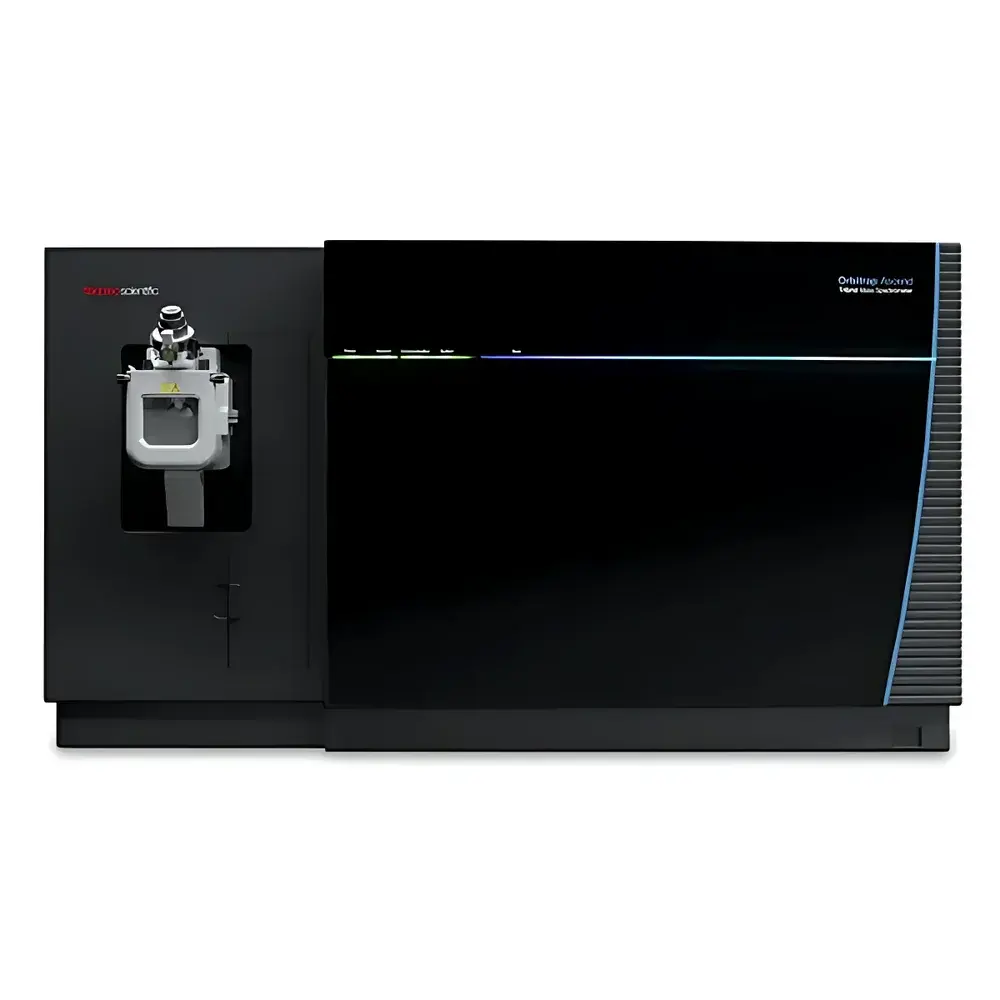
Thermo Scientific Orbitrap Ascend BioPharma Tribrid Mass Spectrometer
| Brand | Thermo Fisher |
|---|---|
| Origin | Shanghai, China |
| Manufacturer Type | Authorized Distributor |
| Regional Classification | Domestic (China-manufactured) |
| Model | Orbitrap Ascend BioPharma Tribrid Mass Spectrometer |
| Pricing | Available Upon Request |
Overview
The Thermo Scientific Orbitrap Ascend BioPharma Tribrid Mass Spectrometer is a purpose-engineered high-resolution, high-mass-accuracy platform designed specifically for the rigorous analytical demands of biopharmaceutical characterization. Built upon the proven Tribrid architecture—integrating a quadrupole mass filter, linear ion trap (LIT), and Orbitrap mass analyzer—the system delivers simultaneous high-sensitivity detection, structural elucidation, and quantitative precision across intact proteins, large peptides, antibody-drug conjugates (ADCs), glycoproteins, and multi-subunit complexes. Its core measurement principle relies on electrostatic trapping and Fourier-transform-based detection in the Orbitrap analyzer, enabling mass resolution up to 500,000 (FWHM at m/z 200) and sub-ppm mass accuracy under calibrated conditions. Unlike conventional platforms constrained by low-mass cutoff limitations in native MS workflows, the BioPharma Edition extends robust performance into the high-m/z regime—supporting full-scan detection up to m/z 16,000 in the Orbitrap and isolation up to m/z 8,000 in both the quadrupole and LIT—with narrow isolation windows as low as m/z 5 (in LIT) and m/z 100 (in quadrupole). This architecture enables direct analysis of non-denatured biomolecular assemblies without compromising sensitivity or duty cycle.
Key Features
- Native MS-ready configuration with optimized ion optics and extended high-m/z transmission for intact protein and complex analysis
- Dual-detection capability: parallel acquisition in Orbitrap (high-resolution, high-mass-accuracy) and LIT (fast, sensitive MS/MS)
- Quadrupole-based precursor selection with variable isolation width (m/z 5–100), enabling precise targeting of heterogeneous species such as glycoforms and charge variants
- Advanced RF voltage control and collision energy ramping for reproducible fragmentation of labile biopharmaceutical analytes
- Integrated front-end compatibility with nanoLC, microLC, and offline fractionation systems—including support for 2D-LC and SEC-MALS coupling
- Modular hardware design compliant with ISO 9001-certified manufacturing standards; assembled and tested at Thermo Fisher’s Shanghai facility
Sample Compatibility & Compliance
The BioPharma Edition supports a broad range of sample types critical to biologics development: monoclonal antibodies (mAbs), bispecifics, Fc-fusion proteins, viral vectors, extracellular vesicles, and membrane protein preparations solubilized in mild detergents or nanodiscs. It meets essential regulatory expectations for analytical instrument qualification, including alignment with ICH Q5E (comparability), USP (mass spectrometry validation), and FDA Guidance for Industry on Analytical Procedures and Methods Validation for Drugs and Biologics. Data integrity features comply with 21 CFR Part 11 requirements through secure user authentication, electronic signatures, and audit-trail-enabled method execution logs. System suitability testing (SST) protocols are embedded within Thermo Scientific BioPharma Finder software to support GLP/GMP-aligned workflows.
Software & Data Management
Controlled exclusively via Thermo Scientific BioPharma Finder 5.0 software, the platform provides end-to-end processing—from raw file ingestion and deconvolution (using advanced charge-state deconvolution algorithms) to higher-order structure assessment (HDX-MS, cross-linking MS, native top-down sequencing). All processing steps are scriptable and exportable as SOP-compliant templates. Raw data files adhere to the open mzML standard (version 1.1.0), ensuring long-term archival compatibility and third-party tool interoperability (e.g., Skyline, Byonic, pLink). Instrument method files include metadata fields for traceable parameter versioning, and all processing results are linked to original acquisition events via unique UUID-based referencing. Data backups follow NIST SP 800-88 Rev. 1 guidelines for media sanitization and retention scheduling.
Applications
- Intact mass analysis of mAbs and ADCs with sub-Da mass accuracy and isotopic fine-structure resolution
- Native MS characterization of protein-ligand interactions, stoichiometry determination, and conformational heterogeneity assessment
- Top-down sequencing of therapeutic proteins with automated fragment annotation and PTM localization
- Comparability studies across biosimilar development stages (cell line, purification, formulation)
- Higher-order structure monitoring during forced degradation (thermal, oxidative, acidic stress)
- Release testing support for CMC documentation packages submitted to EMA, PMDA, and NMPA
FAQ
Is this instrument manufactured in the U.S. or China?
This system is assembled and fully tested at Thermo Fisher Scientific’s ISO 13485-certified facility in Shanghai, China, under strict technology transfer protocols from the U.S. R&D center in San Jose.
Does it support 21 CFR Part 11 compliance out-of-the-box?
Yes—when deployed with Thermo Scientific Chromeleon CDS 7.3 or later and BioPharma Finder 5.0, the system provides validated electronic signature, role-based access control, and immutable audit trails required for regulated environments.
Can it perform native MS on membrane proteins reconstituted in nanodiscs?
Yes—the instrument’s extended high-m/z transmission, low-noise detector electronics, and optimized desolvation gas flow enable robust detection of nanodisc-embedded targets up to ~500 kDa.
What level of technical support is available for method development?
Thermo Fisher offers application-specific support through its Global BioPharma Application Specialists team, including remote method optimization, on-site feasibility studies, and co-authored white papers aligned with ICH and USP guidance documents.







