
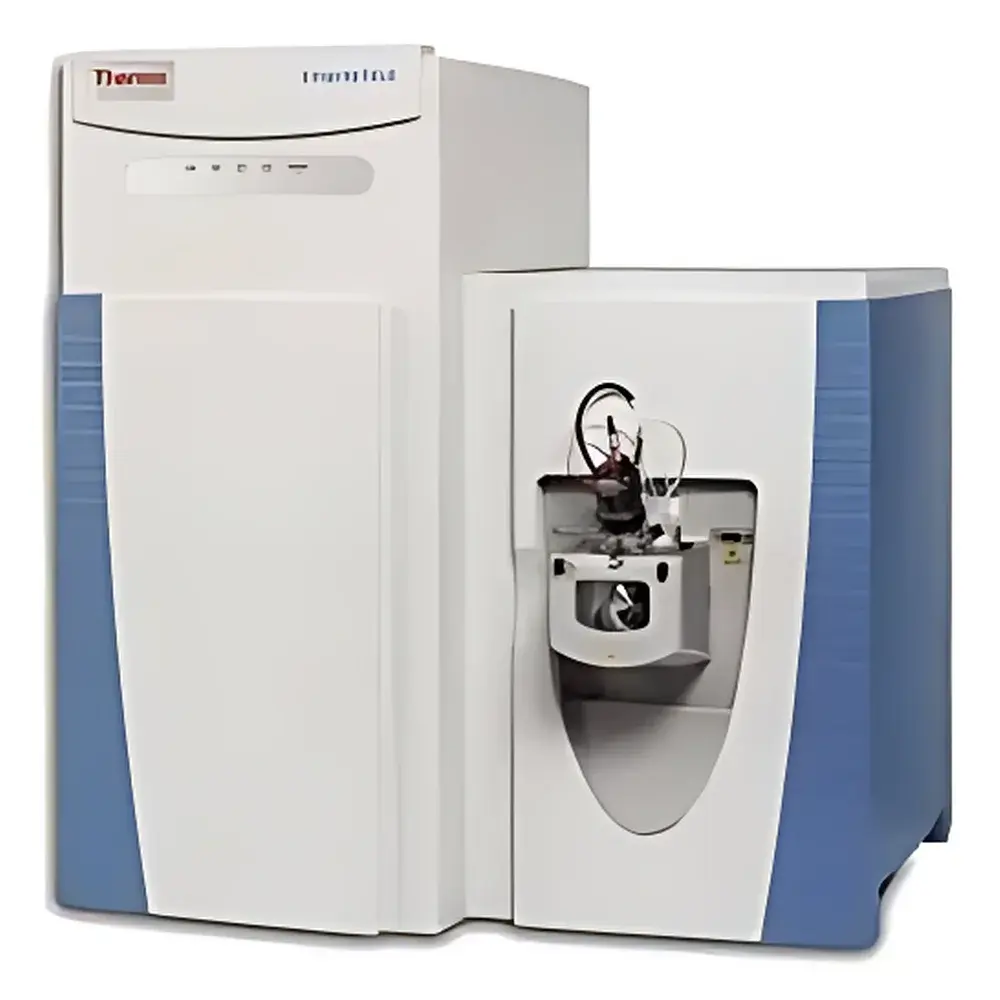
Thermo Scientific Orbitrap-Based Liquid Chromatography Mass Spectrometry (LC-MS) System
| Origin | USA |
|---|---|
| Manufacturer Type | Authorized Distributor |
| Import Status | Imported |
| Model | Thermo Scientific Orbitrap LC-MS Platform |
| Price Range | USD 950,000 – 1,280,000 (FOB) |
| Instrument Class | Hybrid Orbitrap Mass Spectrometer |
| Mass Range | 50–6,000 m/z (typical operational range for small molecules and peptides) |
| Resolution | Up to 500,000 FWHM (at m/z 200) |
| Mass Accuracy | < 1 ppm RMS (with internal calibration) |
| Sensitivity | Sub-femtomole on-column detection for peptides (SRM/MRM mode) |
| Scan Speed | Up to 20 Hz MS/MS acquisition rate in data-dependent mode |
Overview
The Thermo Scientific Orbitrap-based Liquid Chromatography Mass Spectrometry (LC-MS) system is a high-performance hybrid mass spectrometer engineered for precision molecular characterization across life science, pharmaceutical, environmental, and clinical research applications. It integrates ultra-high-resolution Fourier-transform mass analysis (Orbitrap detection) with advanced front-end ionization sources—including electrospray ionization (ESI), heated electrospray ionization (H-ESI), and atmospheric pressure chemical ionization (APCI)—and couples seamlessly with UHPLC separation modules. The core measurement principle relies on electrostatic trapping of ions in a modified orbital trap, followed by image-current detection and fast Fourier transformation to generate mass spectra with exceptional mass accuracy, resolution, and dynamic range. This architecture enables confident identification, structural elucidation, and quantitative profiling of small molecules, lipids, metabolites, peptides, and intact proteins—even in complex biological matrices.
Key Features
- Hybrid quadrupole-Orbitrap architecture supporting both targeted (SRM/MRM, PRM) and untargeted (DDA, DIA, HDMSE) acquisition modes
- Real-time, intelligent data-dependent acquisition (IDA) with dynamic exclusion and intensity-based triggering
- Multi-notch isolation for parallel reaction monitoring (PRM) with unit-resolution precursor selection
- On-the-fly recalibration using lock mass correction (e.g., polysiloxane or internal calibrant) to maintain sub-ppm mass accuracy throughout multi-hour runs
- Robust vacuum system with dual-stage differential pumping and cryo-cooled detectors for long-term stability and signal reproducibility
- Modular ion source design enabling rapid switching between ESI, APCI, and nano-ESI configurations without venting the mass analyzer
Sample Compatibility & Compliance
This LC-MS platform supports aqueous, organic, and mixed-solvent eluents compatible with reversed-phase, HILIC, and ion-pairing chromatography. It accommodates sample types ranging from purified standards and cell lysates to plasma, urine, tissue homogenates, and environmental extracts—provided they meet standard LC-MS compatibility criteria (e.g., low salt content, absence of non-volatile buffers). The instrument complies with international regulatory frameworks essential for GLP and GMP environments: it supports 21 CFR Part 11-compliant audit trails, electronic signatures, and role-based user access control when operated with Thermo Scientific Chromeleon CDS v7.3 or later. Method validation documentation aligns with ICH Q2(R2), USP <1225>, and ISO/IEC 17025 requirements for analytical instrument qualification (AIQ).
Software & Data Management
Data acquisition, processing, and interpretation are fully integrated via Thermo Scientific Compound Discoverer, Proteome Discoverer, and TraceFinder software suites—each validated for specific application domains (metabolomics, proteomics, small-molecule quantitation). Raw data files (.raw) are stored in vendor-neutral, open-format repositories compliant with mzML 1.1.0 specifications. All software modules support automated peak detection, retention time alignment, isotopic pattern deconvolution, formula prediction (via SIRIUS integration), and spectral library matching (against NIST, mzCloud, and HMDB databases). Audit trail logs record every parameter change, calibration event, and data export action with timestamp, operator ID, and IP address—ensuring full traceability during regulatory inspections.
Applications
- Quantitative bioanalysis of pharmaceutical compounds and metabolites in biological fluids (FDA-guided PK/PD studies)
- Comprehensive metabolomic profiling in disease-state discovery and biomarker validation
- Post-translational modification (PTM) mapping and top-down/bottom-up proteomics
- Residue analysis of pesticides, veterinary drugs, and mycotoxins in food and feed (EU SANTE/2023/12784 aligned)
- Characterization of oligonucleotide therapeutics, ADCs, and glycoproteins under ICH Q5 guidelines
- Environmental contaminant screening (PFAS, brominated flame retardants, microplastic additives) at sub-ng/L levels
FAQ
What ionization sources are supported natively?
ESI, H-ESI, APCI, and nanospray ionization (nESI) are factory-integrated and fully software-controlled. Additional sources (e.g., DESI, MALDI) require optional interface kits.
Is method transfer possible between different Orbitrap platforms?
Yes—method parameters (scan ranges, collision energies, AGC targets) are largely portable across current-generation Orbitrap instruments when using identical acquisition modes and firmware versions.
How often does the instrument require mass calibration?
Internal lock mass calibration ensures continuous accuracy; external calibration is recommended every 72 hours for regulated environments or after major maintenance events.
Can this system be integrated into an automated sample workflow?
Yes—it supports direct communication with Thermo Scientific Vanquish UHPLC systems, PAL autosamplers, and third-party LIMS via ASTM E1578-compliant drivers and OPC UA protocol.





