
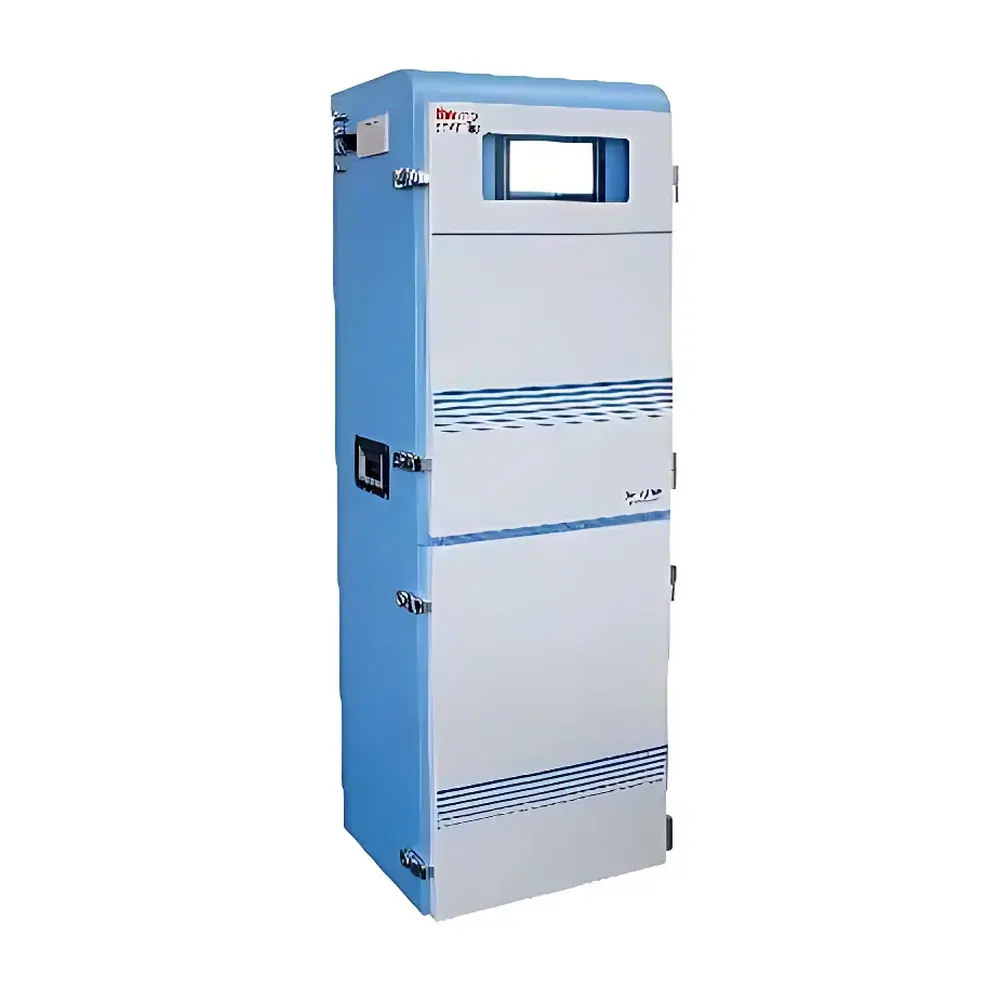
Thermo Scientific Orion 3150 Total Phosphorus and Total Nitrogen Online Analyzer
| Brand | Thermo Fisher Scientific |
|---|---|
| Origin | USA |
| Manufacturer | Thermo Fisher Scientific |
| Product Type | Imported |
| Model | Orion 3150 |
| Measurement Parameters | Total Phosphorus (TP) and Total Nitrogen (TN) |
| Instrument Type | Online Analyzer |
| Measurement Principle | Spectrophotometry (UV-Vis) |
| Measurement Ranges | 0–2 mg/L, 0–10 mg/L, 0–50 mg/L (auto-ranging) |
| Accuracy | ±5% of reading |
| Detection Limit | 0.005 mg/L |
| Resolution | 0.01 mg/L |
Overview
The Thermo Scientific Orion 3150 Total Phosphorus and Total Nitrogen Online Analyzer is an industrial-grade, fully automated spectrophotometric system engineered for continuous, unattended monitoring of total phosphorus (TP) and total nitrogen (TN) in aqueous matrices. It operates on standardized colorimetric methodologies compliant with EPA Methods 365.4 (for TP) and 353.2/351.2 (for TN), incorporating high-temperature alkaline persulfate digestion followed by UV–visible spectrophotometric quantification at specific wavelengths (e.g., 880 nm for phosphomolybdate complex; 220 nm and 275 nm for TN via dual-wavelength correction). Designed for deployment in demanding environmental and industrial settings—including municipal wastewater treatment plants, industrial effluent discharge points, and surface water quality surveillance networks—the Orion 3150 delivers robust performance under variable hydraulic and matrix conditions. Its architecture supports long-term operational stability with minimal manual intervention, meeting the functional requirements of ISO 15839, EN 14181 (QAL1/QAL2), and U.S. EPA’s Performance Specification 10 (PS-10) for online nutrient analyzers.
Key Features
- Auto-ranging measurement capability across three programmable concentration spans (0–2 mg/L, 0–10 mg/L, 0–50 mg/L), enabling optimal signal-to-noise ratio across diverse sample concentrations without manual range switching.
- Modular configuration flexibility: deploy as a dedicated TP analyzer, TN analyzer (with wastewater or surface water optimized chemistries), or integrated TP/TN dual-channel system—each with independent reagent delivery, digestion, and optical paths.
- Integrated digestion–detection cell design eliminates transfer losses and reduces carryover, enhancing measurement repeatability (RSD < 3% over 24 h) and shortening cycle time to ≤25 minutes per parameter.
- High-stability xenon flash lamp (rated for >10⁸ flashes) ensures consistent spectral output across the 190–1100 nm range, critical for accurate dual-wavelength TN determination and long-term photometric drift control.
- Matrix interference mitigation: built-in compensation algorithms correct for non-specific absorbance from color, turbidity, and organic chromophores—eliminating need for separate blanking or filtration steps per sample.
- Automated quality control (QC) verification: scheduled introduction of certified reference standards (e.g., potassium hydrogen phthalate for TN, potassium dihydrogen phosphate for TP) with configurable frequency (hourly to weekly) and pass/fail criteria aligned with ISO/IEC 17025 internal QC protocols.
- Remote operation and diagnostics via Ethernet/IP or Modbus TCP: enables real-time command execution (e.g., calibration, cleaning, forced measurement), firmware updates, and secure data retrieval through TLS 1.2–encrypted channels.
Sample Compatibility & Compliance
The Orion 3150 accepts raw or pre-filtered liquid samples with suspended solids ≤50 mg/L and chloride concentration ≤2,000 mg/L (for TN mode). It accommodates inlet pressures from 0.1–3.0 bar and sample temperatures from 5–40 °C. Pre-treatment options include standard particulate filtration (Orion PU1) or homogenizing slurry handling (Orion PU2) for high-solids influents. All analytical procedures comply with regulatory frameworks governing environmental monitoring: U.S. EPA Clean Water Act reporting requirements, EU Water Framework Directive (WFD) Annex V monitoring specifications, and China’s HJ 670–2013 and HJ 636–2012 standard methods. Data integrity is maintained in accordance with FDA 21 CFR Part 11 (electronic records/signatures) and EU Annex 11 (computerized systems), including full audit trail logging of all user actions, method changes, and calibration events.
Software & Data Management
The embedded Orion Analytical Manager (OAM) firmware provides intuitive web-based interface (HTML5, responsive design) accessible via desktop or tablet. OAM supports configurable data export formats (CSV, XML, MODBUS register mapping) and integrates natively with SCADA, LIMS, and cloud-based platforms (e.g., AWS IoT Core, Microsoft Azure IoT Hub) using MQTT or RESTful APIs. All measurement data are timestamped with NTP-synchronized UTC clocks and stored locally on industrial-grade SD card (≥1 year retention at 1-min intervals). Calibration curves, QC results, maintenance logs, and alarm histories are retained separately with SHA-256 hash verification to ensure immutability. Optional cybersecurity features include role-based access control (RBAC), certificate-based authentication, and periodic vulnerability scanning reports.
Applications
- Municipal wastewater treatment: real-time monitoring of TP/TN removal efficiency across primary, secondary, and tertiary treatment stages—supporting dynamic process control and regulatory discharge compliance reporting.
- Industrial pretreatment systems: continuous tracking of nutrient loads from food processing, chemical manufacturing, and pulp & paper facilities to verify pretreatment efficacy and avoid sewer surcharge penalties.
- Surface water and reservoir management: early detection of eutrophication precursors in intake sources, tributaries, and downstream receiving waters—enabling adaptive watershed response strategies.
- Environmental compliance monitoring: automated generation of certified reports for NPDES permits, ISO 14001 EMS audits, and third-party verification under GLP/GMP-aligned laboratory practices.
- Research and method validation: platform used in inter-laboratory studies evaluating digestion efficiency, reagent stability, and matrix effects across diverse water types (seawater, landfill leachate, agricultural runoff).
FAQ
What digestion method does the Orion 3150 use for total nitrogen and total phosphorus?
It employs high-temperature (120–130 °C), high-pressure alkaline persulfate oxidation in sealed quartz digestion cells—fully automating complete mineralization of organic P/N species, polyphosphates, and refractory nitrogen compounds.
Can the instrument operate unattended for extended periods?
Yes—designed for 30-day minimum maintenance intervals; reagent kits support ≥500 analyses, and consumables (digestion tubes, peristaltic pump tubing, seals) are field-replaceable with documented torque specifications and calibration traceability.
How is data security ensured during remote access?
All remote sessions require multi-factor authentication (MFA), enforce TLS 1.2+ encryption, and log every command with user ID, timestamp, and IP address—meeting NIST SP 800-53 AC-17 and IEC 62443-3-3 requirements.
Is the Orion 3150 compatible with existing plant SCADA systems?
Yes—supports Modbus TCP (registers mapped to measured values, status flags, and diagnostic codes), OPC UA (via optional gateway), and direct integration with Siemens Desigo, Honeywell Experion, and ABB Ability platforms.
What regulatory documentation is provided for validation?
Factory acceptance test (FAT) report, IQ/OQ documentation templates, metrological traceability certificates for onboard photometric calibration standards (NIST-traceable SRMs), and full method validation packages per ISO/IEC 17025 Clause 7.2.2.
Related Products







