
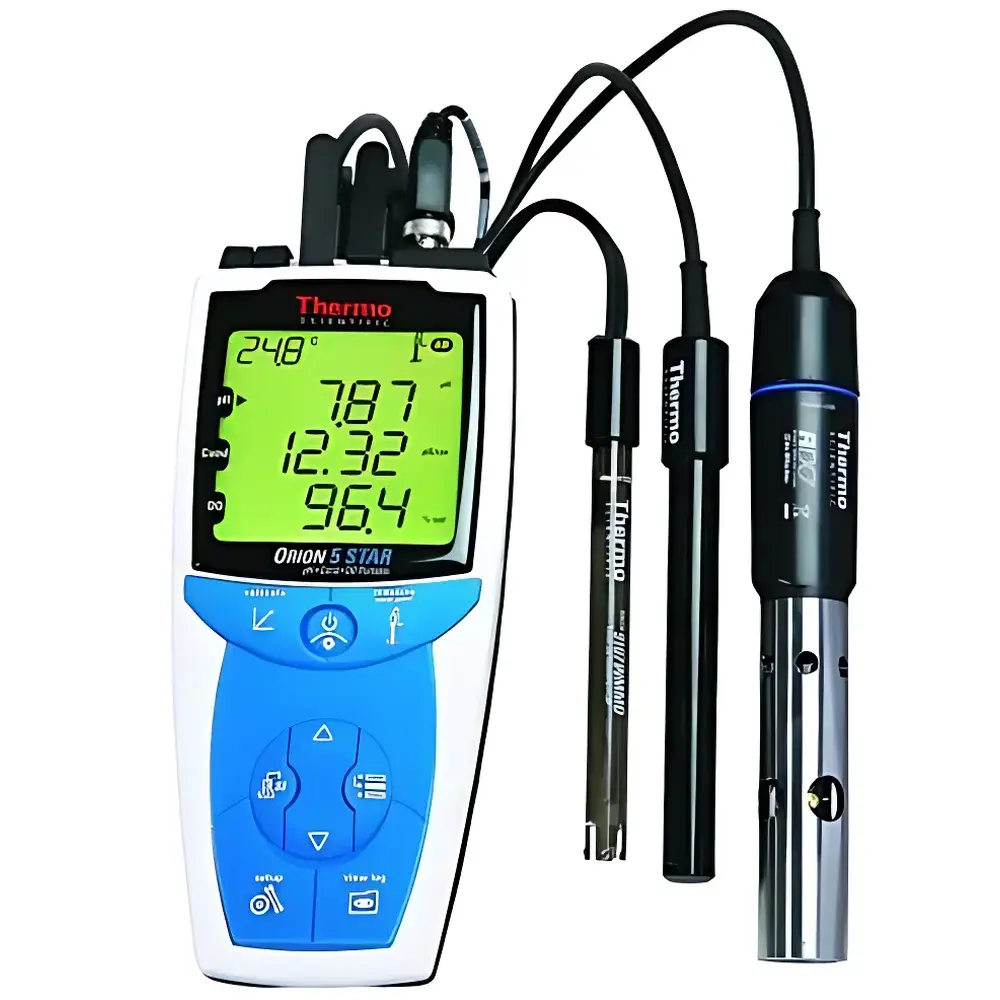
Thermo Scientific Orion Star RDO Portable Fluorescent Dissolved Oxygen Meter
| Brand | Thermo Fisher |
|---|---|
| Origin | USA |
| Manufacturer | Thermo Fisher Scientific |
| Product Type | Imported Instrument |
| Model | Star RDO |
| Pricing | Available Upon Request |
Overview
The Thermo Scientific Orion Star RDO Portable Fluorescent Dissolved Oxygen Meter is an engineered field-deployable instrument designed for high-accuracy, maintenance-efficient dissolved oxygen (DO) measurement in diverse aqueous environments. Unlike traditional electrochemical Clark-type sensors, the Star RDO employs solid-state optical fluorescence quenching technology—where molecular oxygen modulates the lifetime and intensity of a ruthenium-based luminophore immobilized on the sensor tip. This principle eliminates membrane permeation limitations, electrode polarization, and oxygen consumption during measurement, delivering inherently stable, drift-free readings independent of sample color, turbidity, or hydrogen sulfide interference. The system is optimized for environmental monitoring workflows including wastewater treatment plant operations (influent, aeration basins, effluent), surface water quality assessment, aquaculture management, and process control in municipal and industrial water systems.
Key Features
- Fluorescence-based DO sensing with no oxygen consumption or membrane fouling—ideal for low-flow, stagnant, or highly turbid samples
- Annual electrode cap replacement only; no routine membrane changes, electrolyte refills, or polarization time required
- Integrated barometric pressure sensor (450–850 mmHg) with automatic temperature- and pressure-compensated DO calculation per ISO 5814:2012
- Multi-parameter capability across three platform variants: 3-Star (DO + temperature), 4-Star (DO + pH + temperature), and 5-Star (DO + pH + conductivity + salinity + TDS + resistivity + temperature)
- IP67-rated rugged housing with backlit graphical LCD supporting simultaneous display of up to four parameters with real-time units and timestamps
- Long-life operation: >1000 hours on four standard AA alkaline batteries; RS232 interface for firmware updates, data export, and GLP-compliant audit trail generation
- Comprehensive calibration suite: air-saturated water, water-saturated air, manual Winkler reference, and zero-point calibration—fully traceable to NIST standards
Sample Compatibility & Compliance
The Star RDO series is validated for use across raw sewage, activated sludge, chlorinated effluents, estuarine waters, and high-organic-content industrial discharges. Its optical design ensures reliable performance in samples with suspended solids up to 500 NTU and chromaticity exceeding 500 Pt-Co units—conditions that commonly impair amperometric sensors. All models comply with ASTM D888-20 (Standard Test Methods for Dissolved Oxygen in Water), ISO 5814:2012 (Water quality — Determination of dissolved oxygen — Electrochemical probe method), and support regulatory data integrity requirements under EPA Method 360.5 and USP . The 4-Star and 5-Star configurations meet FDA 21 CFR Part 11 criteria when used with Thermo Scientific Orion LogR software for electronic signature-enabled data logging and user-access-controlled audit trails.
Software & Data Management
Data capture is supported via built-in non-volatile memory: 1000 data points (3-Star), 750 points (4-Star), or 500 points (5-Star), each stamped with date, time, operator ID (if enabled), and measurement metadata (e.g., atmospheric pressure, temperature, calibration status). Export is performed via RS232 to Thermo Scientific Orion LogR PC software—a validated application supporting CSV/Excel output, statistical summary reports (mean, SD, min/max), and automated compliance reporting aligned with ISO/IEC 17025 laboratory accreditation requirements. Firmware updates preserve calibration history and user-defined settings, ensuring continuity during instrument lifecycle management.
Applications
- Wastewater treatment: Real-time DO profiling in aerobic digesters, oxidation ditches, and membrane bioreactors (MBRs)
- Environmental field surveys: Benthic DO mapping, hypolimnetic monitoring, and stormwater runoff characterization
- Aquaculture and fisheries: Pond and recirculating aquaculture system (RAS) DO optimization to prevent hypoxia-induced mortality
- Drinking water distribution: Residual DO verification post-chlorination and at storage reservoirs
- Industrial process water: Cooling tower saturation control, boiler feedwater deaerator validation, and pharmaceutical water system qualification (PW/WFI)
FAQ
How does fluorescence-based DO measurement differ from electrochemical methods?
Fluorescence quenching measures oxygen concentration optically without consuming O₂ or requiring diffusion membranes—eliminating response lag, flow dependence, and frequent recalibration typical of Clark electrodes.
Is manual barometric pressure entry required?
No—the integrated barometer provides continuous automatic compensation; manual override is available for fixed-location deployments where ambient pressure remains stable.
What is the recommended calibration frequency for field use?
Daily calibration is advised for critical applications (e.g., regulatory reporting); weekly calibration suffices for routine monitoring when using air-saturated water or water-saturated air standards.
Can the RDO electrode be used in seawater or high-salinity brines?
Yes—the sensor is chemically inert and unaffected by chloride ions; however, salinity correction must be applied via the 4-Star or 5-Star platforms when reporting mg/L DO to account for oxygen solubility differences.
Does the instrument support GLP/GMP documentation requirements?
When paired with Orion LogR software, it supports full electronic records—including calibration logs, user authentication, change history, and digital signatures—meeting 21 CFR Part 11 and EU Annex 11 expectations.
Related Products







