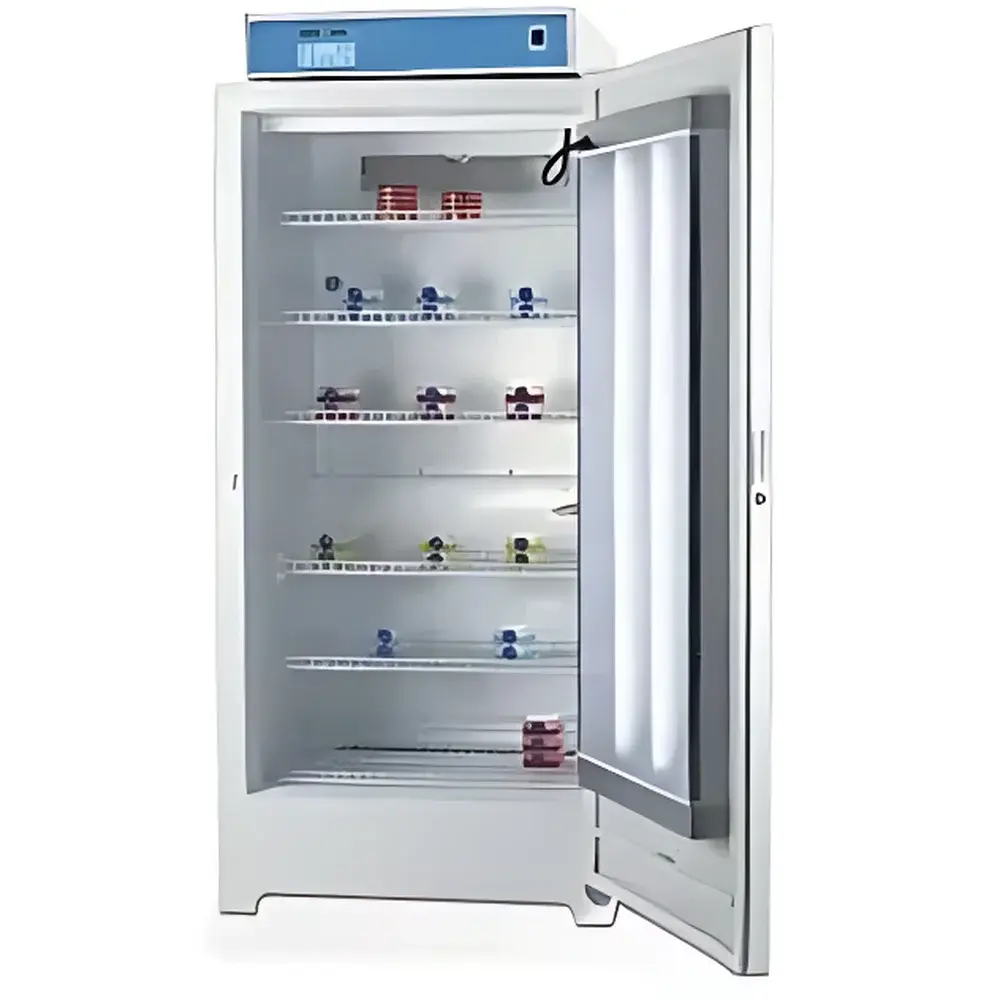
Thermo Scientific Precision 818 Large-Capacity Plant Growth Chamber
| Brand | Thermo Fisher Scientific |
|---|---|
| Origin | USA |
| Manufacturer | Thermo Fisher Scientific |
| Product Type | Imported |
| Model | Precision 818 |
| Internal Volume | 504 L |
| Air Circulation | Forced-air (mechanical convection) |
| Temperature Controller | Microprocessor-based |
| Display | LED |
| Temperature Range | −10°C to 50°C (light off) |
| Temperature Uniformity | ±0.2°C at −10°C (light off) |
| Temperature Recovery | ≤10 min after 30-sec door opening at 20°C |
| Insulation | Non-CFC polyurethane foam (cabinet) |
| Shelving | 6 standard adjustable shelves (max. 6) |
| External Dimensions (W×H×D) | 82 × 191 × 74 cm |
| Internal Dimensions (W×H×D) | 67.3 × 144.8 × 50.8 cm |
| Power Supply | 230 V, 50/60 Hz |
| Power Consumption | 860 W |
| Lighting System | Dual fluorescent lamps, total output up to 300 µmol/m²/s (PPFD), uniform irradiance distribution |
| Programmability | 7-day weekly schedule |
| Compliance | Designed and manufactured in accordance with IEC 61010-1, UL 61010-1, and ISO 14644-1 Class 8 cleanroom-compatible airflow design principles |
Overview
The Thermo Scientific Precision 818 Large-Capacity Plant Growth Chamber is an engineered environmental control system designed for reproducible, long-term plant physiology studies, photobiology research, and controlled-environment agriculture (CEA) applications. It employs a forced-air convection architecture with precision microprocessor-based temperature regulation and programmable dual-fluorescent lighting to emulate natural diurnal cycles. Unlike basic incubators, the Precision 818 integrates thermodynamic stability with photosynthetically active radiation (PAR) delivery—enabling researchers to maintain consistent growth conditions across large sample volumes (504 L internal capacity) while supporting quantitative phenotyping, stress response assays, and genotype-by-environment (G×E) experiments. Its non-CFC polyurethane insulation and fiberglass-reinforced double-glazed door minimize thermal leakage and condensation, ensuring low energy consumption without compromising chamber integrity or sample safety.
Key Features
- Forced-air circulation system ensures rapid equilibration and high spatial temperature uniformity—even under dynamic lighting and load conditions.
- Dual high-output fluorescent lamp arrays deliver up to 300 µmol/m²/s photosynthetic photon flux density (PPFD) with <±5% spatial uniformity across the entire shelf plane.
- Seven-day programmable controller supports two independent light/dark phases per 24-hour cycle—ideal for simulating seasonal photoperiods or circadian entrainment protocols.
- LED-display microprocessor controller provides real-time monitoring of setpoints, actual values, and alarm status; supports password-protected parameter locking for GLP-compliant workflows.
- Six fully adjustable, corrosion-resistant stainless-steel shelves (all standard, no optional upgrades required) allow flexible vertical configuration for multi-tiered plant trays or pot-based cultivation systems.
- Robust cabinet construction uses 100 mm-thick CFC-free polyurethane foam insulation (thermal conductivity ≤0.022 W/m·K), meeting EU F-Gas Regulation (EU No 517/2014) and U.S. EPA SNAP program requirements.
Sample Compatibility & Compliance
The Precision 818 accommodates standard growth containers—including 10-cm pots, hydroponic rafts, Petri dishes, and tissue culture vessels—across its full 504 L working volume. Its mechanical convection design avoids turbulent shear forces that may damage delicate seedlings or callus cultures. The chamber complies with IEC 61010-1:2010 for laboratory equipment safety and UL 61010-1 for North American market access. While not certified as a medical device, its temperature stability profile (±0.2°C at 37°C, light-on condition) meets the repeatability thresholds required for ISO 17025-accredited labs performing environmental validation per ASTM E2874-13 (“Standard Guide for Validation of Environmental Chambers”). Door-opening recovery time (≤10 minutes after 30-second exposure at 20°C) supports routine sampling without significant thermal drift—critical for longitudinal experimental designs.
Software & Data Management
The chamber operates autonomously via embedded firmware with no external PC dependency. All operational logs—including temperature setpoint history, light cycle execution timestamps, and alarm events (e.g., overtemperature, door-open duration)—are stored internally for ≥30 days. Optional RS-232 or Ethernet interface modules (sold separately) enable integration into centralized lab infrastructure via Modbus RTU or TCP/IP protocols. When connected to Thermo Fisher’s ChronoLog™ data acquisition suite (v3.2+), users can generate audit-trail-enabled reports compliant with FDA 21 CFR Part 11 requirements—including electronic signatures, user-level access controls, and immutable event logging. Raw sensor data exports in CSV format support downstream analysis in MATLAB, R, or Python-based phenomics pipelines.
Applications
- Controlled-environment phenotyping of Arabidopsis, rice, maize, and legume species under defined photoperiods and thermal regimes.
- Abiotic stress simulation: cold acclimation (−10°C), heat shock (up to 50°C), and combined light–temperature stress assays.
- Seed germination kinetics and dormancy release studies requiring precise diel cycling.
- Microbial co-culture experiments where plant-associated rhizobacteria or endophytes are grown alongside host tissues.
- Pre-acclimatization of tissue-cultured plantlets prior to greenhouse transfer.
- Regulatory stability testing of genetically modified organisms (GMOs) under OECD Test Guideline 508 (Sediment-Water Chironomid Toxicity).
FAQ
What is the maximum PAR intensity achievable inside the chamber, and how is uniformity verified?
The dual fluorescent system delivers up to 300 µmol/m²/s PPFD at shelf level, measured using a calibrated quantum sensor (LI-COR LI-190R). Uniformity is validated per ASTM E2915-13 at nine grid points across each shelf surface.
Can the chamber operate continuously at −10°C with lighting enabled?
No—lighting must be disabled below 10°C to prevent ballast thermal overload and ensure stable lamp output. The controller enforces this interlock automatically.
Is remote monitoring supported out-of-the-box?
Basic local display and keypad operation is standard. Remote connectivity requires optional communication module installation and configuration via ChronoLog™ software.
Are third-party shelf accessories compatible?
Yes—shelves conform to ISO 10993-5 biocompatibility standards and accept standard 600-mm-deep growth trays (e.g., Conviron PCT-600, Percival E-30B). Custom mounting brackets are available upon request.
Does the unit include calibration documentation traceable to NIST standards?
Each chamber ships with a factory calibration certificate referencing NIST-traceable RTD probes and illuminance meters. On-site recalibration services are available through Thermo Fisher Field Service Engineers.
Related Products