
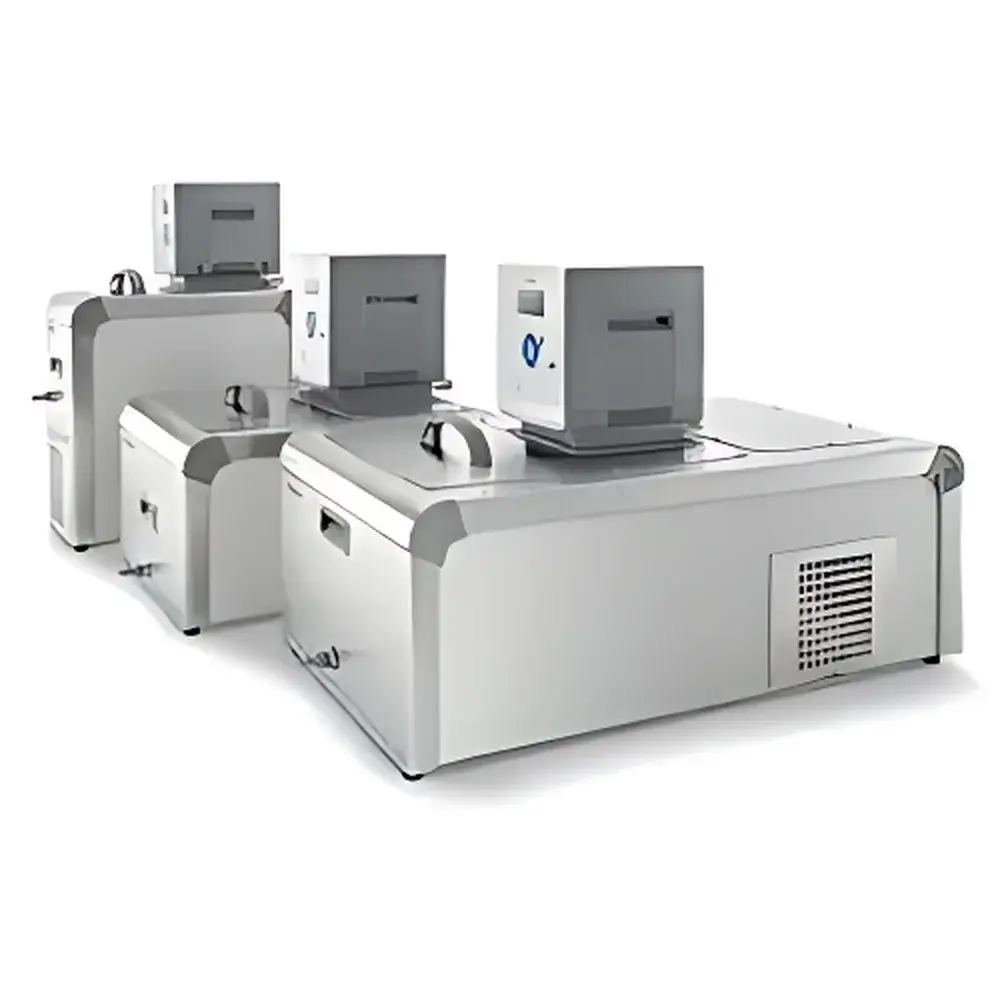
Thermo Scientific™ Sahara Series Stainless Steel Circulating Heated Bath
| Brand | Thermo Fisher |
|---|---|
| Origin | USA |
| Manufacturer | Thermo Fisher Scientific |
| Product Type | Imported |
| Model | S7 / S13 / S21 / S45 / S49 |
| Temperature Range | +13 °C to +300 °C |
| Temperature Stability | ±0.01 °C |
| Bath Volume | 4–53 L |
| Circulation Type | Internal & External |
| Certifications | CE / RoHS / WEEE |
Overview
The Thermo Scientific™ Sahara Series Stainless Steel Circulating Heated Bath is an engineered solution for precise, stable, and repeatable temperature control in demanding laboratory applications requiring elevated thermal setpoints—up to +300 °C. Built on a monolithic, seamless 316 stainless steel bath vessel, the series eliminates crevices and weld seams that could harbor contaminants or compromise structural integrity under prolonged high-temperature operation. Unlike standard aluminum or coated steel baths, the Sahara’s fully passivated stainless construction resists corrosion from water, glycol-water mixtures, silicone oils, and other common heat-transfer fluids—even after extended exposure at temperatures exceeding 200 °C. Its thermally optimized geometry, combined with a high-efficiency immersion heater and low-turbulence circulation pump, ensures rapid thermal equilibration and minimal axial/radial gradients across the working volume. The system operates exclusively in heating mode (no refrigeration), making it ideal for applications where sustained, uniform thermal energy delivery—not cooling—is the primary requirement.
Key Features
- Seamless 316 stainless steel bath tank with electropolished interior surface for enhanced corrosion resistance and cleanability
- Eight programmable controller options—including PID-based analog, digital, and Ethernet-enabled variants—supporting ramp-soak profiles, remote setpoint adjustment, and real-time parameter logging
- Controller housing rotates 90° for ergonomic viewing and accessibility in benchtop or under-hood configurations
- Dual-mode fluid circulation: configurable internal recirculation (for bath-only temperature uniformity) or external loop integration (for jacketed reactors, viscometers, or spectroscopic cells)
- High-stability temperature regulation with ±0.01 °C stability at setpoint (measured at sensor location per ASTM E1137/E1142 protocols)
- Multiple bath volume options (4 L to 53 L) with standardized mounting interfaces for accessories including probe holders, stirrer mounts, and external sensor ports
- Compliance with CE, RoHS, and WEEE directives; designed and manufactured in Thermo Fisher’s ISO 9001-certified facility in the United States
Sample Compatibility & Compliance
The Sahara Series accommodates a broad range of sample containers and analytical instrumentation interfaces—including glass, quartz, and metal-jacketed vessels up to 200 mm in height. Its open-bath architecture supports direct immersion of probes, capillary viscometers, refractometer cells, and cuvette holders without obstruction. For regulated environments, the system supports GLP/GMP workflows through optional controllers with audit-trail functionality (21 CFR Part 11-compliant firmware available upon configuration). All models meet IEC 61010-1 safety requirements for laboratory electrical equipment and are validated for continuous operation at maximum rated temperature (e.g., +300 °C for PC300 variant) per manufacturer-specified thermal cycling limits.
Software & Data Management
Select Sahara controllers integrate with Thermo Fisher’s Connect™ Lab Software platform, enabling centralized monitoring, multi-unit synchronization, and export of time-stamped temperature logs in CSV or XML format. Firmware updates are delivered via secure HTTPS, and all controller variants support Modbus RTU/TCP protocol for integration into SCADA or LIMS environments. Data integrity is maintained through non-volatile memory storage of calibration coefficients, operational history, and user-defined alarm thresholds. Optional USB data-logging modules provide local backup independent of network connectivity.
Applications
- Viscosity measurement using rotational or capillary viscometers requiring stable thermal conditioning between 13 °C and 300 °C
- Temperature-dependent UV-Vis and FTIR spectroscopy, where thermal drift must be minimized to preserve spectral baseline fidelity
- Refractive index determination across temperature gradients per ASTM D1218 and ISO 489 standards
- Calibration of temperature-sensitive transducers, pressure sensors, and flow meters in metrology laboratories
- Thermal preconditioning of polymer melts, lubricants, and pharmaceutical excipients prior to rheological or DSC analysis
- Heating jackets for chromatographic columns, reaction blocks, and electrochemical cells in process development labs
FAQ
What is the maximum allowable operating temperature for each model?
The maximum setpoint depends on the specific model designation: SC100/SC150 series operate up to +100 °C or +150 °C respectively; AC200, PC200, and PC201 models are rated to +200 °C; the PC300 variant supports full-range operation up to +300 °C.
Can the bath be used with silicone oil or other high-boiling-point fluids?
Yes—the seamless 316 stainless steel construction and high-temperature seals are compatible with silicone oils, glycerol, and mineral oil-based heat-transfer media. Refer to the Fluid Compatibility Matrix in the Installation & Operation Manual before selecting a working fluid.
Is external circulation flow rate adjustable?
All models feature a calibrated bypass valve and integrated flow meter (0–2.5 L/min range) with visual indication; fine-tuning is possible via manual valve modulation or automated PID-controlled pump speed on advanced controller variants.
Does the system support validation documentation for regulated labs?
Factory-installed IQ/OQ documentation packages are available as an option, including as-delivered temperature uniformity maps, sensor calibration certificates traceable to NIST standards, and 21 CFR Part 11-ready electronic records configuration.
How is temperature uniformity verified across the bath volume?
Per ISO 17025-accredited verification procedures, uniformity is assessed using nine-point mapping (center + eight peripheral locations) at three vertical planes (top/mid/bottom), with deviation ≤ ±0.05 °C across the specified working zone for all models.



