
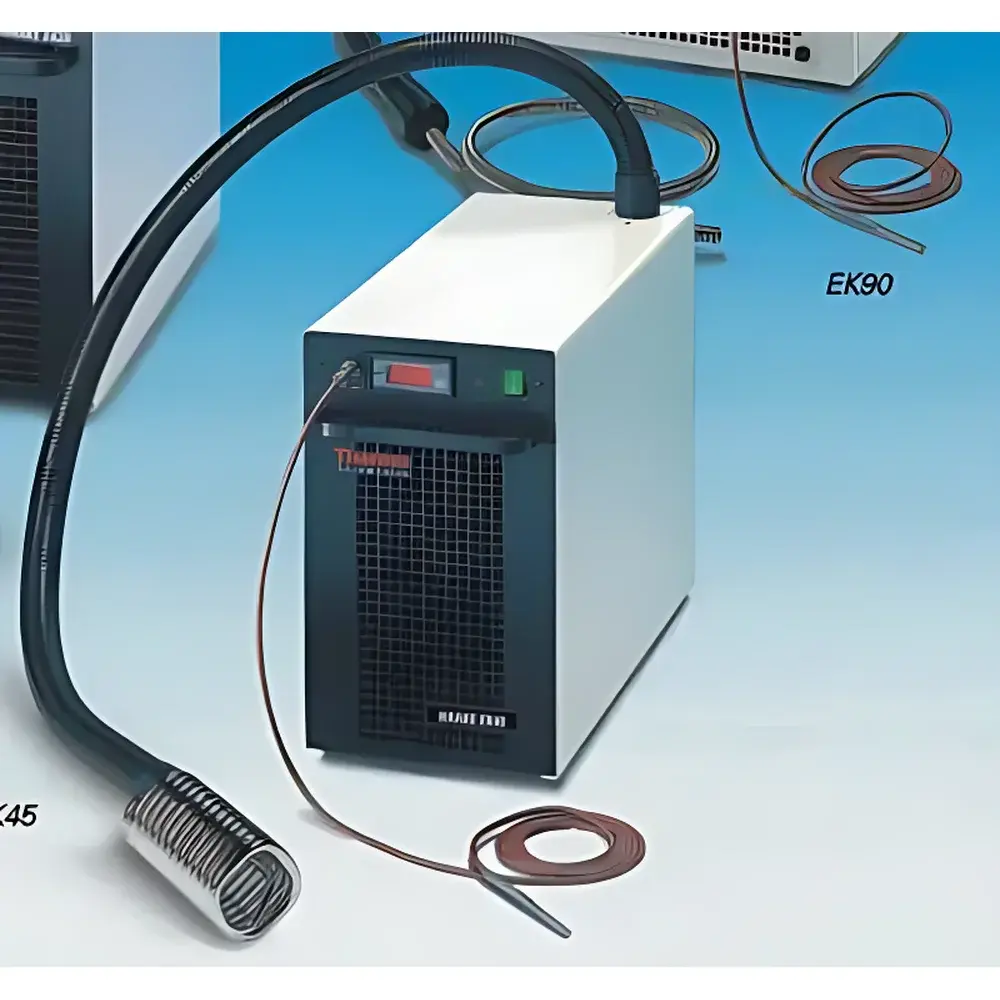
Thermo Scientific Temperature Control Systems
| Origin | Imported |
|---|---|
| Manufacturer Type | Authorized Distributor |
| Model | Thermo Scientific Series |
| Price Range | USD 2,800 – 7,000 (FOB) |
| Instrument Type | Circulating Bath |
| Circulation Mode | Internal & External Loop |
Overview
Thermo Scientific Temperature Control Systems are engineered for precision thermal management in demanding laboratory and industrial environments. These systems operate on the principle of forced-liquid circulation—using a high-efficiency pump to deliver temperature-stabilized fluid (water, water-glycol, or silicone oil) through external equipment or internal baths. Designed for continuous duty, they maintain setpoint stability within ±0.05 °C under dynamic load conditions, supporting applications ranging from reaction calorimetry and material testing to semiconductor process cooling and automotive component validation.
Key Features
- Dual-loop architecture: Independent internal bath circulation and external closed-loop output enable simultaneous operation of multiple devices (e.g., spectrophotometer chillers + reactor jackets) without cross-contamination or thermal interference.
- Wide operational range: Configurable models span –40 °C to +150 °C, with low-temperature units utilizing cascade refrigeration and high-temperature variants featuring dual-heater staging and overheat protection per IEC 61000-4-5.
- Precision PID control: Adaptive algorithm with auto-tuning capability compensates for fluid viscosity shifts, ambient drift, and heat-load transients—ensuring reproducible thermal profiles across extended runs.
- Corrosion-resistant wetted path: Stainless steel 316L reservoirs, EPDM/NBR seals, and titanium-coated impellers ensure compatibility with aggressive coolants and extended service life in GLP-compliant facilities.
- Integrated safety protocols: Real-time monitoring of flow rate, pressure differential, fluid level, and refrigerant saturation temperature triggers automatic shutdown and event logging compliant with ISO/IEC 17025 Clause 7.9.
Sample Compatibility & Compliance
These systems accommodate a broad spectrum of sample containment formats—including jacketed reactors (1–50 L), immersion probes, microfluidic chips, and automotive fogging test chambers (per ISO 6452 and SAE J1756). All units meet CE marking requirements under the EU Machinery Directive 2006/42/EC and Electromagnetic Compatibility Directive 2014/30/EU. Refrigerated models comply with F-Gas Regulation (EU) No. 517/2014 for HFC charge containment. Optional documentation packages support FDA 21 CFR Part 11 audit trails when paired with Thermo Fisher’s ChronoSync™ software suite.
Software & Data Management
Standard Ethernet (RJ45) and RS-485 interfaces enable integration into centralized lab infrastructure via Modbus RTU or TCP/IP. The embedded web server provides real-time access to setpoint history, alarm logs, and calibration status without proprietary drivers. For regulated environments, optional ChronoSync™ software delivers electronic signatures, user role-based access control, and automated report generation aligned with ALCOA+ data integrity principles. All firmware updates undergo cryptographic signature verification prior to installation.
Applications
- Controlled-rate cooling in polymer crystallization studies (ASTM D3418)
- Thermal conditioning of lithium-ion battery cells during cycling tests (UN 38.3 Section 38.3.4)
- Stabilization of optical benches and interferometric measurement platforms
- Temperature ramping for accelerated aging of automotive interior materials (VW TL 226)
- Cooling of high-power laser diodes and RF amplifiers in electronics R&D
- Heat exchange in enzymatic reaction kinetics assays using stopped-flow spectrophotometers
FAQ
What fluid types are compatible with the external loop?
Water, 30–50% aqueous glycol solutions, and silicone oils (cSt 10–100) are validated. Ethanol, acetone, and hydrocarbon solvents require custom wetted-material certification.
Is external pressure regulation supported?
Yes—models with integrated back-pressure regulators (BPR) maintain constant outlet pressure (0.5–3.0 bar) independent of flow resistance, critical for microfluidic applications.
Can the system be operated unattended for 72+ hours?
Yes—when configured with redundant level sensors, refrigerant leak detection, and remote alarm relay outputs, units meet ISO 15197:2013 Annex C for continuous unmonitored operation.
How is calibration traceability maintained?
Each unit ships with NIST-traceable certificate for temperature sensor (Pt100 Class A) and flow meter (±1.5% full scale). On-site recalibration services follow ISO/IEC 17025-accredited procedures.
Do these systems support dry-run protection?
Yes—integrated ultrasonic level sensing and current draw monitoring detect low-fluid or no-flow conditions within 1.2 seconds, initiating immediate pump shutdown and audible/visual alerts.
Related Products



