
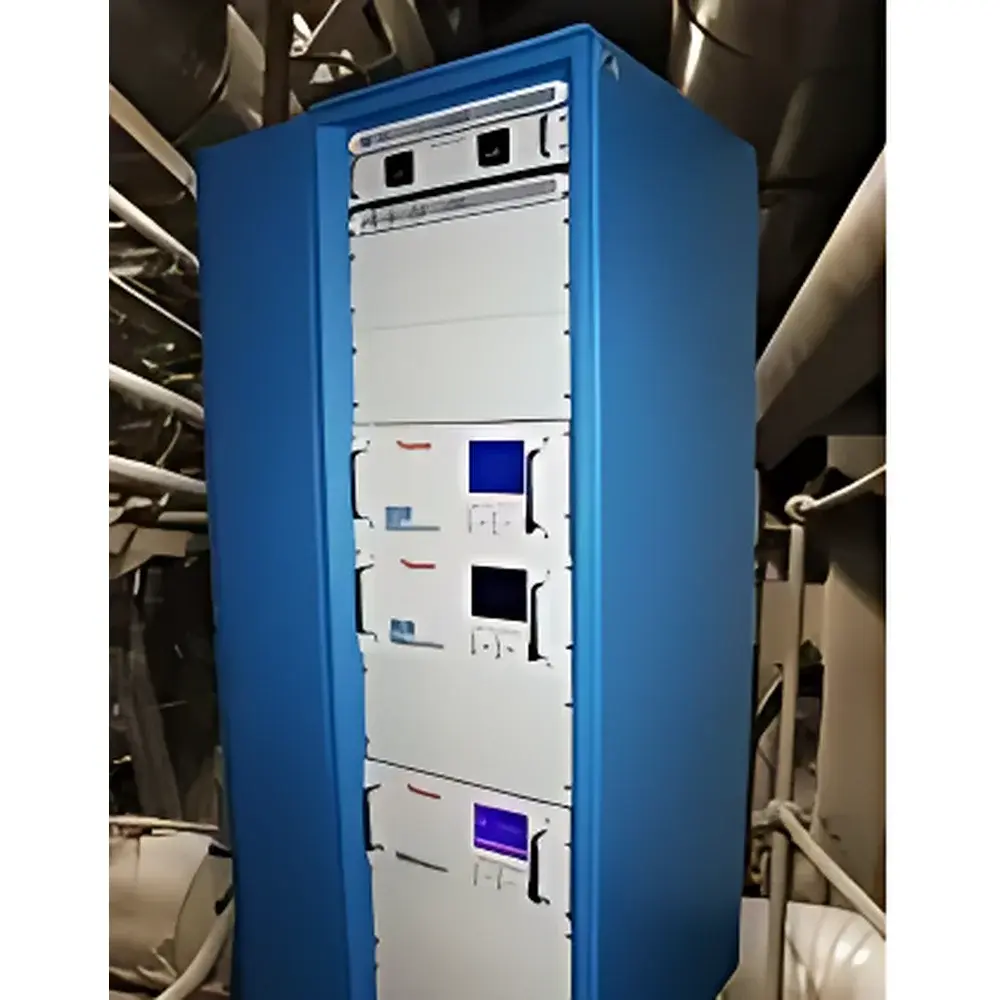
Thermo Scientific TRS CEMS Total Reduced Sulfur Continuous Emission Monitoring System
| Brand | Thermo Fisher |
|---|---|
| Origin | USA |
| Manufacturer | Thermo Fisher Scientific |
| Product Type | Continuous Emission Monitoring System (CEMS) |
| Model | TRS CEMS |
| Measurement Principle | Thermal Oxidation + Pulsed Fluorescence SO₂ Detection |
| Detection Targets | H₂S, CH₃SH, CH₃SCH₃, CH₃SSCH₃, CS₂, COS (reported as SO₂-equivalent concentration) |
| Dilution Ratio | 20:1 to 200:1 |
| Sample Flow Rate | 400–800 cc/min |
| Oxidation Furnace Max Temp | 1093 °C |
| SO₂ Scrubber Efficiency | >99.9% |
| Detection Limit | 0.5 ppb (300-sec avg) |
| Accuracy | ±1% of reading or ±1 ppb |
| Response Time (T₉₀) | 80 s |
| Zero Drift (24 h) | <1 ppb |
| Span Drift (24 h) | ±1% FS |
| Operating Temperature Range | 0–45 °C (analyzer), –40–50 °C (probe) |
| Output Options | 4–20 mA (isolated, optional), RS232/RS485, TCP/IP, 10 status relays |
| Compliance | Designed for EPA Method 15/16A, ASTM D5502, ISO 14687, and supports 21 CFR Part 11 audit trail requirements in configured software mode |
Overview
The Thermo Scientific TRS CEMS is a fully integrated, EPA-compliant continuous emission monitoring system engineered for the precise, stable, and regulatory-grade quantification of total reduced sulfur (TRS) compounds in industrial flue gas streams. Unlike conventional SO₂-only analyzers, this system employs a selective thermal oxidation methodology to convert all volatile reduced sulfur species—including hydrogen sulfide (H₂S), methyl mercaptan (CH₃SH), dimethyl sulfide (CH₃SCH₃), dimethyl disulfide (CH₃SSCH₃), carbon disulfide (CS₂), and carbonyl sulfide (COS)—into sulfur dioxide (SO₂) in a high-temperature quartz furnace (up to 1093 °C). The resulting SO₂ is then measured with sub-part-per-trillion sensitivity using the proven pulsed fluorescence detection principle of the Thermo Scientific 43i SO₂ Analyzer. Crucially, the system incorporates an inline SO₂ scrubber upstream of the oxidizer, enabling accurate TRS measurement even in high-background SO₂ environments—where conventional direct-detection methods fail due to spectral interference or dynamic range saturation.
Key Features
- Patented dilution probe (PRO2001) with heated 0.1 µm glass fiber filter and temperature-controlled critical orifice (149 °C), eliminating condensate formation and preserving reactive TRS species during sampling
- High-efficiency SO₂ removal module (>99.9% removal) using catalytic and chemical scrubbing media, ensuring only TRS compounds enter the oxidation stage
- Robust thermal oxidation furnace with K-type thermocouple feedback, microprocessor-based PID control, and ceramic-fiber insulation for stable 1093 °C operation under variable flow conditions (up to 1000 cc/min)
- 43i SO₂ analyzer with ultra-low detection limit (0.5 ppb, 300-sec average), <1 ppb 24-hour zero drift, and ±1% full-scale span stability—certified per EPA Performance Specification 2 (PS-2)
- Configurable dilution ratios (20:1 to 200:1) optimized for diverse stack concentrations and moisture loads, minimizing maintenance frequency and calibration drift
- Full NEMA 4X-rated enclosure (43.2 × 48.3 × 26.7 cm) with fiberglass housing rated for ambient operation from –40 °C to 50 °C and stack gas exposure up to 538 °C
Sample Compatibility & Compliance
The TRS CEMS is validated for use across pulp & paper mills, petroleum refineries, chemical manufacturing facilities, and wastewater treatment plants—environments characterized by high humidity, particulate loading, and complex sulfur speciation. Its dilution-based sampling architecture complies with EPA Methods 15 and 16A for TRS measurement and aligns with ASTM D5502 (Standard Test Method for Total Reduced Sulfur Compounds in Gaseous Effluents) and ISO 14687 (Air quality — Determination of reduced sulfur compounds). All signal processing, data logging, and alarm generation meet EN 14181 QA/QC requirements for automated monitoring systems. When deployed with Thermo Scientific QAL3-certified software, the system provides full 21 CFR Part 11 compliance—including electronic signatures, audit trails, user access controls, and secure data archiving—supporting GLP/GMP-regulated reporting and third-party verification.
Software & Data Management
Control and data acquisition are managed via Thermo Scientific’s CEMSoft™ platform, a Windows-based application designed for continuous emissions monitoring compliance. CEMSoft™ supports real-time visualization of TRS concentration (as SO₂-equivalent ppm or µg/m³), dilution ratio, oxidation furnace temperature, scrubber status, and system diagnostics. It automatically generates hourly/daily compliance reports compliant with EPA 40 CFR Part 60 and Part 75, including uptime statistics, calibration logs, and out-of-spec event flags. Raw analog outputs (4–20 mA) and digital protocols (Modbus TCP, RS485) enable seamless integration into plant DCS/SCADA systems. Optional historian modules provide long-term trend analysis with configurable data retention policies and export to CSV, PDF, or XML formats for regulatory submission.
Applications
- Monitoring TRS emissions from kraft pulp mill recovery furnaces and odor control scrubbers
- Quantifying sulfur compound breakthrough in refinery amine regenerator off-gas and Claus tail-gas treatment units
- Verifying performance of biogas desulfurization systems in anaerobic digestion facilities
- Regulatory reporting for Title V permits requiring TRS-specific mass emission rates
- Process optimization studies correlating TRS profiles with digester pH, retention time, or feedstock composition
- Odor impact assessment where TRS species serve as quantitative surrogates for nuisance odor potential
FAQ
How does the TRS CEMS distinguish TRS from background SO₂?
The system uses a selective SO₂ removal stage prior to thermal oxidation. Only non-SO₂ sulfur compounds pass through to the furnace; SO₂ is chemically scrubbed and vented, ensuring the final SO₂ signal originates exclusively from oxidized TRS species.
Can the system operate in high-moisture or corrosive flue gas?
Yes—the PRO2001 dilution probe maintains all wetted components at 149 °C, preventing condensation and acid dew point corrosion. The quartz and ceramic construction resists H₂SO₄, HCl, and other acidic condensates.
What calibration standards are required?
Primary calibration uses certified TRS gas standards (e.g., H₂S-in-N₂) traceable to NIST. System linearity is verified across the full operating range using multi-point SO₂ standards post-oxidation, per EPA PS-2 protocol.
Is field service support available globally?
Thermo Fisher Scientific maintains certified service centers across North America, EMEA, and APAC, offering on-site preventive maintenance, EPA audit readiness reviews, and remote diagnostics via secure VPN.
Does the system meet European MCERTS certification requirements?
When configured with QAL1-certified components and operated under QAL2/QAL3 protocols, the TRS CEMS satisfies MCERTS Performance Standards for TRS measurement, including EN 15267-3 and EN 14181 S1/S2 requirements.
Related Products







