
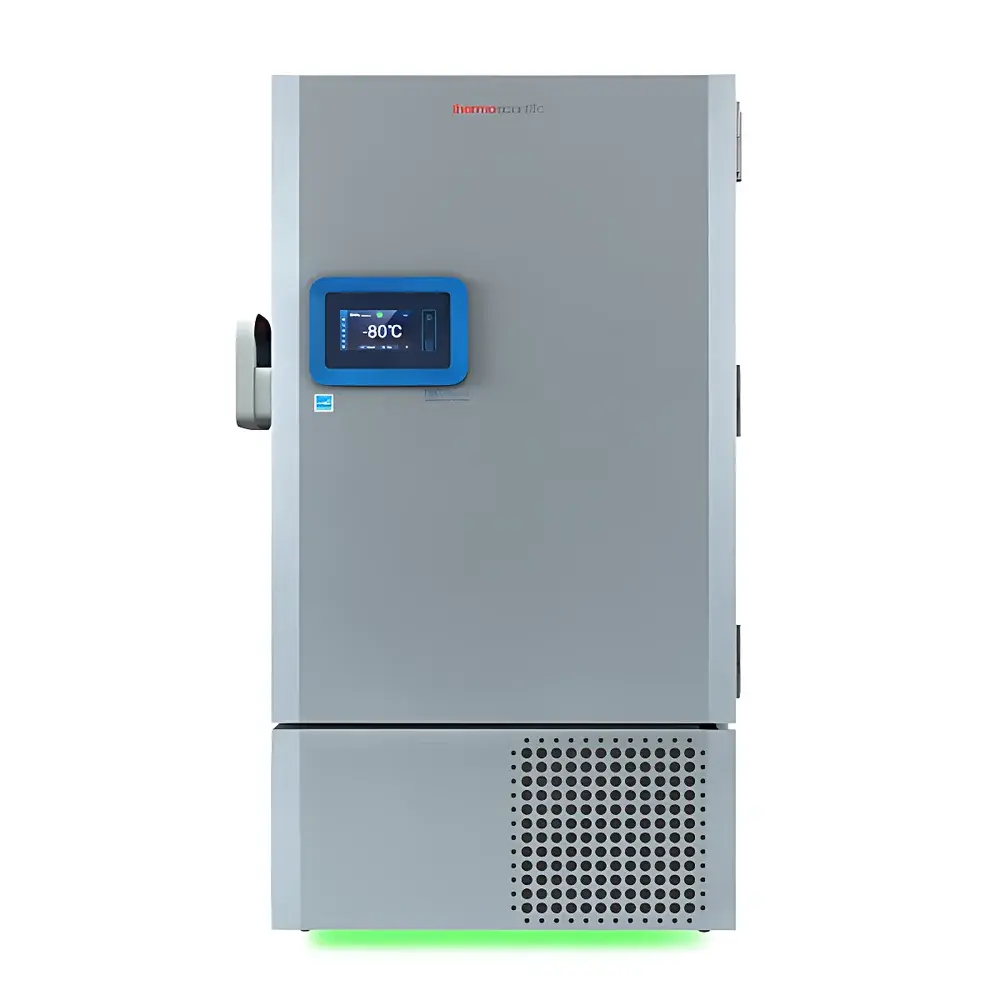
Thermo Scientific TSX Series Ultra Low Temperature Freezers (TSX40086FA / TSX50086FA / TSX60086FA / TSX70086FA)
| Brand | Thermo Scientific |
|---|---|
| Origin | USA |
| Model | TSX40086FA / TSX50086FA / TSX60086FA / TSX70086FA |
| Configuration | Upright |
| Effective Capacity | 549 L / 682 L / 816 L / 949 L |
| Voltage Support | 100–230 V, 50/60 Hz |
| Temperature Range | −40 °C to −86 °C |
| Energy Efficiency | ENERGY STAR® Certified |
| Environmental Certification | My Green Lab ACT Certified |
| Acoustic Performance | 44 dB(A) |
| Re-door Interval | 30 s |
| Power Consumption Reduction | 33% vs. prior TSX generation |
| Temperature Uniformity Improvement | 38% reduction in spatial deviation |
| Cool-down Time Reduction | 41% |
| Recovery Time after Door Opening | 52% faster |
Overview
The Thermo Scientific™ TSX Series Ultra Low Temperature Freezers represent a next-generation platform engineered for precision, reliability, and sustainability in long-term biological sample preservation. Utilizing advanced V-Drive variable-speed refrigeration technology, these upright ULT freezers deliver tightly controlled thermal environments across a broad operational range of −40 °C to −86 °C. The system integrates a high-efficiency inverter-driven compressor, optimized heat exchanger architecture, and adaptive control algorithms to maintain exceptional temperature stability—even under dynamic laboratory conditions such as frequent door access or ambient fluctuations. Designed specifically for demanding life science applications—including biobanking, cell therapy storage, genomic material archiving, and clinical trial sample management—the TSX series meets the stringent thermal consistency requirements defined by ISO 13485, AABB, and CAP accreditation standards.
Key Features
- V-Drive refrigeration system with intelligent load-adaptive compression, enabling precise temperature regulation and reduced thermal overshoot during recovery cycles
- ENERGY STAR® certified performance—exceeding current U.S. federal efficiency benchmarks and aligned with projected 2026–2028 regulatory thresholds
- My Green Lab ACT (Accountability, Consistency, Transparency) certification, verifying environmental impact transparency across materials, energy use, and end-of-life recyclability
- Universal voltage compatibility (100–230 V, 50/60 Hz), eliminating need for site-specific power conditioning or transformers
- Acoustic optimization delivering ≤44 dB(A) at 1 m—enabling installation in shared lab spaces, cleanrooms, or adjacent office environments without disruption
- 30-second re-door interval supported by dual-stage evaporator design and rapid-cycling fan control, minimizing cumulative thermal exposure during routine access
- Enhanced cabinet insulation using vacuum-insulated panels (VIPs) combined with low-global-warming-potential (GWP) hydrofluoroolefin (HFO)-based refrigerant R-450A
Sample Compatibility & Compliance
The TSX series maintains thermal integrity for sensitive biomaterials including cryopreserved PBMCs, primary hepatocytes, induced pluripotent stem cells (iPSCs), viral vectors, mRNA-LNPs, and archival tissue specimens. All models comply with IEC 61010-1 (Safety Requirements for Electrical Equipment for Measurement, Control, and Laboratory Use) and IEC 61326-1 (EMC for Laboratory Equipment). Data logging functionality supports 21 CFR Part 11 compliance when integrated with Thermo Fisher’s SampleManager LIMS or third-party validated electronic lab notebook (ELN) systems. Temperature mapping reports per ISO 14644-3 and IQ/OQ/PQ documentation packages are available upon request to support GLP/GMP-regulated workflows.
Software & Data Management
Embedded touchscreen interface provides intuitive navigation, real-time monitoring of chamber temperature, compressor status, door-open duration, and alarm history. Optional Thermo Fisher Connect™ integration enables remote monitoring via secure cloud-based dashboards, configurable email/SMS alerts, and automated export of CSV-formatted temperature logs. Audit trails record all user-initiated configuration changes—including setpoint adjustments, calibration events, and alarm acknowledgments—with time-stamped, user-ID-tagged entries compliant with ALCOA+ data integrity principles. Firmware updates are delivered through digitally signed packages to ensure cryptographic verification and traceable version control.
Applications
- Long-term storage of reference standards and certified reference materials (CRMs) per ISO Guide 34 requirements
- Cryogenic preservation of clinical-grade cell therapies undergoing FDA IND/BLA submission
- Stabilization of thermolabile diagnostic reagents and monoclonal antibody conjugates
- Support of multi-site biorepository networks requiring harmonized cold chain validation
- Backup storage for ultra-low-temperature liquid nitrogen dewars in hybrid cryo-storage infrastructures
- Compliance-ready archiving for EU IVDR Class C/D in vitro diagnostic device development programs
FAQ
What is the recommended validation frequency for temperature uniformity mapping?
Annual mapping is advised per ISO/IEC 17025 and AABB Standard 13.2; additional mapping should follow major maintenance, relocation, or after firmware upgrades affecting thermal control logic.
Does the TSX series support external temperature probe inputs for independent monitoring?
Yes—each unit includes two calibrated Pt100 sensor ports compatible with third-party continuous monitoring systems (e.g., Dickson, Sensitech) meeting ASTM E2810 criteria.
Can the freezer operate reliably at ambient temperatures up to 35 °C?
Yes—the system is rated for continuous operation at 35 °C ambient with 60% RH, verified per IEC 60068-2-14 (cyclic temperature testing) and documented in the technical specification sheet.
Is the R-450A refrigerant compatible with existing service infrastructure?
R-450A is a zeotropic blend requiring dedicated recovery equipment and certified technicians trained under Section 608 of the U.S. Clean Air Act; retrofitting legacy R-404A systems is not supported.
How does the ACT label inform procurement decisions in academic institutions?
The ACT label provides standardized, third-party-verified metrics on carbon footprint, chemical hazard profile, and circularity—enabling alignment with institutional sustainability scorecards and NSF-funded grant reporting requirements.
Related Products




