
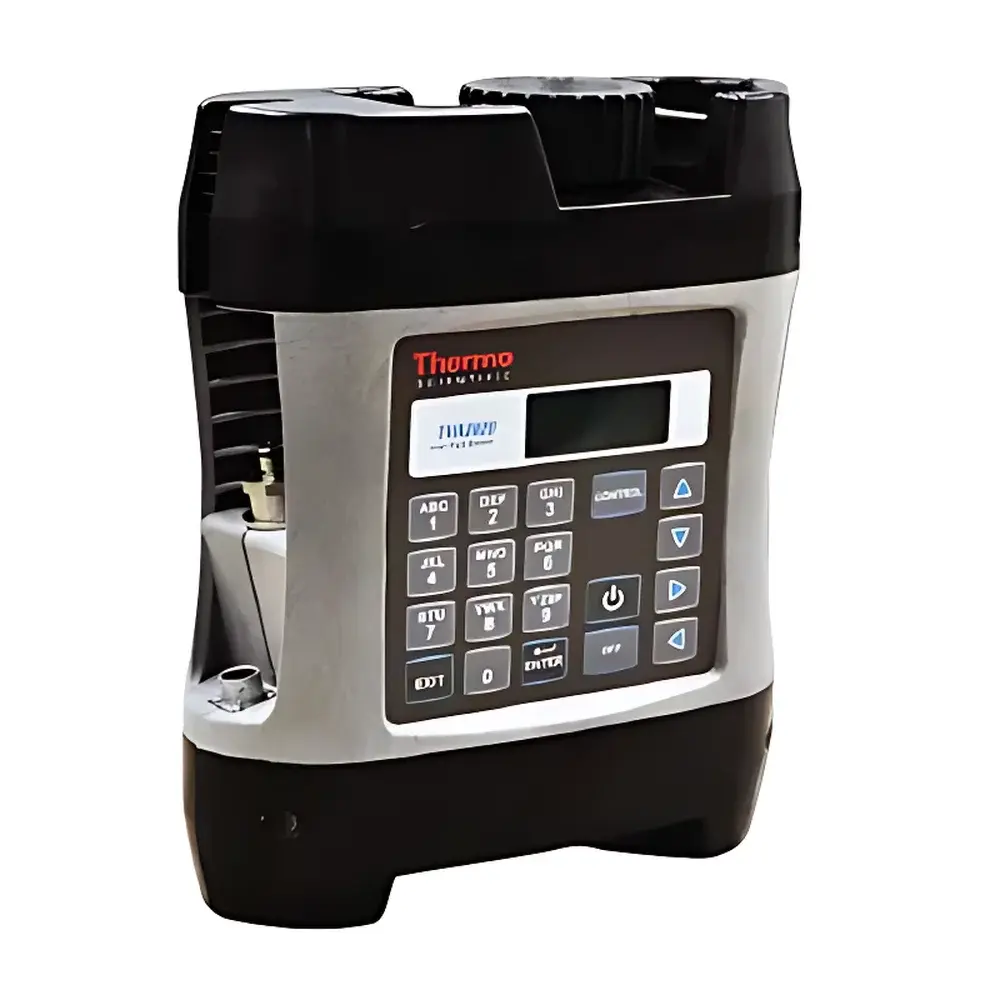
Thermo Scientific TVA2020 Portable FID/PID Dual-Detector Toxic Volatile Organic Compounds Analyzer
| Brand | Thermo Fisher |
|---|---|
| Origin | USA |
| Manufacturer Type | Original Equipment Manufacturer (OEM) |
| Product Category | Imported Instrument |
| Model | Thermo Scientific TVA2020 |
| Detection Principle | Flame Ionization Detection (FID) and Photoionization Detection (PID) |
| Instrument Type | Portable |
| Typical Configuration | Total VOC Analyzer |
| Detection Range | FID: 1.0–30,000 ppm methane |
| PID | 0.5–2,000 ppm isobutylene |
| Resolution | PID: 0.5 ppm isobutylene |
| FID | 0.5 ppm methane |
| Accuracy | FID: ±10% of reading or ±0.1 ppm (whichever is greater) over 1.0–10,000 ppm |
| PID | ±20% of reading or ±0.5 ppm (whichever is greater) over 0.5–500 ppm |
| Response Time | <3.5 s (90% of final value) |
Overview
The Thermo Scientific TVA2020 is a lightweight, intrinsically safe, portable dual-detector analyzer engineered for real-time detection and quantification of toxic volatile organic compounds (VOCs) and select inorganic gases in field applications. It integrates two complementary detection technologies—flame ionization detection (FID) and photoionization detection (PID)—within a single, compact housing. FID provides broad-spectrum, linear response to hydrocarbons and most organic compounds with high dynamic range (1.0–30,000 ppm methane), while PID enables sensitive, non-destructive detection of lower-ionization-potential compounds—including aromatics, ketones, amines, and sulfur-containing species—at sub-ppm levels (0.5–2,000 ppm isobutylene). The instrument operates on the principle of catalytic combustion (FID) and UV photon-induced ionization (PID), delivering orthogonal analytical data that enhances compound identification confidence and reduces false negatives in complex emission matrices. Designed for compliance-driven environmental monitoring, the TVA2020 meets operational requirements for U.S. EPA Method 21 leak detection, landfill gas surveys, site remediation verification, and routine ambient air quality assessment.
Key Features
- Intrinsically safe design certified for Class I, Division 2; Class II, Division 2; and ATEX Zone 2 hazardous locations
- Dual simultaneous detection: FID and PID operate concurrently without cross-interference or duty-cycle limitation
- Optimized ergonomics: 4.26 kg total mass (dual-detector configuration); 21% lighter than predecessor models
- Integrated Bluetooth 4.0 module for wireless telemetry to LDAR handheld devices running Thermo Scientific LDAR Pro or third-party compliant software
- Onboard data logging with user-selectable intervals (1/sec to 1/999 min) and dual operational modes: VOC mode (2–30 sec averaging) and FE (Field Emission) mode
- Configurable response factors, alarm thresholds, and path-based sampling protocols via intuitive menu-driven interface
- Extended consumables life: >5,000 hours for FID sensor; >2,000 hours for PID lamp with routine cleaning
- Robust environmental tolerance: operational range from –10 °C to +45 °C; 15–95% RH (non-condensing)
Sample Compatibility & Compliance
The TVA2020 demonstrates broad compatibility with gaseous samples containing aliphatic and aromatic hydrocarbons, oxygenates, halogenated solvents, and heteroatom-containing VOCs. Its dual-detection architecture ensures reliable response to compounds spanning ionization potentials from 8.5 eV (e.g., benzene) to 12.6 eV (e.g., chloromethane), as well as saturated and unsaturated aliphatics detectable by FID across six orders of magnitude. The analyzer supports regulatory workflows aligned with U.S. EPA Methods 21, 22, and OOOOa; ISO 16000-6 for indoor air; and ASTM D5504 for sulfur analysis. Data integrity is maintained through audit-trail-enabled firmware compliant with 21 CFR Part 11 principles when paired with validated LDAR software platforms. All calibrations follow NIST-traceable standards, and instrument performance verification adheres to internal SOPs consistent with GLP and ISO/IEC 17025 laboratory accreditation frameworks.
Software & Data Management
Data acquisition, annotation, and export are fully managed through the embedded operating system—no external PC required during field operation. Measurement metadata—including GPS coordinates (via optional Bluetooth pairing), operator ID, timestamp, calibration status, and path segment tags—can be embedded directly into each recorded point. Raw analog signals from both detectors are digitized at 10 Hz and stored in a proprietary binary format (.tvx), convertible to CSV or XML via Thermo’s free TVA Data Manager utility. Wireless synchronization enables real-time upload to cloud-hosted LDAR databases (e.g., LDAR Pro Cloud, EnviroSuite), supporting automated report generation per EPA 40 CFR Part 60/63 and state-specific regulatory templates. Firmware updates are delivered via microSD card or OTA (over-the-air) using signed packages to ensure cryptographic integrity and version control traceability.
Applications
- Leak Detection and Repair (LDAR) programs across petrochemical, refining, pharmaceutical, and chemical manufacturing facilities
- Landfill surface emission monitoring and fugitive gas mapping per EPA SW-846 Method 0031
- Soil vapor intrusion assessments and vadose zone characterization during brownfield redevelopment
- Emergency response screening for industrial spills, transportation accidents, or confined-space entry hazard evaluation
- Verification of abatement system efficiency (e.g., thermal oxidizers, carbon adsorbers) through inlet/outlet differential analysis
- Complementary use with EyeCGas® OGI cameras for visual confirmation and quantification of methane and VOC plumes under EPA OOOOa-compliant protocols
FAQ
What gases does the TVA2020 detect?
The TVA2020 detects over 400 VOCs and select inorganics—including methane, benzene, toluene, xylene, ethylene, propylene, methanol, acetone, and formaldehyde—leveraging orthogonal sensitivity profiles from FID and PID.
Is the TVA2020 compatible with EPA Method 21?
Yes. It meets all instrumental performance criteria specified in EPA Method 21 for leak detection, including response time (<3.5 s), accuracy, and minimum detection limits.
Can the instrument store location data?
Yes—when paired with a Bluetooth-enabled GNSS device, it records latitude, longitude, and elevation with each measurement point.
How long does the hydrogen supply last?
From a full 15.3 MPa (2200 psi) H₂ cylinder, continuous operation exceeds 10 hours under typical flow conditions (1 L/min sample draw).
Does the TVA2020 require daily calibration?
No. Field calibration is performed before each survey using certified span gases; zero air and span checks are recommended per EPA Method 21 Section 8.3.3, but not necessarily daily unless environmental conditions or regulatory protocols dictate otherwise.







