
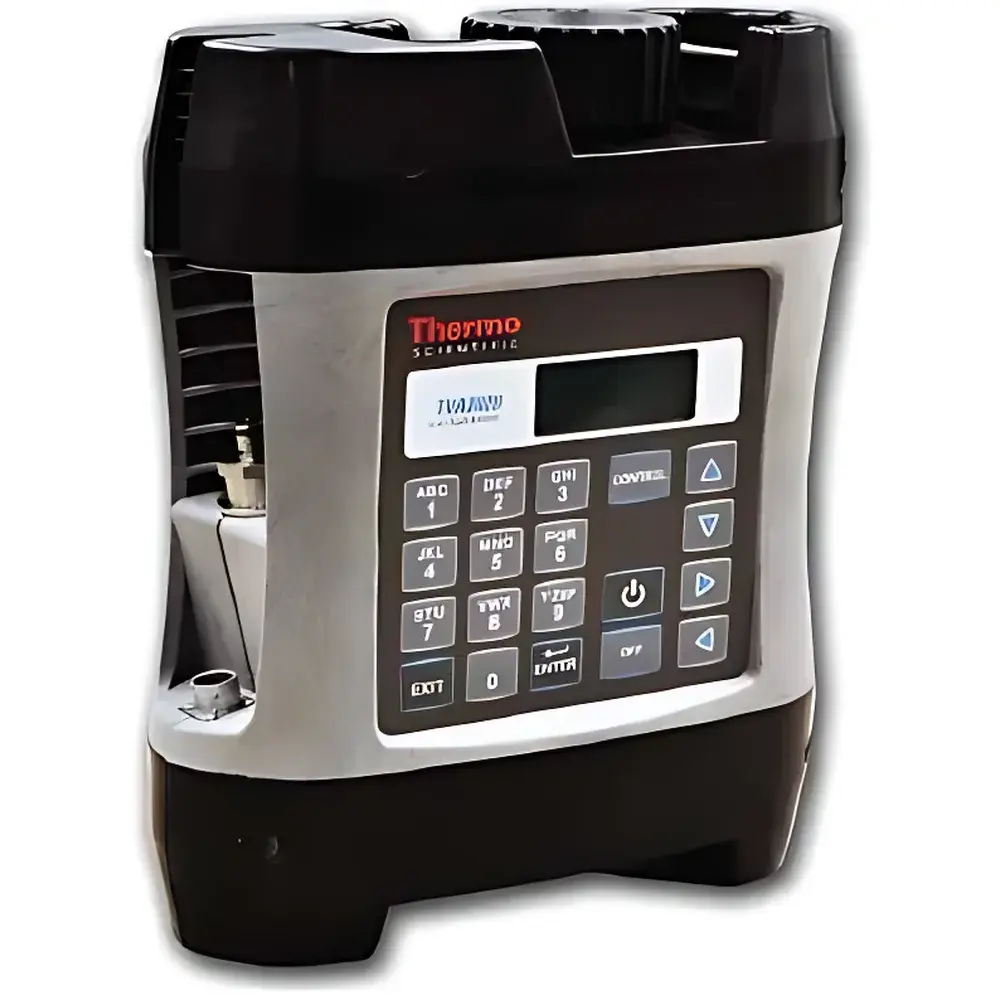
Thermo Scientific TVA2020 Toxic Volatile Organic Compounds Analyzer
| Brand | Thermo Fisher |
|---|---|
| Origin | USA |
| Manufacturer | Thermo Fisher Scientific |
| Product Type | Portable Gas Analyzer |
| Model | TVA2020 |
| Detection Principle | Dual FID & PID |
| Key Configuration | Dual-detector VOC/Inorganic Compound Analyzer |
| Weight (Dual Detector) | 4.26 kg |
| Operating Temperature | −10 °C to +45 °C |
| Battery Runtime | ≥10 h at 0 °C |
| H₂ Cylinder Runtime | >10 h from 15.3 MPa |
| Sample Flow Rate | ~1 L/min |
| FID LOD | 0.5 ppm (methane) |
| PID LOD | 0.5 ppm (isobutylene) |
| FID Accuracy | ±10% of reading or ±0.1 ppm (whichever is greater), 1.0–10,000 ppm |
| PID Accuracy | ±20% of reading or ±0.5 ppm (whichever is greater), 0.5–500 ppm |
| FID Repeatability | ≤2% at 500 ppm methane |
| PID Repeatability | ≤1% at 100 ppm isobutylene |
| FID Linear Range | 1.0–30,000 ppm methane |
| PID Linear Range | 0.5–2,000 ppm isobutylene |
| FID/PID T₉₀ Response Time | <3.5 s |
| Data Logging Interval | 1/s to 1/999 min (user-selectable) |
| VOC/FE mode | 2–30 s |
| Relative Humidity Range | 15–95% RH |
| Detector Lifetime | FID >5,000 h |
Overview
The Thermo Scientific™ TVA2020 Toxic Volatile Organic Compounds Analyzer is a field-deployable, dual-sensor portable gas analyzer engineered for regulatory-compliant leak detection and repair (LDAR), environmental site assessment, landfill monitoring, and industrial hygiene applications. It integrates two complementary detection technologies—flame ionization detection (FID) and photoionization detection (PID)—within a single, ruggedized platform. This dual-detection architecture enables simultaneous, real-time quantification of a broad spectrum of volatile organic compounds (VOCs) and select inorganic species (e.g., ammonia, hydrogen sulfide, phosphine) without cross-interference or method switching. Unlike single-sensor instruments, the TVA2020 delivers orthogonal response profiles: FID provides robust, linear, and compound-independent quantification across a wide dynamic range (1.0–30,000 ppm methane-equivalent), while PID offers enhanced sensitivity to low-concentration, high-ionization-potential VOCs (0.5–2,000 ppm isobutylene-equivalent) and rapid response to transient plumes. The instrument operates on a self-contained hydrogen fuel supply and ambient air oxidant, eliminating dependency on external compressed gases or laboratory infrastructure.
Key Features
- Dual FID/PID detection system with independent signal processing and simultaneous data acquisition
- Regulatory alignment with U.S. EPA Method 21 for fugitive emission monitoring and ASTM D7928 for field VOC screening
- Integrated Bluetooth 4.0 module enabling direct wireless synchronization with Thermo Scientific LDAR mobile software on Android-based handheld devices
- Onboard configuration manager supporting user-defined alarm thresholds, response factor libraries, data logging intervals (1/sec to 1/999 min), and route-based sampling protocols
- Optimized ergonomics: 4.26 kg total mass (dual-detector configuration), 21% lighter than predecessor models, with balanced weight distribution and low-center-of-gravity design for extended operator use
- Robust environmental rating: operational between −10 °C and +45 °C, and 15–95% relative humidity (non-condensing)
- Extended runtime architecture: rechargeable lithium-ion battery supports ≥10 hours of continuous operation at 0 °C; hydrogen cylinder (15.3 MPa initial pressure) sustains >10 hours of FID operation
- Modular accessory ecosystem including standard and enhanced sampling probes, transport case, hydrogen fill valve kit, and calibration gas adapters
Sample Compatibility & Compliance
The TVA2020 is validated for direct analysis of undiluted ambient air, stack effluents, soil vapor, and headspace samples. Its FID channel responds stoichiometrically to virtually all hydrocarbons and many oxygenated organics, while the PID channel detects compounds with ionization potentials below 10.6 eV—including aromatics, ketones, aldehydes, amines, and sulfur-containing volatiles. The instrument meets performance criteria specified in U.S. EPA SW-846 Method 0031 (field portable VOC analyzers) and supports data integrity requirements under 21 CFR Part 11 when used with compliant LDAR software platforms that enforce electronic signatures, audit trails, and secure data export. All factory calibrations are traceable to NIST-certified standards, and field verification procedures align with ISO/IEC 17025–accredited laboratory practices. Routine maintenance—including electrode cleaning, jet inspection, and UV lamp replacement—is documented in the onboard service log and satisfies GLP/GMP preventive maintenance schedules.
Software & Data Management
Data acquisition, annotation, and reporting are managed via the embedded firmware and synchronized through Bluetooth to the Thermo Scientific LDAR Mobile Application. This application supports GPS-tagged measurement waypoints, customizable work order integration, automatic leak classification per EPA Tier definitions, and configurable PDF report generation. Raw sensor outputs (analog mV signals), compensated concentration values (ppm), and metadata (time stamp, battery level, H₂ pressure, ambient temperature/humidity) are stored in a non-volatile internal memory (≥1 million readings). Export formats include CSV and XML, compatible with enterprise EHS databases and regulatory submission portals such as EPA’s GHGRP and state-level LDAR tracking systems. Firmware updates are delivered via USB or over-the-air (OTA) through authenticated cloud channels, ensuring version control and cybersecurity compliance per IEC 62443-3-3 guidelines.
Applications
- Leak detection and repair (LDAR) programs under 40 CFR Part 60, Subpart VV and 40 CFR Part 63, Subpart H
- Soil vapor intrusion assessments per ASTM E2600 and EPA OSWER Directive 9200.2-131
- Landfill surface emission monitoring per EPA Method 21 and EU Landfill Directive 1999/31/EC
- Industrial hygiene surveys for worker exposure evaluation (OSHA PELs, ACGIH TLVs®)
- Emergency response screening during chemical spills or confined-space entry pre-clearance
- Environmental site investigations under ASTM E1527–21 (Phase I ESA) and E1903–22 (Phase II ESA)
FAQ
Does the TVA2020 require daily calibration to maintain compliance with EPA Method 21?
No. EPA Method 21 permits calibration verification before and after each survey day, or every 24 hours of continuous use. The TVA2020 includes automated zero/span checks and stores calibration history with time-stamped audit records.
Can the instrument differentiate between methane and ethane using FID alone?
No. FID is non-selective and responds proportionally to carbon atoms. Compound identification requires coupling with GC separation or supplemental PID response patterns and known response factors.
Is hydrogen gas handling subject to local regulatory oversight?
Yes. Hydrogen cylinders must be stored and transported per DOT 49 CFR and OSHA 1910.101. The TVA2020’s integrated pressure regulator and leak-tested manifold meet ASME B31.12 hydrogen piping requirements.
What is the recommended frequency for PID lamp cleaning and replacement?
Lamp cleaning is advised every 200 operational hours or when baseline noise exceeds 3× RMS. Full lamp replacement is recommended after 2,000 hours or if output intensity drops below 70% of initial specification.
Does the TVA2020 support third-party data integration via API or Modbus?
Not natively. Data exchange is supported exclusively through Bluetooth LE to Thermo’s LDAR Mobile Application or via exported CSV/XML files. Custom API development requires formal engagement with Thermo Fisher Scientific Professional Services.
Related Products







