
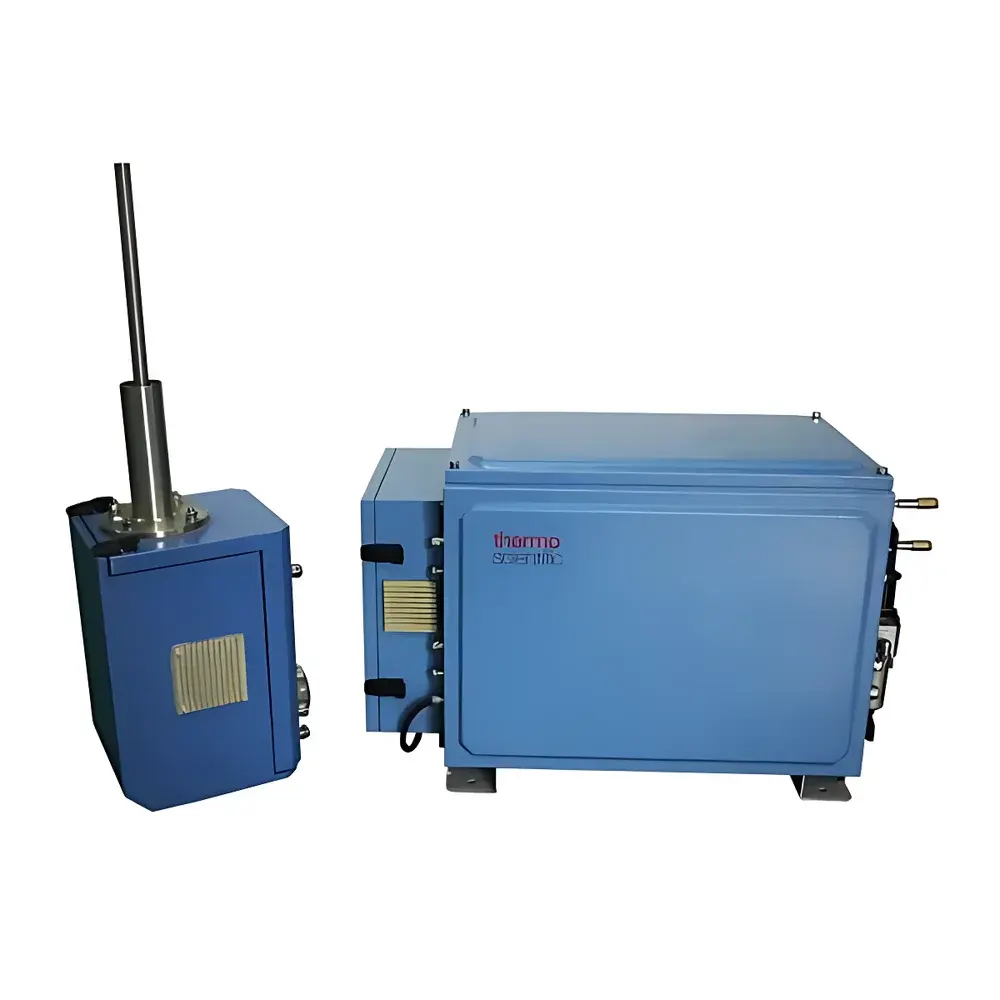
Thermo Scientific UW-50 Marine Continuous Emissions Monitoring System (CEMS)
| Brand | Thermo Fisher Scientific |
|---|---|
| Origin | Shanghai, China |
| Manufacturer Type | Original Equipment Manufacturer (OEM) |
| Product Category | Domestic |
| Model | UW-50 |
| Instrument Type | Continuous Emissions Monitoring System (CEMS) |
| Measurement Accuracy | ≤1.5% F.S. |
| Repeatability | 0.5% |
| Response Time | <60 s |
| Stability | ≤±2% F.S./7 days (zero & span drift) |
| Measured Gases | SO₂, NO, CO₂ |
Overview
The Thermo Scientific UW-50 Marine Continuous Emissions Monitoring System (CEMS) is an engineered solution designed specifically for real-time, in-situ measurement of regulated flue gas constituents aboard commercial vessels operating under International Maritime Organization (IMO) Annex VI and MEPC.259(68) compliance requirements. It employs dual optical spectroscopic methodologies—Ultraviolet Differential Optical Absorption Spectroscopy (UV-DOAS) for SO₂ and NO, and Tunable Diode Laser Absorption Spectroscopy (TDLAS) for CO₂—to deliver interference-free, high-fidelity concentration data under dynamic marine conditions. Unlike land-based CEMS, the UW-50 integrates full-path high-temperature conditioning (180 °C), vibration-resistant solid-state optics, and compact modular architecture to meet the spatial, thermal, and mechanical constraints of engine rooms, exhaust uptakes, and scrubber bypass ducts. Its primary function is to support regulatory verification of sulfur oxide (SOₓ) and nitrogen oxide (NOₓ) emissions during operation on heavy fuel oil (HFO), low-sulfur fuel oil (LSFO), or LNG, enabling accurate sulfur-to-carbon (S/C) ratio calculation—a critical parameter for verifying scrubber efficiency and fuel sulfur content compliance per IMO 2020 and subsequent amendments.
Key Features
- Compact, fully integrated CEMS architecture with front-access service design—optimized for installation in confined shipboard spaces (e.g., machinery control rooms, exhaust manifolds, and scrubber monitoring points)
- Full-path heated sampling system maintained at 180 °C to prevent condensation-induced SO₂ loss and hydrocarbon deposition, eliminating cold-trap artifacts and flow path blockage
- UV-DOAS optical module for simultaneous, multi-component quantification of SO₂ and NO with spectral deconvolution—immune to cross-interference from H₂O vapor, particulate scattering, CH₄, and CO
- TDLAS-based CO₂ analyzer utilizing wavelength-scanned second-harmonic detection for background-free, line-of-sight concentration measurement with sub-ppm resolution
- No moving parts in optical path or sample handling—designed for continuous operation under ISO 8573-1 Class 4 vibration profiles typical of marine diesel propulsion environments
- Automated zero/span calibration with certified reference gases (NIST-traceable), supporting scheduled maintenance intervals ≥7 days without performance degradation
Sample Compatibility & Compliance
The UW-50 is validated for use with exhaust streams from low-speed two-stroke and medium-speed four-stroke marine diesel engines burning HFO, VLSFO, ULSFO, or LNG. It meets the functional and performance criteria outlined in EN 15267-3 (CEMS QA/QC), ISO 14064-3 (GHG verification), and IMO MEPC.259(68) Annex 3 (onboard CEMS technical specifications). Data outputs comply with MARPOL Annex VI Regulation 13 and EU MRV (Monitoring, Reporting, Verification) requirements. The system supports audit-ready electronic logs with time-stamped, tamper-evident records—including raw spectra, calibration events, fault codes, and diagnostic timestamps—aligned with GLP principles and compatible with third-party data acquisition platforms via Modbus TCP and OPC UA protocols.
Software & Data Management
The UW-50 operates with Thermo Scientific CEMS Manager v4.2 firmware, a maritime-qualified embedded application providing real-time concentration visualization, S/C ratio trending, emission rate calculation (g/kWh), and automated report generation per IMO DCS (Data Collection System) templates. All measurements are timestamped with GPS-synchronized UTC and stored locally on industrial-grade SSD with 12-month retention capacity. Audit trails include full change history for configuration parameters, calibration logs, and user access events—supporting 21 CFR Part 11–compliant electronic signatures when deployed in class-approved flag state reporting frameworks. Remote diagnostics and firmware updates are enabled via secure TLS 1.2 encrypted SSH or LTE/VSAT interfaces, with role-based access control (RBAC) for crew, port state control officers, and classification society auditors.
Applications
- Real-time verification of scrubber desulfurization efficiency during HFO operation
- Onboard validation of fuel sulfur content (FSC) against IMO 2020 cap (0.50% m/m) and ECA limits (0.10% m/m)
- NOₓ Tier II/III compliance monitoring for engines equipped with selective catalytic reduction (SCR) or exhaust gas recirculation (EGR)
- CO₂ mass balance analysis for energy efficiency design index (EEDI) and existing ship energy efficiency index (EEXI) calculations
- Supporting carbon intensity indicator (CII) rating documentation and annual operational CII reporting
- Integration into vessel performance management systems (VPMS) for emission-informed voyage optimization
FAQ
Does the UW-50 require external dilution or conditioning equipment?
No—the system incorporates internal high-temperature filtration, heated probe, and full-path 180 °C transport line; no external dilution, chiller, or permeation dryer is required.
Can it be installed on vessels without existing scrubbers?
Yes—it is equally applicable to scrubber-equipped, scrubber-retrofitted, and scrubber-free vessels operating on compliant fuels.
How is calibration traceability ensured?
All factory calibrations use NIST-traceable gas standards certified to ISO 6141; field calibration certificates include uncertainty budgets per ISO/IEC 17025.
Is the system approved by major classification societies?
The UW-50 holds Type Approval from ABS, DNV, LR, and CCS for onboard CEMS deployment under MEPC.259(68) Annex 3 and relevant IACS Unified Requirements.
What data output formats are supported?
Standard outputs include ASCII CSV (hourly/daily), XML (IMO DCS-compliant), and real-time Modbus TCP registers mapped to MARPOL Annex VI Annex 9 data fields.
Related Products







