
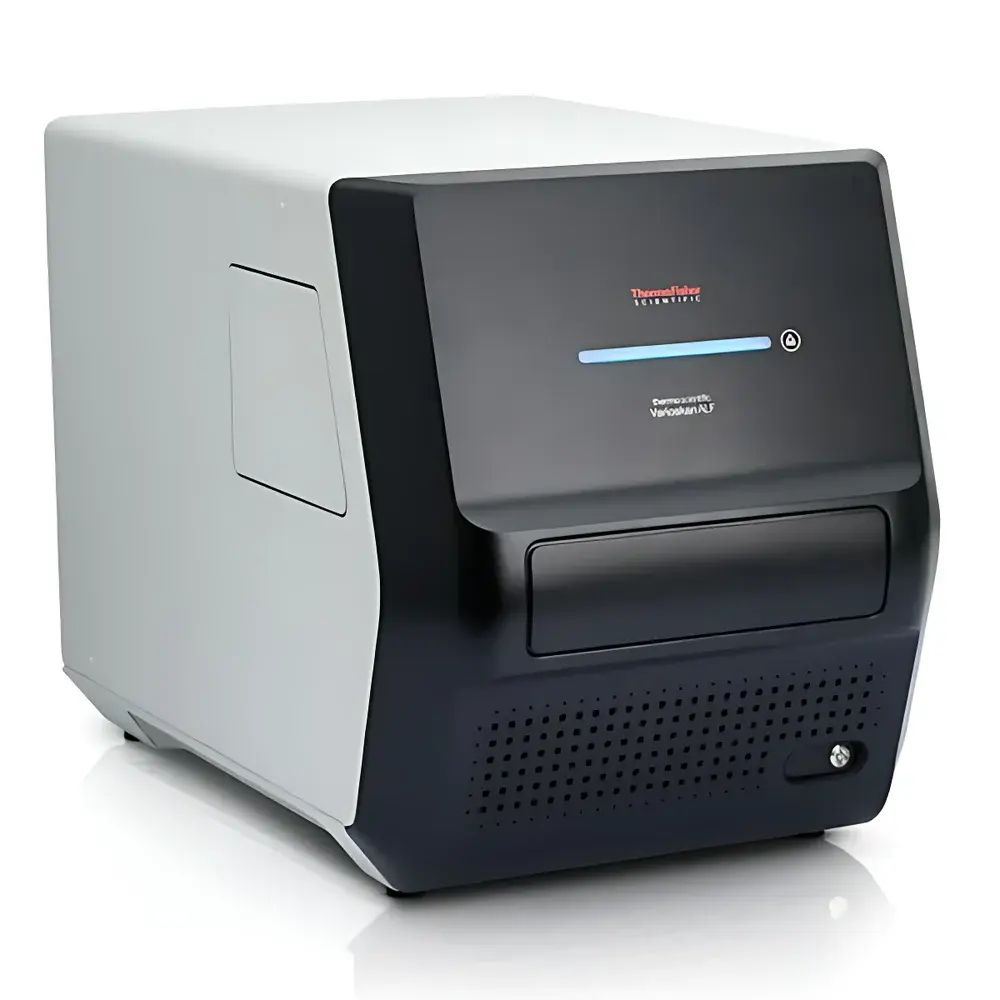
Thermo Scientific Varioskan ALF Multimode Microplate Reader
| Brand | Thermo Fisher |
|---|---|
| Origin | Shanghai, China |
| Manufacturer Type | Authorized Distributor |
| Product Category | Domestic |
| Model | Varioskan ALF |
| Price | Upon Request |
Overview
The Thermo Scientific Varioskan ALF Multimode Microplate Reader is a rigorously engineered entry-level multimodal detection platform designed for reproducible, high-fidelity quantification across absorbance, turbidimetry, fluorescence, and luminescence assays. Its core optical architecture integrates a high-intensity xenon flash lamp with a precision monochromator, enabling continuous wavelength selection from 200 nm to 1000 nm—covering UV, visible, and near-infrared spectral regions critical for nucleic acid (A260), protein (A280), bacterial growth (OD600), ELISA, and cell viability assays (e.g., PrestoBlue, AlamarBlue). Unlike fixed-filter or LED-based systems, the monochromator-based photometric path ensures spectral flexibility without hardware reconfiguration, supporting method development, validation, and compliance-driven workflows in academic, biotech, and QC laboratories.
Key Features
- Monochromator-based optics delivering continuous wavelength scanning (200–1000 nm) with 2.5 nm bandwidth for photometric measurements
- Filter-based fluorescence and luminescence detection with three pre-installed excitation/emission filter pairs optimized for Coumarin, Fluorescein, and Resorufin families
- Five additional open filter slots for user-defined fluorometric or luminometric assay configuration—tool-free exchange via side-access panel
- Automatic gain adjustment (AGA) dynamically optimizes PMT voltage per well based on signal intensity, eliminating manual range selection and ensuring inter-plate and intra-plate consistency
- Integrated temperature-controlled incubation (ambient +2°C to 45°C) and programmable shaking (linear, orbital, double-orbital) for kinetic enzyme or cell-based assays requiring thermal stability
- Native support for microvolume analysis using μDrop and μDrop Duo plates—enabling direct quantification of DNA, RNA, and proteins without dilution
- Comprehensive self-diagnostics suite including optical alignment verification, lamp energy calibration, and baseline noise assessment prior to each run
Sample Compatibility & Compliance
The Varioskan ALF accommodates standard microplate formats from 6- to 384-well, including opaque (white/black), clear, and specialized plates (e.g., TC-treated, low-binding). It reads plates with or without lids and supports both endpoint and kinetic measurement modes. For regulatory environments, the SkanIt Software Research Edition provides audit-trail-capable data handling; the optional Drug Discovery Edition includes full 21 CFR Part 11 compliance features—including electronic signatures, role-based access control, and immutable instrument logs. Thermo Scientific verification plates (traceable to NIST standards) enable routine optical performance qualification aligned with ISO/IEC 17025 and GLP principles. All optical specifications—including photometric accuracy (±1.0% + 0.003 Abs at 0–2 Abs), linearity (0–2.5 Abs), and sensitivity (fluorescein: ≤0.35 fmol/well)—are validated per manufacturer’s published protocols and documented in the instrument’s Certificate of Conformance.
Software & Data Management
Operation is fully managed through Thermo Scientific SkanIt Software—a PC-based application available in English, French, German, Spanish, Portuguese, Italian, Japanese, and Chinese. The software offers unlimited installation across institutional networks with no annual licensing fees. It includes an extensive cloud-hosted protocol library containing pre-validated methods for common applications (e.g., BCA, Bradford, ATP bioluminescence, FRET-based protease assays). Reports are exportable in PDF, Excel, and XML formats, with configurable pass/fail thresholds, statistical summaries (mean, SD, CV%), and plate mapping visualization. Raw data files retain full metadata—including instrument ID, operator, timestamp, measurement parameters, and calibration history—ensuring traceability required under GxP frameworks.
Applications
The Varioskan ALF serves as a foundational platform for diverse life science workflows: quantitative nucleic acid and protein analysis via UV-Vis absorbance; microbial growth monitoring and turbidity-based aggregation studies; cell proliferation, cytotoxicity, and apoptosis assays using fluorescent dyes (e.g., Calcein AM, EthD-1) or luminescent reporters (e.g., luciferase, NanoLuc); and advanced multiplexed detection such as FRET/BRET assays leveraging its dual-filter synchronization capability. Its compatibility with kinetic acquisition and onboard incubation makes it suitable for real-time enzyme kinetics (e.g., β-galactosidase, LDH), receptor binding, and reporter gene expression profiling.
FAQ
Is the Varioskan ALF compliant with FDA 21 CFR Part 11?
Yes—when equipped with the Drug Discovery Edition of SkanIt Software, the system supports electronic signatures, audit trails, and secure user authentication required for regulated environments.
Can I perform spectral scans in fluorescence mode?
No—the monochromator is dedicated to absorbance/turbidimetric measurements; fluorescence and luminescence rely exclusively on filter-based optics for optimal signal-to-noise ratio and specificity.
What microvolume platforms does it support?
The reader natively recognizes Thermo Scientific μDrop and μDrop Duo plates, enabling direct measurement of 2–4 µL samples for nucleic acid and protein quantification without dilution or transfer.
Does it include validation documentation?
Each unit ships with a Certificate of Conformance and optical verification data. Optional IQ/OQ/PQ documentation packages and Thermo Scientific verification plates are available for laboratory qualification.
How is temperature uniformity maintained during incubation?
The integrated Peltier-based incubation system maintains setpoint accuracy within ±0.5°C across the plate surface, verified by independent thermal mapping per ICH Q5C guidelines.




